Finding the Maximum and Minimum Value of a Quadratic Function
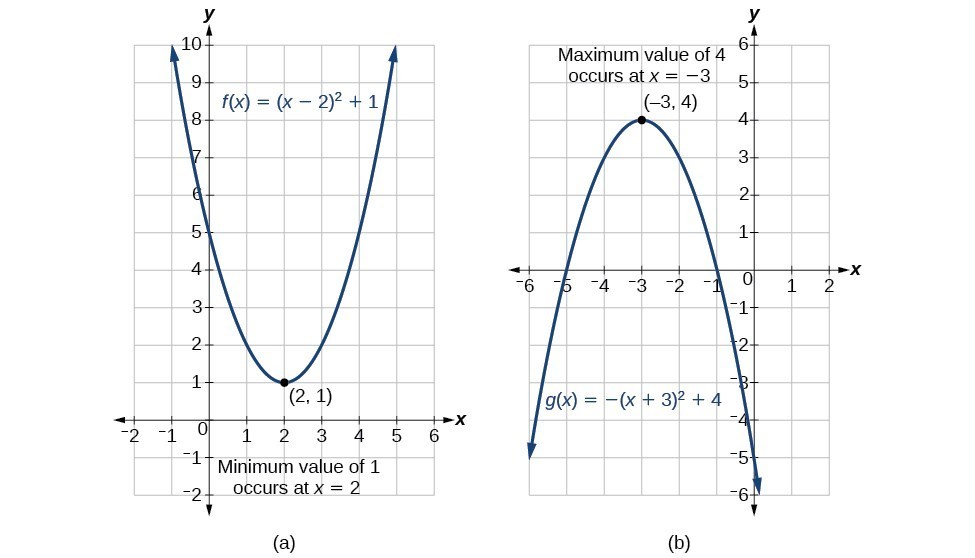
There are many real-world scenarios that involve finding the maximum or minimum value of a quadratic function, such as applications involving area and revenue.
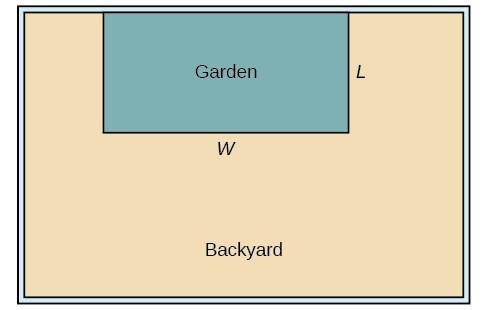 Find a formula for the area enclosed by the fence if the sides of fencing perpendicular to the existing fence have length [latex]L[/latex]. Then, use the formula to answer: What dimensions should she make her garden to maximize the enclosed area?
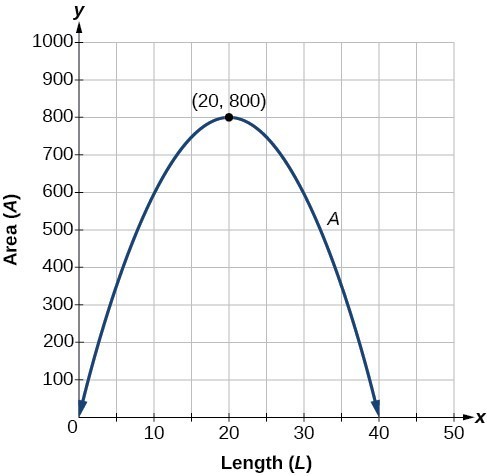 This problem also could be solved by graphing the quadratic function. We can see where the maximum area occurs on a graph of the quadratic function below.
The problem we solved above is called a constrained optimization problem. We can optimize our desired outcome given a constraint, which in this case was a limited amount of fencing materials.
Finding Maximum Revenue
Quadratic functions aren’t just abstract math concepts—they’re super useful in real-life situations, especially in business! One cool way we can use quadratic functions is to figure out how to maximize revenue.
Think of it this way: if you’re running a business and selling a product, you want to find the best price to sell that product so you make the most money. Revenue (the money you bring in) is calculated by multiplying the price per unit by the number of units sold. But here’s the catch—the number of units sold usually changes with the price, creating a quadratic relationship.
Let’s see how to use quadratic functions to find that sweet spot—the price that brings in the most revenue! By looking at the graph of the quadratic function, especially the vertex, we can figure out the optimal price to charge.
- Write a quadratic equation for revenue.
- Find the vertex of the quadratic equation.
- Determine the [latex]y[/latex]-value of the vertex.
The unit price of an item affects its supply and demand. That is, if the unit price goes up, the demand for the item will usually decrease.
A local newspaper currently has [latex]84,000[/latex] subscribers at a quarterly charge of [latex]\$30[/latex]. Market research has suggested that if the owners raise the price to [latex]\$32[/latex], they would lose [latex]5,000[/latex] subscribers.
Assuming that subscriptions are linearly related to the price, what price should the newspaper charge for a quarterly subscription to maximize their revenue?
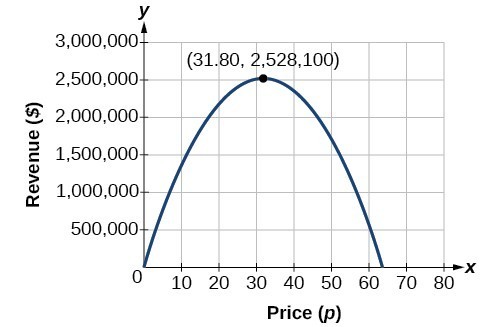
In the example above, we knew the number of subscribers to a newspaper and used that information to find the optimal price for each subscription. What if the price of subscriptions is affected by competition?
[latex]\text{Revenue}-2,500{p}^{2}+159,000p[/latex]
We found that selling the paper at [latex]\$31.80[/latex] per subscription would maximize revenue. What if your closest competitor sells their paper for [latex]\$25.00[/latex] per subscription? What is the maximum revenue you can make you sell your paper for the same?