Knowing the leading coefficient and degree of a polynomial function is useful when predicting its end behavior. To determine its end behavior, look at the leading term of the polynomial function. Because the power of the leading term is the highest, that term will grow significantly faster than the other terms as x gets very large or very small, so its behavior will dominate the graph. For any polynomial, the end behavior of the polynomial will match the end behavior of the term of highest degree.
As we pointed out when discussing quadratic equations, when the leading term of a polynomial function, [latex]{a}_{n}{x}^{n}[/latex], is an even power function, as x increases or decreases without bound, [latex]f\left(x\right)[/latex] increases without bound. When the leading term is an odd power function, as x decreases without bound, [latex]f\left(x\right)[/latex] also decreases without bound; as x increases without bound, [latex]f\left(x\right)[/latex] also increases without bound. If the leading term is negative, it will change the direction of the end behavior. The table below summarizes all four cases.
Even Degree
Odd Degree
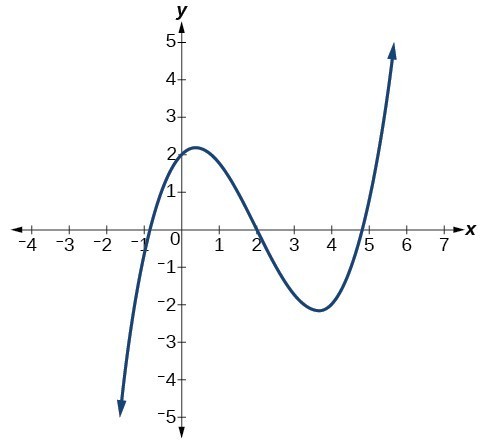
Describe the end behavior and determine a possible degree of the polynomial function in the graph below.
As the input values [latex]x[/latex] get very large, the output values [latex]f\left(x\right)[/latex] increase without bound. As the input values x get very small, the output values [latex]f\left(x\right)[/latex] decrease without bound. We can describe the end behavior symbolically by writing
In words, we could say that as [latex]x[/latex] values approach infinity, the function values approach infinity, and as [latex]x[/latex] values approach negative infinity, the function values approach negative infinity.
We can tell this graph has the shape of an odd degree power function that has not been reflected, so the degree of the polynomial creating this graph must be odd and the leading coefficient must be positive.
To identify the end behavior and degree of a polynomial function, it must be in expanded (general) form. If the function is given to you in factored form, expand it first, then you can identify the leading term.You do not have to fully expand the factored form to find the leading term. Note that each of the first terms of the factors multiplied together will give you the leading term.Given the function [latex]f\left(x\right)=-3{x}^{2}\left(x - 1\right)\left(x+4\right)[/latex], express the function as a polynomial in general form and determine the leading term, degree, and end behavior of the function.
Obtain the general form by expanding the given expression [latex]f\left(x\right)[/latex].
The general form is [latex]f\left(x\right)=-3{x}^{4}-9{x}^{3}+12{x}^{2}[/latex]. The leading term is [latex]-3{x}^{4}[/latex]; therefore, the degree of the polynomial is [latex]4[/latex]. The degree is even ([latex]4[/latex]) and the leading coefficient is negative ([latex]–3[/latex]), so the end behavior is