We have written the volume V in terms of the radius r. However, in some cases, we may start out with the volume and want to find the radius. For example: A customer purchases 100 cubic feet of gravel to construct a cone shape mound with a height twice the radius. What is the radius of the new cone? To answer this question, we use the formula
[latex]r=\sqrt[3]{\dfrac{3V}{2\pi }\\}[/latex]
This function is the inverse of the formula for V in terms of r.
Find the inverse of a polynomial function
Recall that two functions [latex]f[/latex] and [latex]g[/latex] are inverse functions if for every coordinate pair in [latex]f[/latex], [latex](a, b)[/latex], there exists a corresponding coordinate pair in the inverse function, [latex]g[/latex], [latex](b, a)[/latex]. In other words, the coordinate pairs of the inverse functions have the input and output interchanged. Only one-to-one functions have inverses that are also functions. Recall that a one-to-one function has a unique output value for each input value and passes the horizontal line test.
While it is not possible to find an inverse function of most polynomial functions, some basic polynomials do have inverses that are functions. Such functions are called invertible functions, and we use the notation [latex]{f}^{-1}\left(x\right)[/latex].
Warning: [latex]{f}^{-1}\left(x\right)[/latex] is not the same as the reciprocal of the function [latex]f\left(x\right)[/latex]. This use of [latex]–1[/latex] is reserved to denote inverse functions. To denote the reciprocal of a function [latex]f\left(x\right)[/latex], we would need to write [latex]{\left(f\left(x\right)\right)}^{-1}=\frac{1}{f\left(x\right)}[/latex].
An important relationship between inverse functions is that they “undo” each other. If [latex]{f}^{-1}[/latex] is the inverse of a function [latex]f[/latex], then [latex]f[/latex] is the inverse of the function [latex]{f}^{-1}[/latex]. In other words, whatever the function [latex]f[/latex] does to [latex]x[/latex], [latex]{f}^{-1}[/latex] undoes it—and vice-versa. More formally, we write
[latex]{f}^{-1}\left(f\left(x\right)\right)=x,\text{for all }x\text{ in the domain of }f[/latex]
and
[latex]f\left({f}^{-1}\left(x\right)\right)=x,\text{for all }x\text{ in the domain of }{f}^{-1}[/latex]
How To: Given a polynomial function, find the inverse of the function
Verify that [latex]f[/latex] is a one-to-one function.
Replace [latex]f\left(x\right)[/latex] with [latex]y[/latex].
Interchange [latex]x[/latex] and [latex]y[/latex].
Solve for [latex]y[/latex], and rename the function [latex]{f}^{-1}\left(x\right)[/latex].
Find the inverse of the function [latex]f\left(x\right)=5{x}^{3}+1[/latex].
This is a transformation of the basic cubic toolkit function, and based on our knowledge of that function, we know it is one-to-one. Solving for the inverse by solving for [latex]x[/latex].
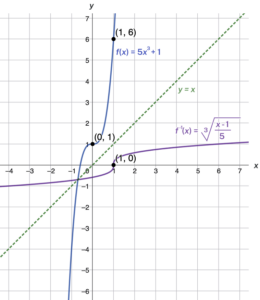
Look at the graph of [latex]f[/latex] and [latex]{f}^{-1}[/latex]. Notice that the two graphs are symmetrical about the line [latex]y=x[/latex]. This is always the case when graphing a function and its inverse function.
Also, since the method involved interchanging [latex]x[/latex] and [latex]y[/latex], notice corresponding points. If [latex]\left(a,b\right)[/latex] is on the graph of [latex]f[/latex], then [latex]\left(b,a\right)[/latex] is on the graph of [latex]{f}^{-1}[/latex]. Since [latex]\left(0,1\right)[/latex] is on the graph of [latex]f[/latex], then [latex]\left(1,0\right)[/latex] is on the graph of [latex]{f}^{-1}[/latex]. Similarly, since [latex]\left(1,6\right)[/latex] is on the graph of [latex]f[/latex], then [latex]\left(6,1\right)[/latex] is on the graph of [latex]{f}^{-1}[/latex].
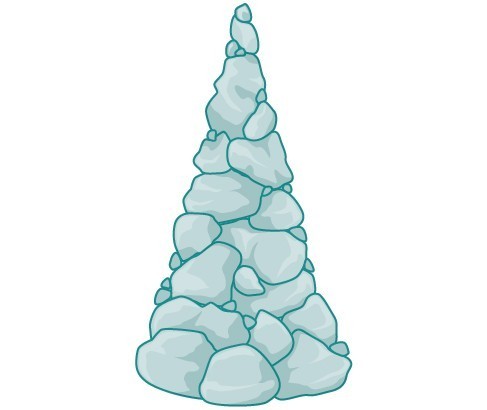 A mound of gravel is in the shape of a cone with the height equal to twice the radius.