- Plot complex numbers in the complex plane.
- Write complex numbers in polar form.
- Convert a complex number from polar to rectangular form.
- Find products and quotients of complex numbers in polar form.
- Find powers and roots of complex numbers in polar form.
Plotting Complex Numbers in the Complex Plane
The Main Idea
Complex numbers combine a real part and an imaginary part. The complex plane is a coordinate system where the horizontal axis represents the real part and the vertical axis represents the imaginary part. Plotting a complex number [latex]a+bi[/latex] works just like plotting a point [latex](x,y)[/latex] in the rectangular plane, except the vertical axis is labeled “Imaginary” instead of “y.”
Quick Tips: Plotting Complex Numbers
-
Identify the Parts
-
Real part = [latex]a[/latex] (x-coordinate).
-
Imaginary part = [latex]b[/latex] (y-coordinate).
-
-
Plot as a Point
-
Plot [latex]a+bi[/latex] at [latex](a,b)[/latex] on the complex plane.
-
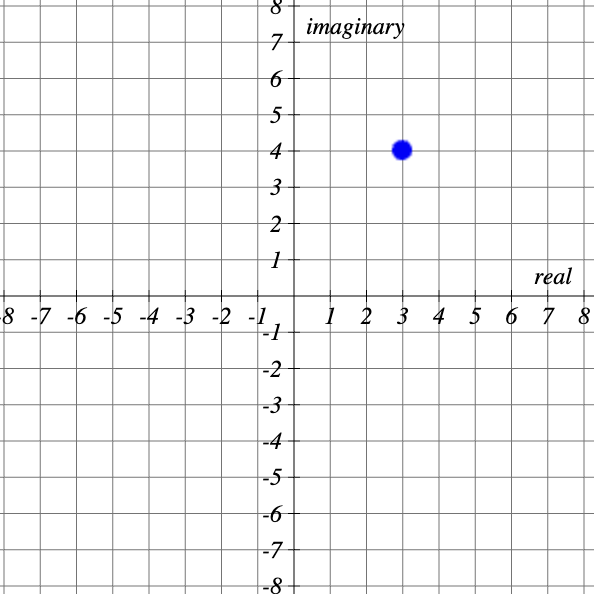
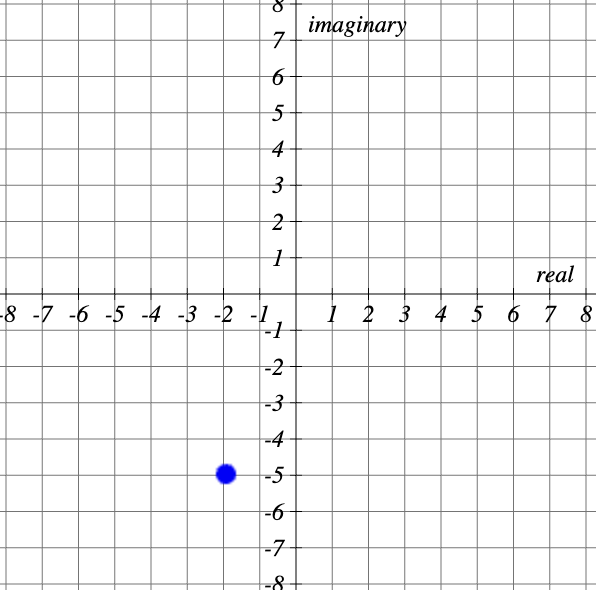
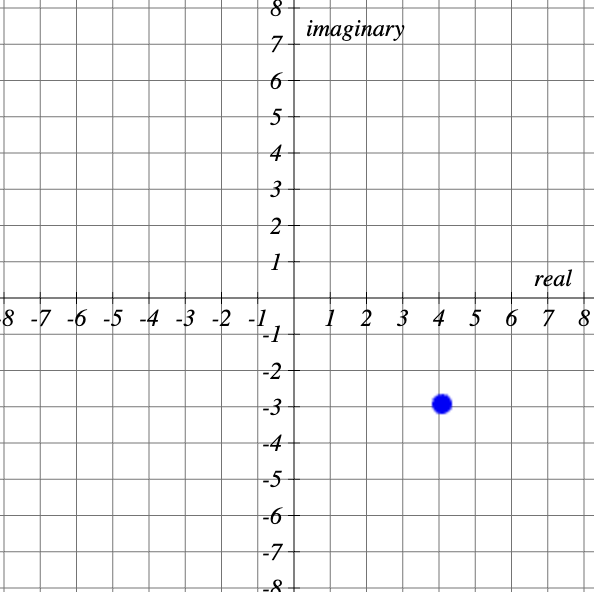
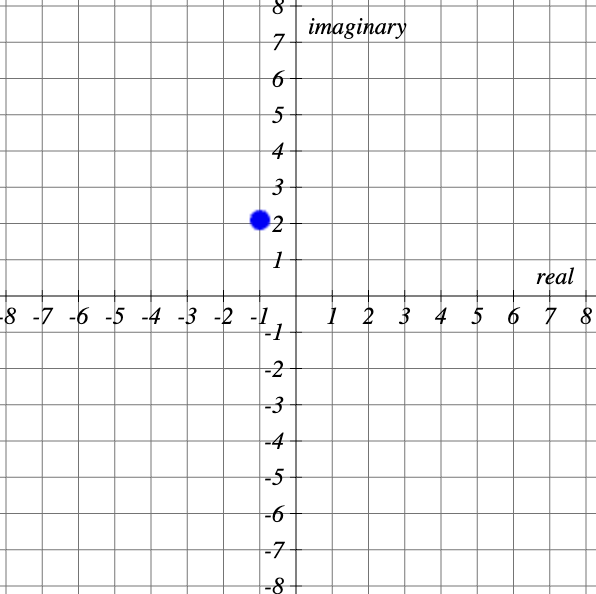
Plot each complex number on the complex plane.
a) [latex]3 + 4i[/latex]
b) [latex]-2 - 5i[/latex]
c) [latex]4 - 3i[/latex]
d) [latex]-1 + 2i[/latex]
You can view the transcript for “Plotting complex numbers on the complex plane | Precalculus | Khan Academy” here (opens in new window).
Writing Complex Numbers in Polar Form
The Main Idea
Complex numbers can be expressed not only in rectangular form [latex]a+bi[/latex], but also in polar form, which uses a magnitude (distance from the origin) and an angle (direction from the positive real axis). This form highlights the geometric meaning of complex numbers and is especially useful for multiplication, division, and powers.
The polar form of a complex number is:
[latex]z = r(\cos\theta + i\sin\theta)[/latex]
where:
-
[latex]r = \sqrt{a^{2}+b^{2}}[/latex] is the magnitude (modulus).
-
[latex]\theta = \tan^{-1}\left(\dfrac{b}{a}\right)[/latex] is the argument (angle), adjusted for quadrant.
Quick Tips: Converting to Polar Form
-
Find the Magnitude
-
[latex]r=\sqrt{a^{2}+b^{2}}[/latex].
-
-
Find the Angle
-
[latex]\theta = \tan^{-1}\left(\dfrac{b}{a}\right)[/latex].
-
Adjust [latex]\theta[/latex] for the correct quadrant.
-
-
Write in Polar Form
Write [latex]-1 + i[/latex] in polar form.
You can view the transcript for “How to Write a Complex Number in Polar Form, Example with 3 + 3i” here (opens in new window).
Converting Complex Numbers from Polar to Rectangular Form
The Main Idea
Polar form expresses a complex number as [latex]z = r(\cos\theta + i\sin\theta)[/latex]. To return to rectangular form [latex]a+bi[/latex], we simply evaluate the cosine and sine at the given angle and multiply by [latex]r[/latex]. This lets us move seamlessly between the two representations: geometric (polar) and algebraic (rectangular).
Quick Tips: Polar → Rectangular
-
Recall the Relationship
-
[latex]z = r(\cos\theta + i\sin\theta)[/latex].
-
So [latex]a = r\cos\theta[/latex], [latex]b = r\sin\theta[/latex].
-
-
Use Calculators When Needed
-
If [latex]\theta[/latex] is not a special angle, compute [latex]\cos\theta[/latex] and [latex]\sin\theta[/latex] with a calculator.
-
-
Check Your Quadrant
-
Make sure the signs of [latex]a[/latex] and [latex]b[/latex] match the quadrant of [latex]\theta[/latex].
-
Convert each complex number from polar form to rectangular form.
a) [latex]z = 5(\cos 60° + i\sin 60°)[/latex]
b) [latex]z = 4\left(\cos\frac{3\pi}{4} + i\sin\frac{3\pi}{4}\right)[/latex]
You can view the transcript for “Converting a complex number from polar to rectangular form | Precalculus | Khan Academy” here (opens in new window).
Products and Quotients of Complex Numbers in Polar Form
The Main Idea
Polar form makes multiplying and dividing complex numbers much easier than working in rectangular form. Instead of expanding and simplifying, we use the magnitudes and angles directly. Multiplication means multiplying magnitudes and adding angles, while division means dividing magnitudes and subtracting angles. This is a direct application of trigonometric identities and Euler’s formula.
Formulas:
-
Product: [latex]z_{1}z_{2} = r_{1}r_{2}\big(\cos(\theta_{1}+\theta_{2}) + i\sin(\theta_{1}+\theta_{2})\big)[/latex]
-
Quotient: [latex]\dfrac{z_{1}}{z_{2}} = \dfrac{r_{1}}{r_{2}}\big(\cos(\theta_{1}-\theta_{2}) + i\sin(\theta_{1}-\theta_{2})\big)[/latex]
Quick Tips: Multiplying and Dividing in Polar Form
-
Multiplication Rule
-
Multiply the magnitudes: [latex]r_{1}r_{2}[/latex].
-
Add the angles: [latex]\theta_{1}+\theta_{2}[/latex].
-
-
Division Rule
-
Divide the magnitudes: [latex]\dfrac{r_{1}}{r_{2}}[/latex].
-
Subtract the angles: [latex]\theta_{1}-\theta_{2}[/latex].
-
-
Keep Results in Polar Form
-
These operations are simplest in polar form.
-
If rectangular form is needed, convert at the end using [latex]x=r\cos\theta, y=r\sin\theta[/latex].
-
Find the product of [latex]z_1 = 3(\cos 45° + i\sin 45°)[/latex] and [latex]z_2 = 2(\cos 60° + i\sin 60°)[/latex].
Find the quotient [latex]\frac{z_1}{z_2}[/latex] where [latex]z_1 = 10(\cos 150° + i\sin 150°)[/latex] and [latex]z_2 = 2(\cos 30° + i\sin 30°)[/latex].
You can view the transcript for “Polar form Multiplication and division of complex numbers” here (opens in new window).
Powers and Roots of Complex Numbers in Polar Form
The Main Idea
Polar form makes it especially easy to compute powers and roots of complex numbers using De Moivre’s Theorem. Instead of expanding binomials, we work directly with magnitudes and angles.
-
De Moivre’s Theorem (Powers):
[latex]z^{n} = \big(r(\cos\theta + i\sin\theta)\big)^{n} = r^{n}\big(\cos(n\theta) + i\sin(n\theta)\big)[/latex] -
nth Roots of a Complex Number:
[latex]z_{k} = r^{\tfrac{1}{n}}\Big(\cos\Big(\dfrac{\theta+2k\pi}{n}\Big) + i\sin\Big(\dfrac{\theta+2k\pi}{n}\Big)\Big), \quad k=0,1,\dots,n-1[/latex]
This guarantees that powers give a single answer, while roots give n distinct solutions, evenly spaced around a circle in the complex plane.
Quick Tips: Powers and Roots
-
Powers with De Moivre’s Theorem
-
Raise the magnitude to the nth power.
-
Multiply the angle by n.
-
-
Work an Example (Power): Find [latex](1+i)^{4}[/latex].
-
Convert: [latex]r=\sqrt{1^{2}+1^{2}}=\sqrt{2}, \ \theta=45^\circ[/latex].
-
Apply De Moivre: [latex]z^{4} = (\sqrt{2})^{4}\big(\cos(4\cdot 45^\circ)+i\sin(4\cdot 45^\circ)\big)[/latex].
-
[latex]= 4(\cos 180^\circ + i\sin 180^\circ) = 4(-1+0i)=-4[/latex].
-
-
nth Roots
-
Take the nth root of the magnitude: [latex]r^{1/n}[/latex].
-
Divide the angle by n, then add [latex]\dfrac{2k\pi}{n}[/latex] for each root.
-
-
Work an Example (Roots): Find the cube roots of [latex]8(\cos 0^\circ+i\sin 0^\circ)[/latex].
-
Magnitude: [latex]8^{1/3}=2[/latex].
-
Angles: [latex]\dfrac{0^\circ+360^\circ k}{3}, \ k=0,1,2[/latex].
-
Roots:
-
[latex]2(\cos 0^\circ+i\sin 0^\circ)=2[/latex].
-
[latex]2(\cos 120^\circ+i\sin 120^\circ) = -1+\sqrt{3}i[/latex].
-
[latex]2(\cos 240^\circ+i\sin 240^\circ) = -1-\sqrt{3}i[/latex].
-
-
-
Remember the Geometry
-
Powers “stretch” the vector and rotate it.
-
Roots divide the angle into equal arcs, producing evenly spaced solutions around a circle.
-
Find [latex](1 + i)^4[/latex].