- Plot complex numbers in the complex plane.
- Write complex numbers in polar form.
- Convert a complex number from polar to rectangular form.
- Find products and quotients of complex numbers in polar form.
- Find powers and roots of complex numbers in polar form.
Complex numbers were invented by people and represent over a thousand years of continuous investigation and struggle by mathematicians such as Pythagoras, Descartes, De Moivre, Euler, Gauss, and others. Complex numbers answered questions that for centuries had puzzled the greatest minds in science.
Plotting Complex Numbers in the Complex Plane
Plotting a complex number [latex]a+bi[/latex] is similar to plotting a real number, except that the horizontal axis represents the real part of the number, [latex]a[/latex], and the vertical axis represents the imaginary part of the number, [latex]bi[/latex].
- Label the horizontal axis as the real axis and the vertical axis as the imaginary axis.
- Plot the point in the complex plane by moving [latex]a[/latex] units in the horizontal direction and [latex]b[/latex] units in the vertical direction.


Finding the Absolute Value of a Complex Number
The first step toward working with a complex number in polar form is to find the absolute value. The absolute value of a complex number is the same as its magnitude, or [latex]|z|[/latex]. It measures the distance from the origin to a point in the plane.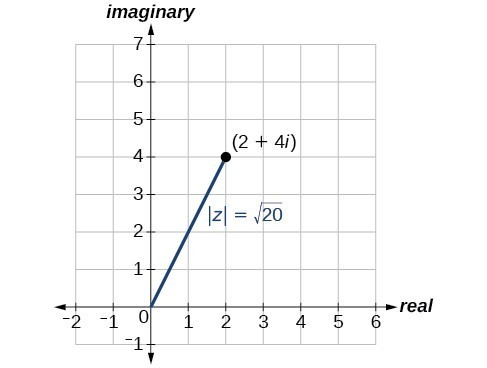
absolute value of a complex number
Given [latex]z=x+yi[/latex], a complex number, the absolute value of [latex]z[/latex] is defined as
[latex]|z|=\sqrt{{x}^{2}+{y}^{2}}[/latex]
It is the distance from the origin to the point [latex]\left(x,y\right)[/latex].
Notice that the absolute value of a real number gives the distance of the number from 0, while the absolute value of a complex number gives the distance of the number from the origin, [latex]\left(0,\text{ }0\right)[/latex].

Find the absolute value of the complex number [latex]z=12 - 5i[/latex].

Given [latex]z=1 - 7i[/latex], find [latex]|z|[/latex].