Converting Between Polar Coordinates to Rectangular Coordinates
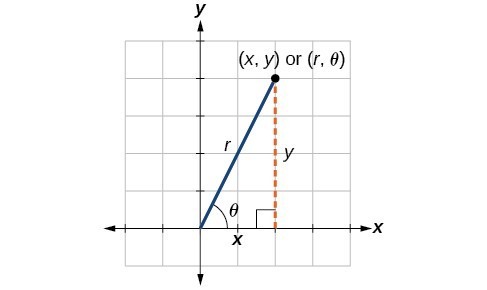
When given a set of polar coordinates, we may need to convert them to rectangular coordinates. To do so, we can recall the relationships that exist among the variables [latex]x,y,r[/latex], and [latex]\theta[/latex].
Dropping a perpendicular from the point in the plane to the x-axis forms a right triangle. An easy way to remember the equations above is to think of [latex]\cos \theta[/latex] as the adjacent side over the hypotenuse and [latex]\sin \theta[/latex] as the opposite side over the hypotenuse.
converting polar to rectangular coordinates
To convert polar coordinates [latex]\left(r,\theta \right)[/latex] to rectangular coordinates [latex]\left(x,y\right)[/latex], let
Converting from Rectangular Coordinates to Polar Coordinates
To convert rectangular coordinates to polar coordinates, we will use two other familiar relationships. With this conversion, however, we need to be aware that a set of rectangular coordinates will yield more than one polar point.
converting rectangular to polar coordinates
Converting from rectangular coordinates to polar coordinates requires the use of one or more of the relationships:
[latex]\begin{gathered}\cos \theta =\frac{x}{r}\text{ or }x=r\cos \theta \\ \sin \theta =\frac{y}{r}\text{ or }y=r\sin \theta \\ {r}^{2}={x}^{2}+{y}^{2} \\ \tan \theta =\frac{y}{x} \end{gathered}[/latex]
Convert the rectangular coordinates [latex]\left(3,3\right)[/latex] to polar coordinates.
We see that the original point [latex]\left(3,3\right)[/latex] is in the first quadrant. To find [latex]\theta[/latex], use the formula [latex]\tan \theta =\frac{y}{x}[/latex]. This gives
To find [latex]r[/latex], we substitute the values for [latex]x[/latex] and [latex]y[/latex] into the formula [latex]r=\sqrt{{x}^{2}+{y}^{2}}[/latex]. We know that [latex]r[/latex] must be positive, as [latex]\frac{\pi }{4}[/latex] is in the first quadrant. Thus
So, [latex]r=3\sqrt{2}[/latex] and [latex]\theta \text{=}\frac{\pi }{4}[/latex], giving us the polar point [latex]\left(3\sqrt{2},\frac{\pi }{4}\right)[/latex].
Analysis of the Solution
There are other sets of polar coordinates that will be the same as our first solution. For example, the points [latex]\left(-3\sqrt{2},\frac{5\pi }{4}\right)[/latex] and [latex]\left(3\sqrt{2},-\frac{7\pi }{4}\right)[/latex] will coincide with the original solution of [latex]\left(3\sqrt{2},\frac{\pi }{4}\right)[/latex]. The point [latex]\left(-3\sqrt{2},\frac{5\pi }{4}\right)[/latex] indicates a move further counterclockwise by [latex]\pi[/latex], which is directly opposite [latex]\frac{\pi }{4}[/latex]. The radius is expressed as [latex]-3\sqrt{2}[/latex]. However, the angle [latex]\frac{5\pi }{4}[/latex] is located in the third quadrant and, as [latex]r[/latex] is negative, we extend the directed line segment in the opposite direction, into the first quadrant. This is the same point as [latex]\left(3\sqrt{2},\frac{\pi }{4}\right)[/latex]. The point [latex]\left(3\sqrt{2},-\frac{7\pi }{4}\right)[/latex] is a move further clockwise by [latex]-\frac{7\pi }{4}[/latex], from [latex]\frac{\pi }{4}[/latex]. The radius, [latex]3\sqrt{2}[/latex], is the same.