- Perform vector addition and scalar multiplication.
- Perform operations with vectors in terms of i and j .
- Find the dot product of two vectors.
Performing Vector Addition and Scalar Multiplication
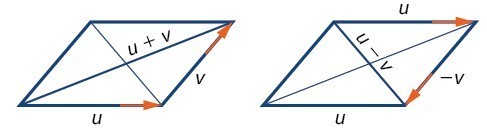
Now that we understand the properties of vectors, we can perform operations involving them. While it is convenient to think of the vector [latex]\boldsymbol{u}[/latex] [latex]=\langle x,y\rangle[/latex] as an arrow or directed line segment from the origin to the point [latex]\left(x,y\right)[/latex], vectors can be situated anywhere in the plane. The sum of two vectors u and v, or vector addition, produces a third vector u+ v, the resultant vector.
To find u + v, we first draw the vector u, and from the terminal end of u, we drawn the vector v. In other words, we have the initial point of v meet the terminal end of u. This position corresponds to the notion that we move along the first vector and then, from its terminal point, we move along the second vector. The sum u + v is the resultant vector because it results from addition or subtraction of two vectors. The resultant vector travels directly from the beginning of u to the end of v in a straight path.
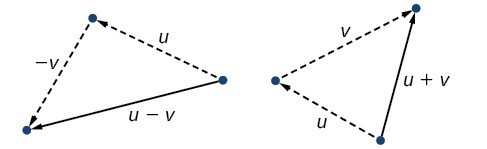
Vector subtraction is similar to vector addition. To find u − v, view it as u + (−v). Adding −v is reversing direction of v and adding it to the end of u. The new vector begins at the start of u and stops at the end point of −v.

Performing Operations on Vectors in Terms of i and j
When vectors are written in terms of i and j, we can carry out addition, subtraction, and scalar multiplication by performing operations on corresponding components.
adding and subtracting vectors in rectangular coordinates
Given v = ai + bj and u = ci + dj, then
[latex]\begin{gathered}\boldsymbol{v}+\boldsymbol{u}=\left(a+c\right)\boldsymbol{i}+\left(b+d\right)\boldsymbol{j}\\ \boldsymbol{v}-\boldsymbol{u}=\left(a-c\right)\boldsymbol{i}+\left(b-d\right)\boldsymbol{j}\end{gathered}[/latex]