Finding the Area of an Oblique Triangle Using the Sine Function
Now that we can solve a triangle for missing values, we can use some of those values and the sine function to find the area of an oblique triangle. Recall that the area formula for a triangle is given as [latex]\text{Area}=\frac{1}{2}bh[/latex], where [latex]b[/latex] is base and [latex]h[/latex] is height. For oblique triangles, we must find [latex]h[/latex] before we can use the area formula. Observing the two triangles, one acute and one obtuse, we can drop a perpendicular to represent the height and then apply the trigonometric property [latex]\sin \alpha =\frac{\text{opposite}}{\text{hypotenuse}}[/latex] to write an equation for area in oblique triangles. In the acute triangle, we have [latex]\sin \alpha =\frac{h}{c}[/latex] or [latex]c\sin \alpha =h[/latex]. However, in the obtuse triangle, we drop the perpendicular outside the triangle and extend the base [latex]b[/latex] to form a right triangle. The angle used in calculation is [latex]{\alpha }^{\prime }[/latex], or [latex]180-\alpha[/latex].
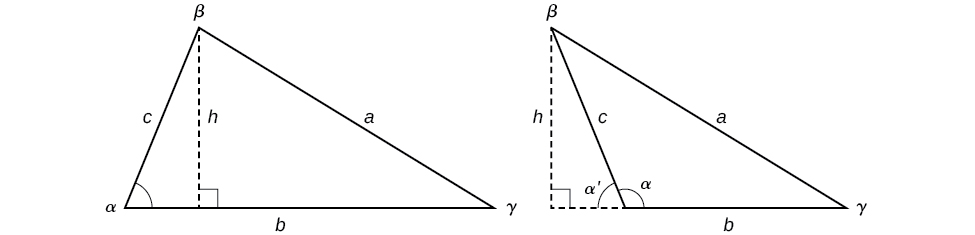
Thus,
Similarly,
area of an oblique triangle
The formula for the area of an oblique triangle is given by
[latex]\begin{align}\text{Area}&=\frac{1}{2}bc\sin \alpha \\ &=\frac{1}{2}ac\sin \beta \\ &=\frac{1}{2}ab\sin \gamma \end{align}[/latex]
This is equivalent to one-half of the product of two sides and the sine of their included angle.