- Use the Law of Sines to solve oblique triangles.
- Find the area of an oblique triangle using the sine function.
- Solve applied problems using the Law of Sines.
Solving Oblique Triangles with the Law of Sines
The Main Idea
The Law of Sines is a powerful tool for solving oblique triangles (non-right triangles). It relates the ratios of side lengths to the sines of their opposite angles, allowing us to find missing sides or angles when certain combinations of information are known. The formula works for both acute and obtuse triangles, but care must be taken with the ambiguous case (SSA), where two different triangles may satisfy the given conditions.
The Law of Sines:
[latex]\dfrac{a}{\sin A} = \dfrac{b}{\sin B} = \dfrac{c}{\sin C}[/latex]
Quick Tips: Using the Law of Sines
-
Know When to Use It
-
Works best with ASA (angle-side-angle) and AAS (angle-angle-side).
-
Also used in SSA (side-side-angle), but this may lead to the ambiguous case.
-
-
Set Up Ratios
-
Match a known side with its opposite angle: [latex]\dfrac{a}{\sin A}[/latex].
-
Use that ratio to find missing sides or angles.
-
-
Solve for Missing Angles
-
Use inverse sine: [latex]B = \sin^{-1}\left(\dfrac{b\sin A}{a}\right)[/latex].
-
Be mindful of possible supplementary solutions (an acute or obtuse angle).
-
-
Finish the Triangle
-
After finding two angles, the third can be calculated by subtracting from [latex]180^\circ[/latex] (or [latex]\pi[/latex]).
-
-
Check for Ambiguity
-
In SSA cases, if [latex]\sin^{-1}[/latex] gives an acute angle, check if its supplement also creates a valid triangle.
-
In triangle ABC, [latex]A = 35°[/latex], [latex]C = 65°[/latex], and [latex]c = 10[/latex] cm. Find side [latex]a[/latex] and angle [latex]B[/latex].
You can view the transcript for “The Ambiguous Case for Sine Law – Nerdstudy” here (opens in new window).
Area of an Oblique Triangle with Sine
The Main Idea
When a triangle isn’t a right triangle, we can still find its area using the sine function. Instead of needing the height, we use two sides and the sine of the included angle. This is especially useful for SAS (side–angle–side) cases, where two sides and the angle between them are known.
The formula is:
[latex]\text{Area} = \dfrac{1}{2}ab\sin C = \dfrac{1}{2}bc\sin A = \dfrac{1}{2}ca\sin B[/latex]
Find the area of triangle ABC where [latex]a = 8[/latex] m, [latex]c = 14[/latex] m, and [latex]B = 55°[/latex].
Applied Problems with the Law of Sines
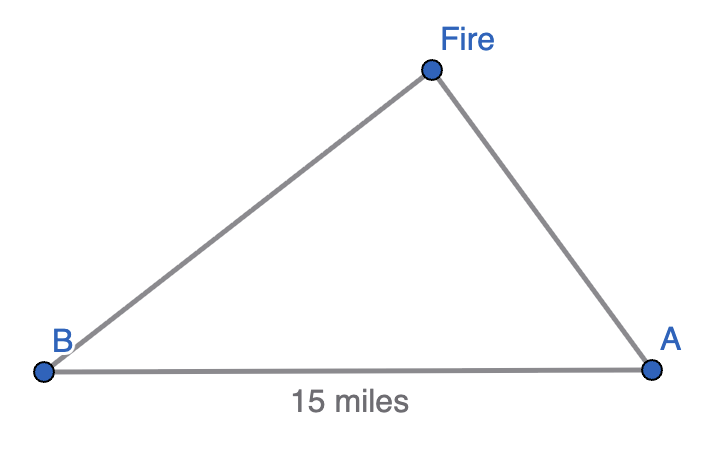
Two ranger stations are 15 miles apart, with station A directly east of station B. A fire is spotted from both stations. From station A, the angle to the fire is [latex]42°[/latex] west of north. From station B, the angle to the fire is [latex]64°[/latex] east of north. How far is the fire from station A?