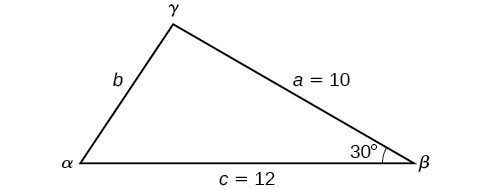
First, make note of what is given: two sides and the angle between them. This arrangement is classified as SAS and supplies the data needed to apply the Law of Cosines.
Each one of the three laws of cosines begins with the square of an unknown side opposite a known angle. For this example, the first side to solve for is side [latex]b[/latex], as we know the measurement of the opposite angle [latex]\beta[/latex].
[latex]\begin{align}&{b}^{2}={a}^{2}+{c}^{2}-2ac\cos \beta \\ &{b}^{2}={10}^{2}+{12}^{2}-2\left(10\right)\left(12\right)\cos \left({30}^{\circ }\right) && \text{Substitute the measurements for the known quantities}. \\ &{b}^{2}=100+144 - 240\left(\frac{\sqrt{3}}{2}\right)&& \text{Evaluate the cosine and begin to simplify}. \\ &{b}^{2}=244 - 120\sqrt{3} \\ &b=\sqrt{244 - 120\sqrt{3}}&& \text{Use the square root property}. \\ &b\approx 6.013 \end{align}[/latex]
Because we are solving for a length, we use only the positive square root. Now that we know the length [latex]b[/latex], we can use the Law of Sines to fill in the remaining angles of the triangle. Solving for angle [latex]\alpha[/latex], we have
[latex]\begin{align}&\frac{\sin \alpha }{a}=\frac{\sin \beta }{b} \\ &\frac{\sin \alpha }{10}=\frac{\sin \left(30^\circ \right)}{6.013} \\ &\sin \alpha =\frac{10\sin \left(30^\circ \right)}{6.013}&& \text{Multiply both sides of the equation by 10}. \\ &\alpha ={\sin }^{-1}\left(\frac{10\sin \left(30^\circ \right)}{6.013}\right)&& \text{Find the inverse sine of }\frac{10\sin \left(30^\circ \right)}{6.013}. \\ &\alpha \approx 56.3^\circ \end{align}[/latex]
The other possibility for [latex]\alpha[/latex] would be [latex]\alpha =180^\circ -56.3^\circ \approx 123.7^\circ[/latex]. In the original diagram, [latex]\alpha[/latex] is adjacent to the longest side, so [latex]\alpha[/latex] is an acute angle and, therefore, [latex]123.7^\circ[/latex] does not make sense. Notice that if we choose to apply the Law of Cosines, we arrive at a unique answer. We do not have to consider the other possibilities, as cosine is unique for angles between [latex]0^\circ[/latex] and [latex]180^\circ[/latex]. Proceeding with [latex]\alpha \approx 56.3^\circ[/latex], we can then find the third angle of the triangle.
[latex]\gamma =180^\circ -30^\circ -56.3^\circ \approx 93.7^\circ[/latex]
The complete set of angles and sides is
[latex]\begin{align}&\alpha \approx 56.3^\circ && a=10\\ &\beta =30^\circ && b\approx 6.013\\ &\gamma \approx 93.7^\circ && c=12 \end{align}[/latex]