Essential Concepts
Angles and Angle Measurement
- An angle is the union of two rays having a common endpoint
- Greek letters ([latex]\theta, \phi, \alpha, \beta, \gamma[/latex]) are commonly used to represent angle measures
- The measure of an angle is the amount of rotation from the initial side to the terminal side
- Counterclockwise rotation produces a positive angle
- Clockwise rotation produces a negative angle
- An angle is in standard position when its vertex is at the origin and its initial side extends along the positive x-axis
- The coordinate plane is divided into four quadrants, numbered I through IV counterclockwise starting from the positive x-axis
Degrees and Radians
- A complete circular rotation contains 360°
- Always include the degree symbol (°) or the word “degrees”
- One radian is the measure of a central angle that intercepts an arc equal in length to the radius
- A full revolution equals [latex]2\pi[/latex] radians
- When an angle is described without units, it refers to radian measure
- Use the proportion: [latex]\frac{\theta}{180} = \frac{\theta^R}{\pi}[/latex]
- To convert radians to degrees: multiply by [latex]\frac{180}{\pi}[/latex]
- To convert degrees to radians: multiply by [latex]\frac{\pi}{180}[/latex]
DMS Form (Degrees, Minutes, Seconds)
- One degree equals 60 minutes: [latex]1° = 60'[/latex]
- One minute equals 60 seconds: [latex]1' = 60"[/latex]
- Written as [latex]D° M' S"[/latex]
Coterminal Angles
- Two angles in standard position with the same terminal side
- To find coterminal angles in degrees: add or subtract multiples of 360°
- To find coterminal angles in radians: add or subtract multiples of [latex]2\pi[/latex]
Reference Angles
- The measure of the smallest positive acute angle formed by the terminal side and the horizontal axis
- Always between 0° and 90° (or 0 and [latex]\frac{\pi}{2}[/latex] radians)
- For Quadrant II or III: [latex]|\pi - t|[/latex] or [latex]|180° - t|[/latex]
- For Quadrant IV: [latex]2\pi - t[/latex] or [latex]360° - t[/latex]
Complementary and Supplementary Angles
- Complementary angles sum to 90° (or [latex]\frac{\pi}{2}[/latex] radians)
- Supplementary angles sum to 180° (or [latex]\pi[/latex] radians)
- An angle can only have a complement if it measures less than 90°
Arcs and Sectors
- In a circle of radius [latex]r[/latex], the length of an arc [latex]s[/latex] subtended by angle [latex]\theta[/latex] (in radians) is: [latex]s = r\theta[/latex]. The angle must be in radians for this formula to work
- The area of a sector with radius [latex]r[/latex] and central angle [latex]\theta[/latex] (in radians) is: [latex]A = \frac{1}{2}\theta r^2[/latex]
Linear and Angular Speed
- Linear speed [latex]v[/latex] is the distance traveled per unit time: [latex]v = \frac{s}{t}[/latex]
- Angular speed [latex]\omega[/latex] is the angular rotation per unit time: [latex]\omega = \frac{\theta}{t}[/latex]
Sine and Cosine Functions
The Unit Circle
- A circle centered at the origin with radius 1
- Any point on the unit circle can be written as [latex](x, y) = (\cos t, \sin t)[/latex]
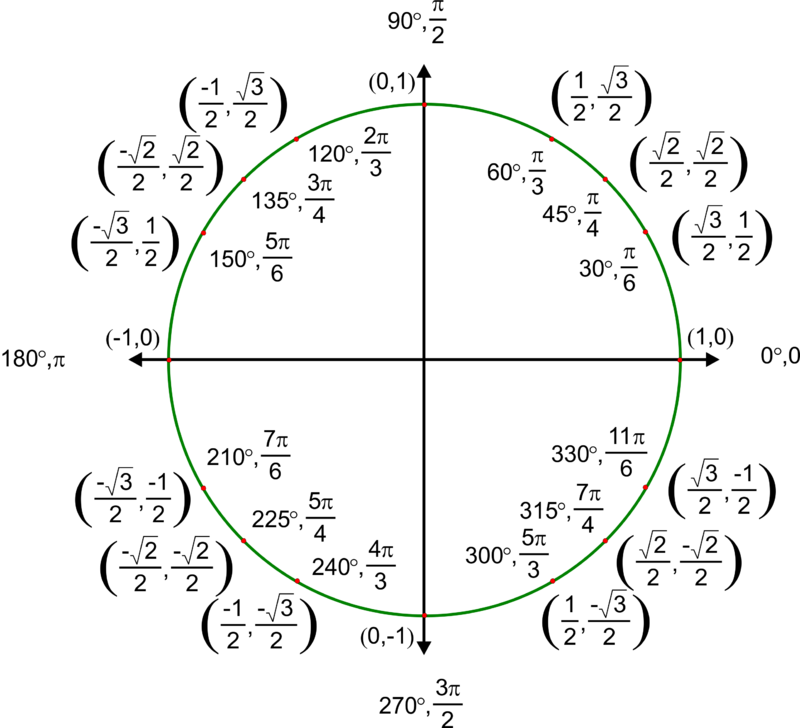

Sine and Cosine Functions
- For a point [latex](x, y)[/latex] on the unit circle corresponding to angle [latex]t[/latex]:
- [latex]\cos t = x[/latex] (the x-coordinate)
- [latex]\sin t = y[/latex] (the y-coordinate)
- Output values are always between -1 and 1
The Pythagorean Identity
- [latex]\cos^2 t + \sin^2 t = 1[/latex]
- Derived from the unit circle equation [latex]x^2 + y^2 = 1[/latex]
Special Angles and Their Values
| Angle | 0 | [latex]\frac{\pi}{6}[/latex] (30°) | [latex]\frac{\pi}{4}[/latex] (45°) | [latex]\frac{\pi}{3}[/latex] (60°) | [latex]\frac{\pi}{2}[/latex] (90°) |
|---|---|---|---|---|---|
| Cosine | 1 | [latex]\frac{\sqrt{3}}{2}[/latex] | [latex]\frac{\sqrt{2}}{2}[/latex] | [latex]\frac{1}{2}[/latex] | 0 |
| Sine | 0 | [latex]\frac{1}{2}[/latex] | [latex]\frac{\sqrt{2}}{2}[/latex] | [latex]\frac{\sqrt{3}}{2}[/latex] | 1 |
The Other Trigonometric Functions
- Tangent: [latex]\tan t = \frac{y}{x} = \frac{\sin t}{\cos t}[/latex] (where [latex]x \neq 0[/latex])
- Secant: [latex]\sec t = \frac{1}{x} = \frac{1}{\cos t}[/latex] (where [latex]x \neq 0[/latex])
- Cosecant: [latex]\csc t = \frac{1}{y} = \frac{1}{\sin t}[/latex] (where [latex]y \neq 0[/latex])
- Cotangent: [latex]\cot t = \frac{x}{y} = \frac{\cos t}{\sin t}[/latex] (where [latex]y \neq 0[/latex])
Even and Odd Functions
- Even functions (symmetric about y-axis): [latex]\cos(-t) = \cos t[/latex] and [latex]\sec(-t) = \sec t[/latex]
- Odd functions (symmetric about origin): [latex]\sin(-t) = -\sin t[/latex], [latex]\tan(-t) = -\tan t[/latex], [latex]\csc(-t) = -\csc t[/latex], [latex]\cot(-t) = -\cot t[/latex]
Alternate Pythagorean Identities
- [latex]1 + \tan^2 t = \sec^2 t[/latex]
- [latex]\cot^2 t + 1 = \csc^2 t[/latex]
Period of Trigonometric Functions
- A period is the shortest interval over which a function completes one full cycle
- Sine, cosine, secant, and cosecant have period [latex]2\pi[/latex]
- Tangent and cotangent have period [latex]\pi[/latex]
Key Equations
| Arc length | [latex]s = r\theta[/latex] |
| Area of a sector | [latex]A = \frac{1}{2}\theta r^2[/latex] |
| Angular speed | [latex]\omega = \frac{\theta}{t}[/latex] |
| Linear speed | [latex]v = \frac{s}{t}[/latex] or [latex]v = r\omega[/latex] |
| Pythagorean Identity | [latex]\cos^2 t + \sin^2 t = 1[/latex]
[latex]1 + \tan^2 t = \sec^2 t[/latex] [latex]\cot^2 t + 1 = \csc^2 t[/latex] |
| Tangent function | [latex]\tan t = \frac{\sin t}{\cos t}[/latex] |
| Secant function | [latex]\sec t = \frac{1}{\cos t}[/latex] |
| Cosecant function | [latex]\csc t = \frac{1}{\sin t}[/latex] |
| Cotangent function | [latex]\cot t = \frac{\cos t}{\sin t}[/latex] |
Glossary
angle
The union of two rays having a common endpoint called the vertex.
angular speed
The angular rotation [latex]\theta[/latex] per unit time [latex]t[/latex], denoted [latex]\omega = \frac{\theta}{t}[/latex].
arc length
The length of the arc [latex]s[/latex] along a circle subtended by a central angle, calculated as [latex]s = r\theta[/latex] where [latex]\theta[/latex] is in radians.
complementary angles
Two angles whose measures add up to 90° (or [latex]\frac{\pi}{2}[/latex] radians).
cosecant
The reciprocal of the sine function: [latex]\csc t = \frac{1}{\sin t}[/latex].
cosine
For a point [latex](x, y)[/latex] on the unit circle corresponding to angle [latex]t[/latex], [latex]\cos t = x[/latex].
cotangent
The reciprocal of the tangent function: [latex]\cot t = \frac{\cos t}{\sin t}[/latex].
coterminal angles
Two angles in standard position that have the same terminal side.
degree
A unit of angle measurement where one degree is [latex]\frac{1}{360}[/latex] of a circular rotation.
DMS form
Notation for expressing angles using degrees, minutes, and seconds (D° M’ S”), where 1° = 60′ and 1′ = 60″.
even function
A function where [latex]f(-x) = f(x)[/latex]. Cosine and secant are even trigonometric functions.
initial side
The fixed ray from which angle measurement begins, extending along the positive x-axis in standard position.
linear speed
The distance traveled per unit time, calculated as [latex]v = \frac{s}{t}[/latex] or [latex]v = r\omega[/latex].
odd function
A function where [latex]f(-x) = -f(x)[/latex]. Sine, tangent, cosecant, and cotangent are odd trigonometric functions.
period
The shortest interval [latex]P[/latex] over which a function completes one full cycle, where [latex]f(x + P) = f(x)[/latex].
quadrantal angles
Angles whose terminal side lies on an axis, including 0°, 90°, 180°, 270°, and 360°.
radian
The measure of a central angle that intercepts an arc equal in length to the radius of the circle. A full revolution equals [latex]2\pi[/latex] radians.
reference angle
The measure of the smallest positive acute angle formed by the terminal side of an angle and the horizontal axis.
secant
The reciprocal of the cosine function: [latex]\sec t = \frac{1}{\cos t}[/latex].
sector
A region of a circle bounded by two radii and the intercepted arc, with area [latex]A = \frac{1}{2}\theta r^2[/latex].
sine
For a point [latex](x, y)[/latex] on the unit circle corresponding to angle [latex]t[/latex], [latex]\sin t = y[/latex].
standard position
An angle positioned with its vertex at the origin and its initial side extending along the positive x-axis.
supplementary angles
Two angles whose measures add up to 180° (or [latex]\pi[/latex] radians).
tangent
The ratio of sine to cosine: [latex]\tan t = \frac{\sin t}{\cos t}[/latex].
terminal side
The rotated ray of an angle after rotation from the initial side.
unit circle
A circle centered at the origin with radius 1, where [latex]x^2 + y^2 = 1[/latex].