Graphs of the Sine and Cosine Function: Apply It 1
Determine amplitude, period, phase shift, and vertical shift of a sine or cosine graph from its equation.
Graph transformations of y=cos x and y=sin x .
Determine a function formula that would have a given sinusoidal graph.
Determine functions that model circular and periodic motion.
Using Transformations of Sine and Cosine Functions
We can use the transformations of sine and cosine functions in numerous applications. As mentioned at the beginning of the chapter, circular motion can be modeled using either the sine or cosine function.
A point rotates around a circle of radius 3 centered at the origin. Sketch a graph of the y-coordinate of the point as a function of the angle of rotation.
Recall that, for a point on a circle of radius r, the y-coordinate of the point is [latex]y=r\sin(x)[/latex], so in this case, we get the equation [latex]y(x)=3\sin(x)[/latex]. The constant 3 causes a vertical stretch of the y-values of the function by a factor of 3, which we can see in the graph.
Analysis of the Solution
Notice that the period of the function is still 2π; as we travel around the circle, we return to the point (3,0) for [latex]x=2\pi,4\pi,6\pi,\dots[/latex] Because the outputs of the graph will now oscillate between –3 and 3, the amplitude of the sine wave is 3.
What is the amplitude of the function [latex]f(x)=7\cos(x)[/latex]? Sketch a graph of this function.
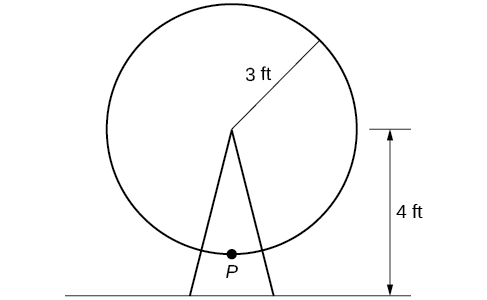
A circle with radius 3 ft is mounted with its center 4 ft off the ground. The point closest to the ground is labeled P. Sketch a graph of the height above the ground of the point P as the circle is rotated; then find a function that gives the height in terms of the angle of rotation.
Sketching the height, we note that it will start 1 ft above the ground, then increase up to 7 ft above the ground, and continue to oscillate 3 ft above and below the center value of 4 ft.
Although we could use a transformation of either the sine or cosine function, we start by looking for characteristics that would make one function easier to use than the other. Let’s use a cosine function because it starts at the highest or lowest value, while a sine function starts at the middle value. A standard cosine starts at the highest value, and this graph starts at the lowest value, so we need to incorporate a vertical reflection.
Second, we see that the graph oscillates 3 above and below the center, while a basic cosine has an amplitude of 1, so this graph has been vertically stretched by 3, as in the last example.
Finally, to move the center of the circle up to a height of 4, the graph has been vertically shifted up by 4. Putting these transformations together, we find that
[latex]y=−3\cos(x)+4[/latex]
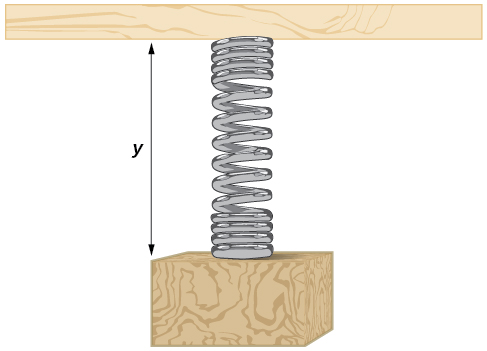
A weight is attached to a spring that is then hung from a board. As the spring oscillates up and down, the position y of the weight relative to the board ranges from –1 in. (at time x = 0) to –7in. (at time x = π) below the board. Assume the position of y is given as a sinusoidal function of x. Sketch a graph of the function, and then find a cosine function that gives the position y in terms of x.
[latex]y=3\cos(x)−4[/latex]
The London Eye is a huge Ferris wheel with a diameter of 135 meters (443 feet). It completes one rotation every 30 minutes. Riders board from a platform 2 meters above the ground. Express a rider’s height above ground as a function of time in minutes.
With a diameter of 135 m, the wheel has a radius of 67.5 m. The height will oscillate with amplitude 67.5 m above and below the center.
Passengers board 2 m above ground level, so the center of the wheel must be located 67.5 + 2 = 69.5 m above ground level. The midline of the oscillation will be at 69.5 m.
The wheel takes 30 minutes to complete 1 revolution, so the height will oscillate with a period of 30 minutes.
Lastly, because the rider boards at the lowest point, the height will start at the smallest value and increase, following the shape of a vertically reflected cosine curve.
Amplitude: 67.5, so A = 67.5
Midline: 69.5, so D = 69.5
Period: 30, so [latex]B=\frac{2\pi}{30}=\frac{\pi}{15}[/latex]
![A graph of 3sin(x). Graph has period of 2pi, amplitude of 3, and range of [-3,3].](https://s3-us-west-2.amazonaws.com/courses-images/wp-content/uploads/sites/3675/2018/09/27003959/CNX_Precalc_Figure_06_01_023.jpg)
![A graph of 7cos(x). Graph has amplitude of 7, period of 2pi, and range of [-7,7].](https://s3-us-west-2.amazonaws.com/courses-images/wp-content/uploads/sites/3675/2018/09/27004029/CNX_Precalc_Figure_06_01_024.jpg)

![A cosine graph with range [-1,-7]. Period is 2 pi. Local maximums at (0,-1), (2pi,-1), and (4pi, -1). Local minimums at (pi,-7) and (3pi, -7).](https://s3-us-west-2.amazonaws.com/courses-images/wp-content/uploads/sites/3675/2018/09/27004032/CNX_Precalc_Figure_06_01_027.jpg)