Graphs of the Other Trigonometric Functions: Learn It 2
Graphing Transformations of y = tan x
Graphing One Period of a Shifted Tangent Function
Now that we can graph a tangent function that is stretched or compressed, we will add a vertical and/or horizontal (or phase) shift. In this case, we add C and D to the general form of the tangent function.
[latex]f(x)=A\tan(Bx−C)+D[/latex]
The graph of a transformed tangent function is different from the basic tangent function tan x in several ways:
features of the graph of [latex]y = A\tan\left(Bx−C\right)+D[/latex]
The period is [latex]\frac{\pi}{|B|}[/latex].
The domain is [latex]x\ne\frac{C}{B}+\frac{\pi}{|B|}k[/latex], where k is an integer.
The range is [latex](-\infty,\infty)[/latex]
The vertical asymptotes occur at [latex]x=\frac{C}{B}+\frac{\pi}{2|B|}k[/latex], where k is an odd integer.
There is no amplitude.
[latex]y=A\tan(Bx)[/latex] is an odd function because it is the quotient of odd and even functions (sine and cosine respectively).
How To: Given the function [latex]y=A\tan(Bx−C)+D[/latex], sketch the graph of one period.
Express the function given in the form [latex]y=A\tan(Bx−C)+D[/latex].
Identify the stretching/compressing factor, |A|.
Identify B and determine the period, [latex]P=\frac{\pi}{|B|}[/latex].
Identify C and determine the phase shift, [latex]\frac{C}{B}[/latex].
Draw the graph of [latex]y=A\tan(Bx)[/latex] shifted to the right by [latex]\frac{C}{B}[/latex] and up by D.
Sketch the vertical asymptotes, which occur at [latex]x=\frac{C}{B}+\frac{\pi}{2|B|}k[/latex], where k is an odd integer.
Plot any three reference points and draw the graph through these points.
Graph one period of the function [latex]y=−2\tan(\pi x+\pi)−1[/latex].
Step 1. The function is already written in the form [latex]y=A\tan(Bx−C)+D[/latex].Step 2. [latex]A=−2[/latex], so the stretching factor is [latex]|A|=2[/latex].
Step 3. [latex]B=\pi[/latex], so the period is [latex]P=\frac{\pi}{|B|}=\frac{\pi}{\pi}=1[/latex].
Step 4. [latex]C=−\pi[/latex], so the phase shift is [latex]\dfrac{C}{B}=\dfrac{−\pi}{\pi}=−1[/latex].
Step 5–7. The asymptotes are at [latex]x=−\frac{3}{2}[/latex] and [latex]x=−\frac{1}{2}[/latex] and the three recommended reference points are (−1.25, 1), (−1,−1), and (−0.75, −3).
Analysis of the Solution
Note that this is a decreasing function because A < 0.
How would the graph in Example 2 look different if we made A = 2 instead of −2?
It would be reflected across the line [latex]y=−1[/latex], becoming an increasing function.
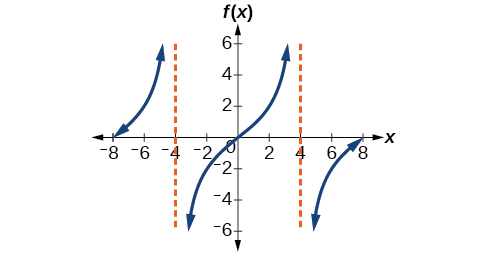
Find a formula for the function.
The graph has the shape of a tangent function.
Step 1. One cycle extends from –4 to 4, so the period is [latex]P=8[/latex]. Since [latex]P=\frac{\pi}{|B|}[/latex], we have [latex]B=\frac{\pi}{P}=\frac{\pi}{8}[/latex].
Step 2. The equation must have the [latex]\text{form}f(x)=A\tan\left(\frac{\pi}{8}x\right)[/latex].
Step 3. To find the vertical stretch A, we can use the point (2,2).