Exponential Functions
2. Given a formula for an exponential function, is it possible to determine whether the function grows or decays exponentially just by looking at the formula? Explain.
For the following exercises, identify whether the statement represents an exponential function. Explain.
5. A population of bacteria decreases by a factor of [latex]\frac{1}{8}[/latex] every 24 hours.
6. The value of a coin collection has increased by 3.25% annually over the last 20 years.
7. For each training session, a personal trainer charges his clients $5 less than the previous training session.
For the following exercises, consider this scenario: For each year t, the population of a forest of trees is represented by the function [latex]A\left(t\right)=115{\left(1.025\right)}^{t}[/latex]. In a neighboring forest, the population of the same type of tree is represented by the function [latex]B\left(t\right)=82{\left(1.029\right)}^{t}[/latex]. (Round answers to the nearest whole number.)
9. Which forest’s population is growing at a faster rate?
10. Which forest had a greater number of trees initially? By how many?
11. Assuming the population growth models continue to represent the growth of the forests, which forest will have a greater number of trees after 20 years? By how many?
12. Assuming the population growth models continue to represent the growth of the forests, which forest will have a greater number of trees after 100 years? By how many?
For the following exercises, determine whether the equation represents exponential growth, exponential decay, or neither. Explain.
15. [latex]y=220{\left(1.06\right)}^{x}[/latex]
17. [latex]y=11,701{\left(0.97\right)}^{t}[/latex]
For the following exercises, find the formula for an exponential function that passes through the two points given.
19. [latex]\left(0,2000\right)[/latex] and [latex]\left(2,20\right)[/latex]
21. [latex]\left(-2,6\right)[/latex] and [latex]\left(3,1\right)[/latex]
For the following exercises, determine whether the table could represent a function that is linear, exponential, or neither. If it appears to be exponential, find a function that passes through the points.
23.
| x | 1 | 2 | 3 | 4 |
| f(x) | 70 | 40 | 10 | -20 |
25.
| x | 1 | 2 | 3 | 4 |
| m(x) | 80 | 61 | 42.9 | 25.61 |
For the following exercises, use the compound interest formula, [latex]A\left(t\right)=P{\left(1+\frac{r}{n}\right)}^{nt}[/latex].
31. An account is opened with an initial deposit of $6,500 and earns 3.6% interest compounded semi-annually. What will the account be worth in 20 years?
32. How much more would the account in the previous exercise have been worth if the interest were compounding weekly?
35. How much more would the account in the previous two exercises be worth if it were earning interest for 5 more years?
42. Suppose an investment account is opened with an initial deposit of $12,000 earning 7.2% interest compounded continuously. How much will the account be worth after 30 years?
43. How much less would the account from Exercise 42 be worth after 30 years if it were compounded monthly instead?
For the following exercises, use a graphing calculator to find the equation of an exponential function given the points on the curve.
51. [latex]\left(0,3\right)[/latex] and [latex]\left(3,375\right)[/latex]
53. [latex]\left(20,29.495\right)[/latex] and [latex]\left(150,730.89\right)[/latex]
55. [latex]\left(11,310.035\right)[/latex] and [latex]\left(25,356.3652\right)[/latex]
61. The fox population in a certain region has an annual growth rate of 9% per year. In the year 2012, there were 23,900 fox counted in the area. What is the fox population predicted to be in the year 2020?
63. In the year 1985, a house was valued at $110,000. By the year 2005, the value had appreciated to $145,000. What was the annual growth rate between 1985 and 2005? Assume that the value continued to grow by the same percentage. What was the value of the house in the year 2010?
65. Jamal wants to save $54,000 for a down payment on a home. How much will he need to invest in an account with 8.2% APR, compounding daily, in order to reach his goal in 5 years?
67. Alyssa opened a retirement account with 7.25% APR in the year 2000. Her initial deposit was $13,500. How much will the account be worth in 2025 if interest compounds monthly? How much more would she make if interest compounded continuously?
Graphs of Exponential Functions
1. What role does the horizontal asymptote of an exponential function play in telling us about the end behavior of the graph?
3. The graph of [latex]f\left(x\right)={3}^{x}[/latex] is reflected about the y-axis and stretched vertically by a factor of 4. What is the equation of the new function, [latex]g\left(x\right)[/latex]? State its y-intercept, domain, and range.
5. The graph of [latex]f\left(x\right)={10}^{x}[/latex] is reflected about the x-axis and shifted upward 7 units. What is the equation of the new function, [latex]g\left(x\right)[/latex]? State its y-intercept, domain, and range.
7. The graph of [latex]f\left(x\right)=\left(\frac{1}{4}\right)}^{x }[/latex] is shifted left 2 units, stretched vertically by a factor of 4, reflected about the x-axis, and then shifted downward 4 units. What is the equation of the new function, [latex]g\left(x\right)[/latex]? State its y-intercept, domain, and range.
For the following exercises, graph each set of functions on the same axes.
11. [latex]f\left(x\right)=3{\left(\frac{1}{4}\right)}^{x}[/latex], [latex]g\left(x\right)=3{\left(2\right)}^{x}[/latex], and [latex]h\left(x\right)=3{\left(4\right)}^{x}[/latex]
For the following exercises, match each function with one of the graphs pictured below.
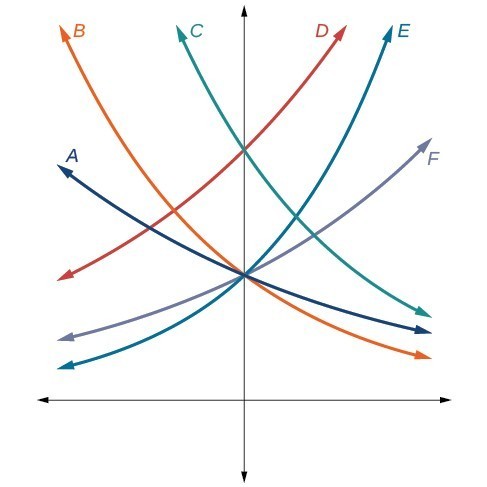
13. [latex]f\left(x\right)=2{\left(0.69\right)}^{x}[/latex]
14. [latex]f\left(x\right)=2{\left(1.28\right)}^{x}[/latex]
15. [latex]f\left(x\right)=2{\left(0.81\right)}^{x}[/latex]
16. [latex]f\left(x\right)=4{\left(1.28\right)}^{x}[/latex]
17. [latex]f\left(x\right)=2{\left(1.59\right)}^{x}[/latex]
18. [latex]f\left(x\right)=4{\left(0.69\right)}^{x}[/latex]
For the following exercises, graph the transformation of [latex]f\left(x\right)={2}^{x}[/latex]. Give the horizontal asymptote, the domain, and the range.
26. [latex]f\left(x\right)={2}^{-x}[/latex]
27. [latex]h\left(x\right)={2}^{x}+3[/latex]
28. [latex]f\left(x\right)={2}^{x - 2}[/latex]
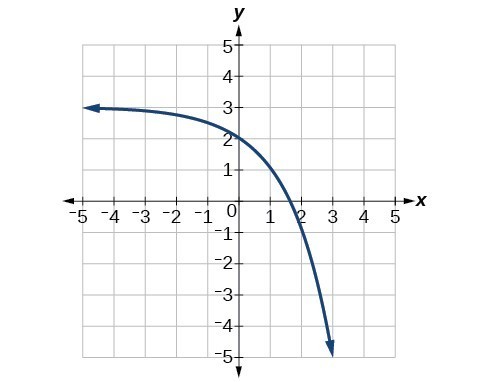
For the following exercises, each graph is a transformation of [latex]y={2}^{x}[/latex]. Write an equation describing the transformation.
39.
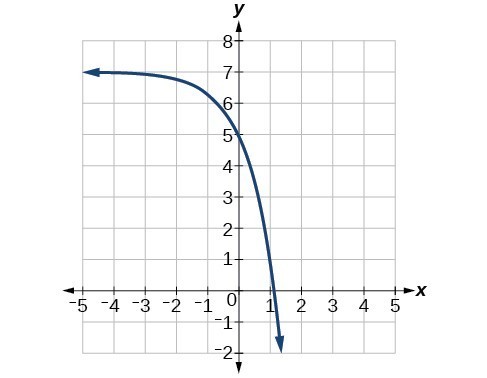
For the following exercises, find an exponential equation for the graph.
41.
For the following exercises, use a graphing calculator to approximate the solutions of the equation. Round to the nearest thousandth. [latex]f\left(x\right)=a{b}^{x}+d[/latex].
47. [latex]116=\frac{1}{4}{\left(\frac{1}{8}\right)}^{x}[/latex]
49. [latex]5=3{\left(\frac{1}{2}\right)}^{x - 1}-2[/latex]
Logarithmic Functions
3. How can the logarithmic equation [latex]{\mathrm{log}}_{b}x=y[/latex] be solved for x using the properties of exponents?
For the following exercises, rewrite each equation in exponential form.
7. [latex]{\text{log}}_{a}\left(b\right)=c[/latex]
9. [latex]{\mathrm{log}}_{x}\left(64\right)=y[/latex]
11. [latex]{\mathrm{log}}_{15}\left(a\right)=b[/latex]
13. [latex]{\mathrm{log}}_{13}\left(142\right)=a[/latex]
15. [latex]\text{ln}\left(w\right)=n[/latex]
For the following exercises, rewrite each equation in logarithmic form.
17. [latex]{c}^{d}=k[/latex]
19. [latex]{19}^{x}=y[/latex]
21. [latex]{n}^{4}=103[/latex]
23. [latex]{y}^{x}=\frac{39}{100}[/latex]
25. [latex]{e}^{k}=h[/latex]
For the following exercises, solve for x by converting the logarithmic equation to exponential form.
27. [latex]{\text{log}}_{2}\left(x\right)=-3[/latex]
29. [latex]{\mathrm{log}}_{3}\left(x\right)=3[/latex]
31. [latex]{\text{log}}_{9}\left(x\right)=\frac{1}{2}[/latex]
33. [latex]{\mathrm{log}}_{6}\left(x\right)=-3[/latex]
35. [latex]\text{ln}\left(x\right)=2[/latex]
For the following exercises, use the definition of common and natural logarithms to simplify.
37. [latex]{10}^{\text{log}\left(32\right)}[/latex]
39. [latex]{e}^{\mathrm{ln}\left(1.06\right)}[/latex]
41. [latex]{e}^{\mathrm{ln}\left(10.125\right)}+4[/latex]
For the following exercises, evaluate the base b logarithmic expression without using a calculator.
43. [latex]{\text{log}}_{6}\left(\sqrt{6}\right)[/latex]
45. [latex]6{\text{log}}_{8}\left(4\right)[/latex]
For the following exercises, evaluate the common logarithmic expression without using a calculator.
47. [latex]\text{log}\left(0.001\right)[/latex]
49. [latex]2\text{log}\left({100}^{-3}\right)[/latex]
For the following exercises, evaluate the natural logarithmic expression without using a calculator.
51. [latex]\text{ln}\left(1\right)[/latex]
53. [latex]25\text{ln}\left({e}^{\frac{2}{5}}\right)[/latex]
59. Is x = 0 in the domain of the function [latex]f\left(x\right)=\mathrm{log}\left(x\right)[/latex]? If so, what is the value of the function when x = 0? Verify the result.
66. The intensity levels I of two earthquakes measured on a seismograph can be compared by the formula [latex]\mathrm{log}\frac{{I}_{1}}{{I}_{2}}={M}_{1}-{M}_{2}[/latex] where M is the magnitude given by the Richter Scale. In August 2009, an earthquake of magnitude 6.1 hit Honshu, Japan. In March 2011, that same region experienced yet another, more devastating earthquake, this time with a magnitude of 9.0.[1] How many times greater was the intensity of the 2011 earthquake? Round to the nearest whole number.
Graphs of Logarithmic Functions
1. The inverse of every logarithmic function is an exponential function and vice-versa. What does this tell us about the relationship between the coordinates of the points on the graphs of each?
2. What type(s) of translation(s), if any, affect the range of a logarithmic function?
3. What type(s) of translation(s), if any, affect the domain of a logarithmic function?
For the following exercises, state the domain, range, and x- and y-intercepts, if they exist. If they do not exist, write DNE.
21. [latex]h\left(x\right)={\mathrm{log}}_{4}\left(x - 1\right)+1[/latex]
23. [latex]g\left(x\right)=\mathrm{ln}\left(-x\right)-2[/latex]
25. [latex]h\left(x\right)=3\mathrm{ln}\left(x\right)-9[/latex]
For the following exercises, match each function in the figure below with the letter corresponding to its graph.
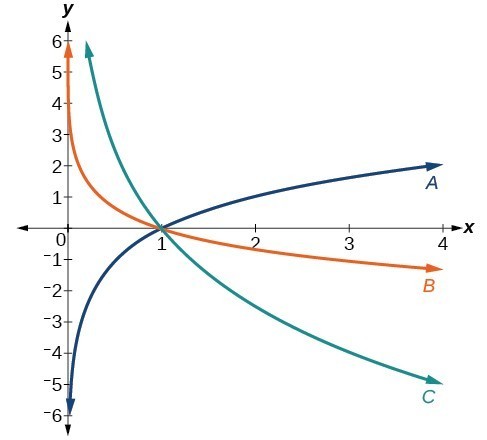
31. [latex]f\left(x\right)={\mathrm{log}}_{\frac{1}{3}}\left(x\right)[/latex]
32. [latex]g\left(x\right)={\mathrm{log}}_{2}\left(x\right)[/latex]
33. [latex]h\left(x\right)={\mathrm{log}}_{\frac{3}{4}}\left(x\right)[/latex]
For the following exercises, sketch the graphs of each pair of functions on the same axis.
35. [latex]f\left(x\right)=\mathrm{log}\left(x\right)[/latex] and [latex]g\left(x\right)={\mathrm{log}}_{\frac{1}{2}}\left(x\right)[/latex]
37. [latex]f\left(x\right)={e}^{x}[/latex] and [latex]g\left(x\right)=\mathrm{ln}\left(x\right)[/latex]
For the following exercises, match each function in the graph below with the letter corresponding to its graph.
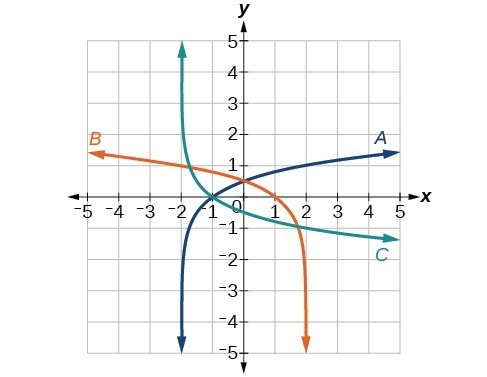
38. [latex]f\left(x\right)={\mathrm{log}}_{4}\left(-x+2\right)[/latex]
39. [latex]g\left(x\right)=-{\mathrm{log}}_{4}\left(x+2\right)[/latex]
40. [latex]h\left(x\right)={\mathrm{log}}_{4}\left(x+2\right)[/latex]
For the following exercises, sketch the graph of the indicated function.
41. [latex]f\left(x\right)={\mathrm{log}}_{2}\left(x+2\right)[/latex]
43. [latex]f\left(x\right)=\mathrm{ln}\left(-x\right)[/latex]
45. [latex]g\left(x\right)=\mathrm{log}\left(6 - 3x\right)+1[/latex]
For the following exercises, use a graphing calculator to find approximate solutions to each equation.
51. [latex]\mathrm{log}\left(x - 1\right)+2=\mathrm{ln}\left(x - 1\right)+2[/latex]
53. [latex]\mathrm{ln}\left(x - 2\right)=-\mathrm{ln}\left(x+1\right)[/latex]
55. [latex]\frac{1}{3}\mathrm{log}\left(1-x\right)=\mathrm{log}\left(x+1\right)+\frac{1}{3}[/latex]
- "M 9.1 - 2011 Great Tohoku Earthquake, Japan," Earthquake Hazards Program, U.S. Geological Survey, accessed: April 1, 2026, https://earthquake.usgs.gov/earthquakes/eventpage/official20110311054624120_30/executive/. ↵