Logarithmic Properties
For the following exercises, expand each logarithm as much as possible. Rewrite each expression as a sum, difference, or product of logs.
3. [latex]{\mathrm{log}}_{b}\left(7x\cdot 2y\right)[/latex]
5. [latex]{\mathrm{log}}_{b}\left(\frac{13}{17}\right)[/latex]
7. [latex]\mathrm{ln}\left(\frac{1}{{4}^{k}}\right)[/latex]
For the following exercises, condense to a single logarithm if possible.
9. [latex]\mathrm{ln}\left(7\right)+\mathrm{ln}\left(x\right)+\mathrm{ln}\left(y\right)[/latex]
11. [latex]{\mathrm{log}}_{b}\left(28\right)-{\mathrm{log}}_{b}\left(7\right)[/latex]
13. [latex]-{\mathrm{log}}_{b}\left(\frac{1}{7}\right)[/latex]
For the following exercises, use the properties of logarithms to expand each logarithm as much as possible. Rewrite each expression as a sum, difference, or product of logs.
15. [latex]\mathrm{log}\left(\frac{{x}^{15}{y}^{13}}{{z}^{19}}\right)[/latex]
17. [latex]\mathrm{log}\left(\sqrt{{x}^{3}{y}^{-4}}\right)[/latex]
19. [latex]\mathrm{log}\left({x}^{2}{y}^{3}\sqrt[3]{{x}^{2}{y}^{5}}\right)[/latex]
For the following exercises, condense each expression to a single logarithm using the properties of logarithms.
21. [latex]\mathrm{ln}\left(6{x}^{9}\right)-\mathrm{ln}\left(3{x}^{2}\right)[/latex]
23. [latex]\mathrm{log}\left(x\right)-\frac{1}{2}\mathrm{log}\left(y\right)+3\mathrm{log}\left(z\right)[/latex]
For the following exercises, suppose [latex]{\mathrm{log}}_{5}\left(6\right)=a[/latex] and [latex]{\mathrm{log}}_{5}\left(11\right)=b[/latex]. Use the change-of-base formula along with properties of logarithms to rewrite each expression in terms of a and b. Show the steps for solving.
27. [latex]{\mathrm{log}}_{11}\left(5\right)[/latex]
29. [latex]{\mathrm{log}}_{11}\left(\frac{6}{11}\right)[/latex]
For the following exercises, use properties of logarithms to evaluate without using a calculator.
31. [latex]6{\mathrm{log}}_{8}\left(2\right)+\frac{{\mathrm{log}}_{8}\left(64\right)}{3{\mathrm{log}}_{8}\left(4\right)}[/latex]
For the following exercises, use the change-of-base formula to evaluate each expression as a quotient of natural logs. Use a calculator to approximate each to five decimal places.
33. [latex]{\mathrm{log}}_{3}\left(22\right)[/latex]
35. [latex]{\mathrm{log}}_{6}\left(5.38\right)[/latex]
37. [latex]{\mathrm{log}}_{\frac{1}{2}}\left(4.7\right)[/latex]
39. Use the quotient rule for logarithms to find all x values such that [latex]{\mathrm{log}}_{6}\left(x+2\right)-{\mathrm{log}}_{6}\left(x - 3\right)=1[/latex]. Show the steps for solving.
Exponential and Logarithmic Equations
2. When does an extraneous solution occur? How can an extraneous solution be recognized?
3. When can the one-to-one property of logarithms be used to solve an equation? When can it not be used?
For the following exercises, use like bases to solve the exponential equation.
5. [latex]64\cdot {4}^{3x}=16[/latex]
7. [latex]{2}^{-3n}\cdot \frac{1}{4}={2}^{n+2}[/latex]
9. [latex]\frac{{36}^{3b}}{{36}^{2b}}={216}^{2-b}[/latex]
For the following exercises, use logarithms to solve.
11. [latex]{9}^{x - 10}=1[/latex]
13. [latex]{e}^{r+10}-10=-42[/latex]
15. [latex]-8\cdot {10}^{p+7}-7=-24[/latex]
21. [latex]{e}^{2x}-{e}^{x}-132=0[/latex]
27. [latex]{e}^{2x}-{e}^{x}-6=0[/latex]
For the following exercises, use the definition of a logarithm to solve the equation.
31. [latex]5{\mathrm{log}}_{7}n=10[/latex]
33. [latex]4+{\mathrm{log}}_{2}\left(9k\right)=2[/latex]
35. [latex]10 - 4\mathrm{ln}\left(9 - 8x\right)=6[/latex]
For the following exercises, use the one-to-one property of logarithms to solve.
37. [latex]{\mathrm{log}}_{13}\left(5n - 2\right)={\mathrm{log}}_{13}\left(8 - 5n\right)[/latex]
39. [latex]\mathrm{ln}\left(-3x\right)=\mathrm{ln}\left({x}^{2}-6x\right)[/latex]
41. [latex]\mathrm{ln}\left(x - 2\right)-\mathrm{ln}\left(x\right)=\mathrm{ln}\left(54\right)[/latex]
43. [latex]\mathrm{ln}\left({x}^{2}-10\right)+\mathrm{ln}\left(9\right)=\mathrm{ln}\left(10\right)[/latex]
For the following exercises, solve the equation for x, if there is a solution. Then graph both sides of the equation, and observe the point of intersection (if it exists) to verify the solution.
51. [latex]{\mathrm{log}}_{9}\left(x\right)-5=-4[/latex]
53. [latex]\mathrm{ln}\left(3x\right)=2[/latex]
55. [latex]\mathrm{log}\left(4\right)+\mathrm{log}\left(-5x\right)=2[/latex]
57. [latex]\mathrm{ln}\left(4x - 10\right)-6=-5[/latex]
59. [latex]{\mathrm{log}}_{11}\left(-2{x}^{2}-7x\right)={\mathrm{log}}_{11}\left(x - 2\right)[/latex]
61. [latex]{\mathrm{log}}_{9}\left(3-x\right)={\mathrm{log}}_{9}\left(4x - 8\right)[/latex]
For the following exercises, solve for the indicated value, and graph the situation showing the solution point.
65. An account with an initial deposit of $6,500 earns 7.25% annual interest, compounded continuously. How much will the account be worth after 20 years?
67. The population of a small town is modeled by the equation [latex]P=1650{e}^{0.5t}[/latex] where t is measured in years. In approximately how many years will the town’s population reach 20,000?
For the following exercises, solve each equation by rewriting the exponential expression using the indicated logarithm. Then use a calculator to approximate x to 3 decimal places.
69. [latex]{e}^{5x}=17[/latex] using the natural log
71. [latex]{3}^{4x - 5}=38[/latex] using the common log
For the following exercises, use a calculator to solve the equation. Unless indicated otherwise, round all answers to the nearest ten-thousandth.
73. [latex]7{e}^{3x - 5}+7.9=47[/latex]
75. [latex]\mathrm{log}\left(-0.7x - 9\right)=1+5\mathrm{log}\left(5\right)[/latex]
77. The magnitude M of an earthquake is represented by the equation [latex]M=\frac{2}{3}\mathrm{log}\left(\frac{E}{{E}_{0}}\right)[/latex] where E is the amount of energy released by the earthquake in joules and [latex]{E}_{0}={10}^{4.4}[/latex] is the assigned minimal measure released by an earthquake. To the nearest hundredth, what would the magnitude be of an earthquake releasing [latex]1.4\cdot {10}^{13}[/latex] joules of energy?
81. Newton’s Law of Cooling states that the temperature T of an object at any time t can be described by the equation [latex]T={T}_{s}+\left({T}_{0}-{T}_{s}\right){e}^{-kt}[/latex], where [latex]{T}_{s}[/latex] is the temperature of the surrounding environment, [latex]{T}_{0}[/latex] is the initial temperature of the object, and k is the cooling rate. Use the definition of a logarithm along with properties of logarithms to solve the formula for time t such that t is equal to a single logarithm.
Exponential and Logarithmic Models
1. With what kind of exponential model would half-life be associated? What role does half-life play in these models?
For the following exercises, use the logistic growth model [latex]f\left(x\right)=\frac{150}{1+8{e}^{-2x}}[/latex].
7. Find and interpret [latex]f\left(0\right)[/latex]. Round to the nearest tenth.
9. Find the carrying capacity.
11. Determine whether the data from the table could best be represented as a function that is linear, exponential, or logarithmic. Then write a formula for a model that represents the data.
| x | f (x) |
| –2 | 0.694 |
| –1 | 0.833 |
| 0 | 1 |
| 1 | 1.2 |
| 2 | 1.44 |
| 3 | 1.728 |
| 4 | 2.074 |
| 5 | 2.488 |
For the following exercises, enter the data from each table into a graphing calculator and graph the resulting scatter plots. Determine whether the data from the table could represent a function that is linear, exponential, or logarithmic.
13.
| x | f (x) |
| 1 | 2 |
| 2 | 4.079 |
| 3 | 5.296 |
| 4 | 6.159 |
| 5 | 6.828 |
| 6 | 7.375 |
| 7 | 7.838 |
| 8 | 8.238 |
| 9 | 8.592 |
| 10 | 8.908 |
15.
| x | f(x) |
| 4 | 9.429 |
| 5 | 9.972 |
| 6 | 10.415 |
| 7 | 10.79 |
| 8 | 11.115 |
| 9 | 11.401 |
| 10 | 11.657 |
| 11 | 11.889 |
| 12 | 12.101 |
| 13 | 12.295 |
For the following exercises, use a graphing calculator and this scenario: the population of a fish farm in t years is modeled by the equation [latex]P\left(t\right)=\frac{1000}{1+9{e}^{-0.6t}}[/latex].
17. Graph the function.
21. To the nearest tenth, how long will it take for the population to reach 900?
23. A substance has a half-life of 2.045 minutes. If the initial amount of the substance was 132.8 grams, how many half-lives will have passed before the substance decays to 8.3 grams? What is the total time of decay?
25. Recall the formula for calculating the magnitude of an earthquake, [latex]M=\frac{2}{3}\mathrm{log}\left(\frac{S}{{S}_{0}}\right)[/latex]. Show each step for solving this equation algebraically for the seismic moment S.
For the following exercises, use this scenario: A doctor prescribes 125 milligrams of a therapeutic drug that decays by about 30% each hour.
28. To the nearest hour, what is the half-life of the drug?
29. Write an exponential model representing the amount of the drug remaining in the patient’s system after t hours. Then use the formula to find the amount of the drug that would remain in the patient’s system after 3 hours. Round to the nearest milligram.
For the following exercises, use this scenario: A tumor is injected with 0.5 grams of Iodine-125, which has a decay rate of 1.15% per day.
31. To the nearest day, how long will it take for half of the Iodine-125 to decay?
32. Write an exponential model representing the amount of Iodine-125 remaining in the tumor after t days. Then use the formula to find the amount of Iodine-125 that would remain in the tumor after 60 days. Round to the nearest tenth of a gram.
33. A scientist begins with 250 grams of a radioactive substance. After 250 minutes, the sample has decayed to 32 grams. Rounding to five significant digits, write an exponential equation representing this situation. To the nearest minute, what is the half-life of this substance?
35. The half-life of Erbium-165 is 10.4 hours. What is the hourly decay rate? Express the decimal result to four significant digits and the percentage to two significant digits.
37. A research student is working with a culture of bacteria that doubles in size every twenty minutes. The initial population count was 1350 bacteria. Rounding to five significant digits, write an exponential equation representing this situation. To the nearest whole number, what is the population size after 3 hours?
For the following exercises, use this scenario: A pot of boiling soup with an internal temperature of 100º Fahrenheit was taken off the stove to cool in a 69ºF room. After fifteen minutes, the internal temperature of the soup was 95ºF.
40. Use Newton’s Law of Cooling to write a formula that models this situation.
41. To the nearest minute, how long will it take the soup to cool to 80ºF?
Fitting Exponential Models to Data
4. What might a scatterplot of data points look like if it were best described by a logarithmic model?
For the following exercises, match the given function of best fit with the appropriate scatterplot. Answer using the letter beneath the matching graph.
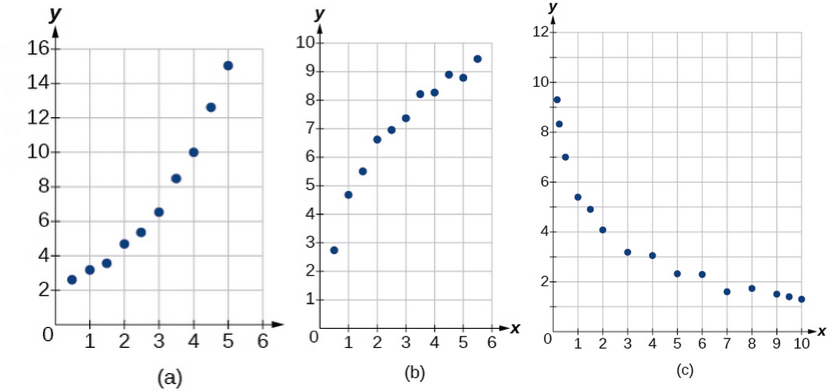
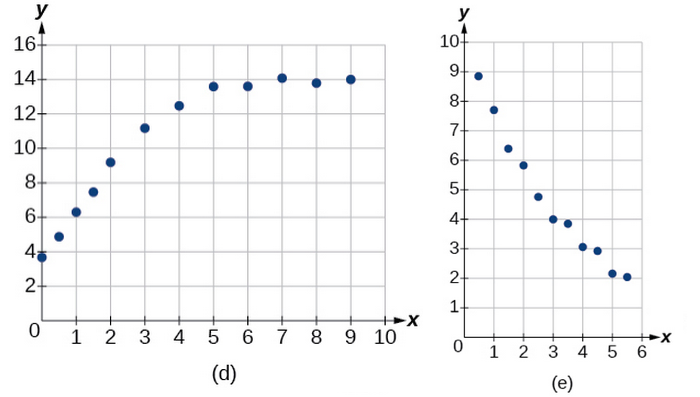
6. [latex]y=10.209{e}^{-0.294x}[/latex]
7. [latex]y=5.598 - 1.912\mathrm{ln}\left(x\right)[/latex]
8. [latex]y=2.104{\left(1.479\right)}^{x}[/latex]
9. [latex]y=4.607+2.733\mathrm{ln}\left(x\right)[/latex]
10. [latex]y=\frac{14.005}{1+2.79{e}^{-0.812x}}[/latex]
11. To the nearest whole number, what is the initial value of a population modeled by the logistic equation [latex]P\left(t\right)=\frac{175}{1+6.995{e}^{-0.68t}}[/latex]? What is the carrying capacity?
13. A logarithmic model is given by the equation [latex]h\left(p\right)=67.682 - 5.792\mathrm{ln}\left(p\right)[/latex]. To the nearest hundredth, for what value of p does [latex]h\left(p\right)=62[/latex]?
For the following exercises, use this scenario: The population P of a koi pond over x months is modeled by the function [latex]P\left(x\right)=\frac{68}{1+16{e}^{-0.28x}}[/latex].
16. Graph the population model to show the population over a span of 3 years.
17. What was the initial population of koi?
18. How many months will it take before there are 20 koi in the pond?
For the following exercises, use this scenario: The population P of an endangered species habitat for wolves is modeled by the function [latex]P\left(x\right)=\frac{558}{1+54.8{e}^{-0.462x}}[/latex], where x is given in years.
20. Graph the population model to show the population over a span of 10 years.
21. What was the initial population of wolves transported to the habitat?
23. How many years will it take before there are 100 wolves in the habitat?
For the following exercises, refer to the table below.
| x | f(x) |
| 1 | 1125 |
| 2 | 1495 |
| 3 | 2310 |
| 4 | 3294 |
| 5 | 4650 |
| 6 | 6361 |
25. Use a graphing calculator to create a scatter diagram of the data.
26. Use the regression feature to find an exponential function that best fits the data in the table.
For the following exercises, refer to the table below.
| x | f(x) |
| 1 | 555 |
| 2 | 383 |
| 3 | 307 |
| 4 | 210 |
| 5 | 158 |
| 6 | 122 |
30. Use a graphing calculator to create a scatter diagram of the data.
31. Use the regression feature to find an exponential function that best fits the data in the table.
For the following exercises, refer to the table below.
| x | f(x) |
| 1 | 5.1 |
| 2 | 6.3 |
| 3 | 7.3 |
| 4 | 7.7 |
| 5 | 8.1 |
| 6 | 8.6 |
35. Use a graphing calculator to create a scatter diagram of the data.
36. Use the logarithm option of the regression feature to find a logarithmic function of the form [latex]y=a+b\mathrm{ln}\left(x\right)[/latex] that best fits the data in the table.
37. Use the logarithmic function to find the value of the function when x = 10.
For the following exercises, refer to the table below.
| x | f(x) |
| 1 | 7.5 |
| 2 | 6 |
| 3 | 5.2 |
| 4 | 4.3 |
| 5 | 3.9 |
| 6 | 3.4 |
| 7 | 3.1 |
| 8 | 2.9 |
40. Use a graphing calculator to create a scatter diagram of the data.
41. Use the LOGarithm option of the REGression feature to find a logarithmic function of the form [latex]y=a+b\mathrm{ln}\left(x\right)[/latex] that best fits the data in the table.
For the following exercises, refer to the table below.
| x | f(x) |
| 1 | 8.7 |
| 2 | 12.3 |
| 3 | 15.4 |
| 4 | 18.5 |
| 5 | 20.7 |
| 6 | 22.5 |
| 7 | 23.3 |
| 8 | 24 |
| 9 | 24.6 |
| 10 | 24.8 |
45. Use a graphing calculator to create a scatter diagram of the data.
46. Use the LOGISTIC regression option to find a logistic growth model of the form [latex]y=\frac{c}{1+a{e}^{-bx}}[/latex] that best fits the data in the table.
For the following exercises, refer to the table below.
| x | f(x) |
| 0 | 12 |
| 2 | 28.6 |
| 4 | 52.8 |
| 5 | 70.3 |
| 7 | 99.9 |
| 8 | 112.5 |
| 10 | 125.8 |
| 11 | 127.9 |
| 15 | 135.1 |
| 17 | 135.9 |
50. Use a graphing calculator to create a scatter diagram of the data.
51. Use the LOGISTIC regression option to find a logistic growth model of the form [latex]y=\frac{c}{1+a{e}^{-bx}}[/latex] that best fits the data in the table.
53. To the nearest whole number, what is the predicted carrying capacity of the model?