Let’s turn our attention to finding the domain of a function whose equation is provided. Oftentimes, finding the domain of such functions involves remembering three different forms.
First, if the function has no denominator or an even root, consider whether the domain could be all real numbers.
Second, if there is a denominator in the function’s equation, exclude values in the domain that force the denominator to be zero.
Third, if there is an even root, consider excluding values that would make the radicand negative.
How To: Given a function written in equation form, find the domain.
Identify the input values.
Identify any restrictions on the input and exclude those values from the domain.
Write the domain in interval form, if possible.
Find the domain of the following function:
[latex]f\left(x\right)={x}^{2}-1[/latex]
The input value, shown by the variable [latex]x[/latex] in the equation, is squared and then the result is lowered by one. Any real number may be squared and then be lowered by one, so there are no restrictions on the domain of this function. The domain is the set of real numbers.In interval form the domain of [latex]f[/latex] is [latex]\left(-\infty ,\infty \right)[/latex].
While zero divided by any number equals zero, division by zero results in an undefined ratio.
An even root of a negative number does not exist in the real numbers.
[latex]\sqrt{-1} = i[/latex]
Since the domain of any function defined in the real plane is the set of all real input into the function, we must exclude any values of the input variable that create undefined expressions or even roots of a negative.
How To: Given a function written in an equation form that includes a fraction, find the domain.
Identify the input values.
Identify any restrictions on the input. If there is a denominator in the function’s formula, set the denominator equal to zero and solve for [latex]x[/latex] . These are the values that cannot be inputs in the function.
Write the domain in interval form, making sure to exclude any restricted values from the domain.
Find the domain of the following function:
[latex]f\left(x\right)=\dfrac{x+1}{2-x}[/latex]
When there is a denominator, we want to include only values of the input that do not force the denominator to be zero. So, we will set the denominator equal to [latex]0[/latex] and solve for [latex]x[/latex].
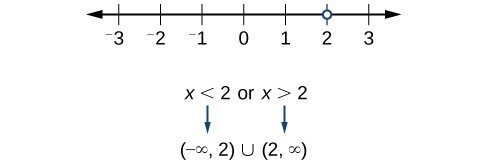
Now, we will exclude [latex]2[/latex] from the domain. The answers are all real numbers where [latex]x<2[/latex] or [latex]x>2[/latex]. We can use a symbol known as the union, [latex]\cup[/latex], to combine the two sets. In interval notation, we write the solution: [latex]\left(\mathrm{-\infty },2\right)\cup \left(2,\infty \right)[/latex].
In interval form, the domain of [latex]f[/latex] is [latex]\left(-\infty ,2\right)\cup \left(2,\infty \right)[/latex].
How To: Given a function written in equation form including an even root, find the domain.
Identify the input values.
Since there is an even root, exclude any real numbers that result in a negative number in the radicand. Set the radicand greater than or equal to zero and solve for [latex]x[/latex].
The solution(s) are the domain of the function. If possible, write the answer in interval form.
Find the domain of the following function:
[latex]f\left(x\right)=\sqrt{7-x}[/latex]
When there is an even root in the formula, we exclude any real numbers that result in a negative number in the radicand. Set the radicand greater than or equal to zero and solve for [latex]x[/latex].
Now, we will exclude any number greater than [latex]7[/latex] from the domain. The answers are all real numbers less than or equal to [latex]7[/latex], or [latex]\left(-\infty ,7\right][/latex].
Rational Functions with Even Roots
Find the domain of [latex]\frac{\sqrt{x-2}}{x+1}[/latex]
When there is an even root in the formula, we exclude any real numbers that result in a negative number in the radicand.
Set the radicand greater than or equal to zero and solve for [latex]x[/latex].
The domain restriction for the even root is [latex]x-2\geq 0[/latex] which is solved as [latex]x\geq 2[/latex].
When there is a denominator, we want to include only values of the input that do not force the denominator to be zero. So, we will set the denominator equal to [latex]0[/latex] and solve for [latex]x[/latex].
The domain restriction for the denominator is [latex]x+1 \neq 0[/latex] which gives us [latex]x\neq -1[/latex].
Since numbers greater than or equal to [latex]2[/latex] do not include [latex]-1[/latex] the domain of this function is [latex]x\geq 2[/latex] or [latex][2,\infty)[/latex] in interval notation.
To find the domain of a function with both an even root and a denominator:
Find the restriction for the root
Find the restriction for the denominator
Determine where the restrictions overlap and combine them
(a) Find the domain of [latex]\frac{1}{\sqrt{x^2 - 4}}[/latex]
Step 1: The square root tells us that [latex]x^2 - 4 \geq 0[/latex]. Which factors to [latex](x - 2)(x + 2) \geq 0[/latex] so [latex]x\geq 2[/latex] or [latex]x\leq 2[/latex]
Step 2: The domain restriction for the denominator is that [latex]x^2-4\neq 0[/latex] which factors to [latex](x-2)(x+2)\neq 0[/latex]. So [latex]x\neq 2[/latex] and [latex]x\neq -2[/latex].
Step 3: Combining the restrictions tells us that [latex]x>2[/latex] or [latex]x<-2[/latex] which is [latex](-\infty,-2)\cup (2,\infty)[/latex].
(b) Find the domain of [latex]\frac{\sqrt{x - 1}}{\sqrt{x^2 - 9}}[/latex]
The numerator contains a square root, so we require [latex]x - 1 \geq 0[/latex] which is solved as [latex]x \geq 1[/latex]
The denominator also contains a square root, but because it is in the denominator, it also can’t equal 0. Therefore we must have [latex]x^2 - 9 > 0[/latex]
Factor and solve: [latex](x - 3)(x + 3) > 0[/latex] This gives [latex]x < -3[/latex] or [latex]x > 3[/latex]
To satisfy both conditions, we take the overlap of the intervals [latex]x \geq 1[/latex] and [latex]x > 3[/latex], which is [latex]x > 3[/latex]
The domain of this function is [latex]x > 3[/latex], or [latex](3, \infty)[/latex] in interval notation