Finding Coterminal Angles
Converting between degrees and radians can make working with angles easier in some applications. For other applications, we may need another type of conversion. Negative angles and angles greater than a full revolution are more awkward to work with than those in the range of 0° to 360°, or 0 to [latex]2\pi[/latex]. It would be convenient to replace those out-of-range angles with a corresponding angle within the range of a single revolution.
It is possible for more than one angle to have the same terminal side. Look at Figure 16. The angle of 140° is a positive angle, measured counterclockwise. The angle of –220° is a negative angle, measured clockwise. But both angles have the same terminal side. If two angles in standard position have the same terminal side, they are coterminal angles. Every angle greater than 360° or less than 0° is coterminal with an angle between 0° and 360°, and it is often more convenient to find the coterminal angle within the range of 0° to 360° than to work with an angle that is outside that range.
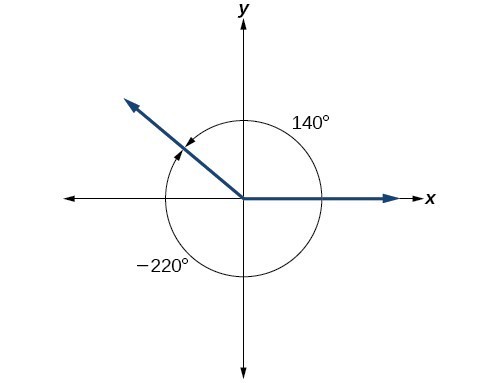
coterminal angles
Two angles in standard position have the same terminal side.
Any angle has infinitely many coterminal angles because each time we add 360° to that angle—or subtract 360° from it—the resulting value has a terminal side in the same location. For example, 100° and 460° are coterminal for this reason, as is −260°. Recognizing that any angle has infinitely many coterminal angles explains the repetitive shape in the graphs of trigonometric functions.
An angle’s reference angle is the measure of the smallest, positive, acute angle [latex]t[/latex] formed by the terminal side of the angle [latex]t[/latex] and the horizontal axis. Thus positive reference angles have terminal sides that lie in the first quadrant and can be used as models for angles in other quadrants.
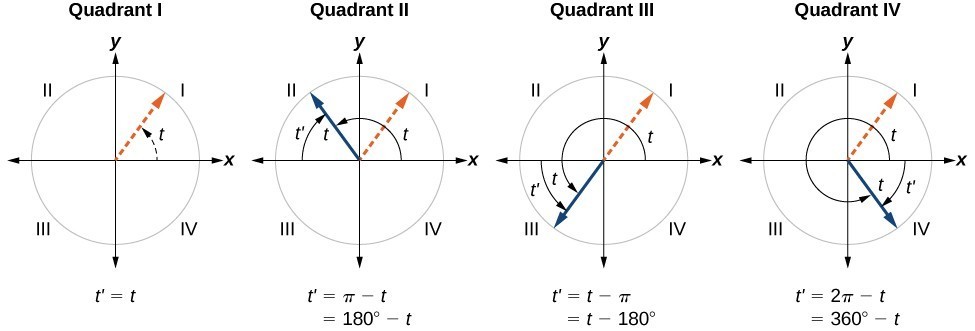
reference angles
An angle’s reference angle is the size of the smallest acute angle, [latex]{t}^{\prime }[/latex], formed by the terminal side of the angle [latex]t[/latex] and the horizontal axis.
- Subtract 360° from the given angle.
- If the result is still greater than 360°, subtract 360° again till the result is between 0° and 360°.
- The resulting angle is coterminal with the original angle.

Find an angle [latex]\alpha[/latex] that is coterminal with an angle measuring 870°, where [latex]0^\circ \le \alpha <360^\circ[/latex].
- Add 360° to the given angle.
- If the result is still less than 0°, add 360° again until the result is between 0° and 360°.
- The resulting angle is coterminal with the original angle.

- First find the coterminal angle between 0° and 360°
- Find the angle between the terminal side and the nearest [latex]x[/latex]-axis.
- For angles in the second quadrant: subtract the angle from 180°
- For angles in the third quadrant: subtract 180°
- For angles in the fourth quadrant: subtract the angle from 360
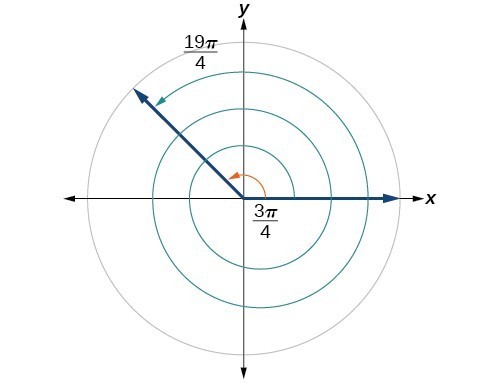
Finding Coterminal Angles Measured in Radians
- Subtract [latex]2\pi[/latex] from the given angle.
- If the result is still greater than [latex]2\pi[/latex], subtract [latex]2\pi[/latex] again until the result is between [latex]0[/latex] and [latex]2\pi[/latex].
- The resulting angle is coterminal with the original angle.