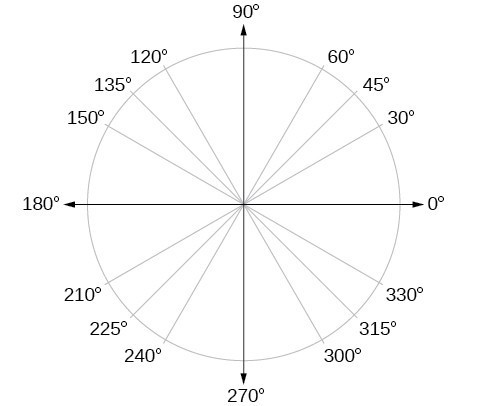
In addition to knowing the measurements in degrees and radians of a quarter revolution, a half revolution, and a full revolution, there are other frequently encountered angles in one revolution of a circle with which we should be familiar. It is common to encounter multiples of 30, 45, 60, and 90 degrees. Memorizing these angles will be very useful as we study the properties associated with angles.
Commonly encountered angles measured in degreesFind the equivalent radian measure for each degree.
Converting between Radians and Degrees
Because degrees and radians both measure angles, we need to be able to convert between them. We can easily do so using a proportion.
converting between radians and degrees
To convert between degrees and radians, use the proportion [latex]\dfrac{\theta }{180}=\frac{{\theta }^{R}}{\pi }[/latex]
radian [latex]\times \dfrac{180}{\pi}[/latex]
degree [latex]\times \dfrac{\pi}{180}[/latex]
Convert each radian measure to degrees.
a. [latex]\frac{\pi }{6}[/latex]
b. 3
Because we are given radians and we want degrees, we should set up a proportion and solve it.
a. We use the proportion, substituting the given information.
Convert [latex]-\frac{3\pi }{4}[/latex] radians to degrees.
−135°
Convert [latex]15[/latex] degrees to radians.
In this example, we start with degrees and want radians, so we again set up a proportion and solve it, but we substitute the given information into a different part of the proportion.
Another way to think about this problem is by remembering that [latex]{30}^{\circ }=\frac{\pi }{6}[/latex].
Because [latex]{15}^{\circ }=\frac{1}{2}\left({30}^{\circ }\right)[/latex], we can find that [latex]\frac{1}{2}\left(\frac{\pi }{6}\right)[/latex] is [latex]\frac{\pi }{12}[/latex].