Radians
Dividing a circle into 360 parts is an arbitrary choice, although it creates the familiar degree measurement. We may choose other ways to divide a circle.
The circumference of a circle is [latex]C=2\pi r[/latex]. If we divide both sides of this equation by [latex]r[/latex], we create the ratio of the circumference to the radius, which is always [latex]2\pi[/latex] regardless of the length of the radius.
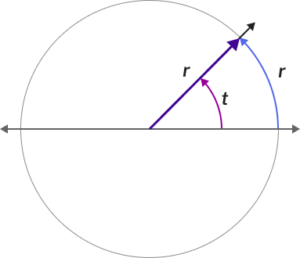
This brings us to our new angle measure. One radian is the measure of a central angle of a circle that intercepts an arc equal in length to the radius of that circle. A central angle is an angle formed at the center of a circle by two radii. Because the total circumference equals [latex]2\pi[/latex] times the radius, a full circular rotation is [latex]2\pi[/latex] radians. So
radian
One radian is the measure of the central angle of a circle such that the length of the arc between the initial side and the terminal side is equal to the radius of the circle. A full revolution (360°) equals [latex]2\pi[/latex] radians. A half revolution (180°) is equivalent to [latex]\pi[/latex] radians.
The radian measure of an angle is the ratio of the length of the arc subtended by the angle to the radius of the circle. In other words, if [latex]s[/latex] is the length of an arc of a circle, and [latex]r[/latex] is the radius of the circle, then the central angle containing that arc measures [latex]\frac{s}{r}[/latex] radians. In a circle of radius 1, the radian measure corresponds to the length of the arc.
Using Radians
Considering the most basic case, the unit circle (a circle with radius 1), we know that 1 rotation equals 360 degrees, 360°. We can also track one rotation around a circle by finding the circumference, [latex]C=2\pi r[/latex], and for the unit circle [latex]C=2\pi[/latex]. These two different ways to rotate around a circle give us a way to convert from degrees to radians.