- Draw angles in standard position.
- Convert between degrees and radians.
- Find coterminal angles.
Angles in Standard Position
The Main Idea
An angle in standard position has its vertex at the origin and its initial side lying along the positive x-axis. The direction of rotation determines the sign of the angle:
- counterclockwise rotations are positive
- clockwise rotations are negative
Understanding an angle in standard position is important because it provides a consistent way to classify angles, no matter their size or sign. By using standard position, you can easily determine which quadrant an angle’s terminal side lands in and connect angles to trigonometric values.
Quick Tips: Drawing Angles in Standard Position
- Start on the positive x-axis: Place the initial side along the positive x-axis, vertex at the origin.
- Choose the direction of rotation:
- Counterclockwise → positive angle
- Clockwise → negative angle
- Mark the rotation: Move the terminal side to the correct position according to the given measure.
- Identify the quadrant:
- Quandrant I: [latex]0^\circ - 90^\circ[/latex]
- Quandrant II: [latex]90^\circ - 180^\circ[/latex]
- Quandrant III: [latex]180^\circ - 270^\circ[/latex]
- Quandrant IV: [latex]270^\circ - 360^\circ[/latex]
- Extend beyond one rotation if needed: Angles greater than [latex]360^\circ[/latex] or less than [latex]0^\circ[/latex] wrap around, but still land on a terminal side in one of the four quadrants.

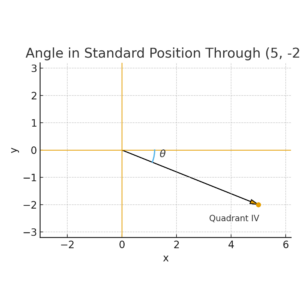
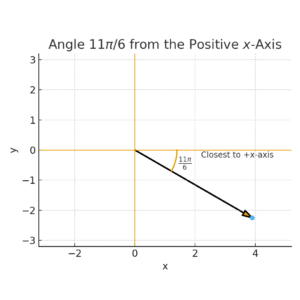
You can view the transcript for “How to Draw an Angle in Standard Position” here (opens in new window).
Converting Between Degrees and Radians
The Main Idea
Angles can be measured in degrees or radians, and being able to switch between the two is essential in precalculus and beyond. A full circle is [latex]360^\circ[/latex], which equals [latex]2\pi[/latex] radians. A key conversion relationship to remember is: [latex]180^\circ=\pi[/latex] radians. Degrees are more often seen in everyday use, while radians are the natural unit in higher mathematics because they link angle measure directly to arc length.
Quick Tips: Converting Between Degrees and Radians
- Memorize the core relationship: [latex]180^\circ=\pi[/latex] radians.
- Degrees → Radians: Multiply by [latex]\dfrac{\pi}{180}[/latex].
- Ex: [latex]60^\circ \cdot \dfrac{\pi}{180} = \dfrac{\pi}{3}[/latex].
- Radians → Degrees: Multiply by [latex]\dfrac{180}{\pi}[/latex].
- Ex: [latex]\dfrac{3\pi}{4} \cdot \dfrac{180}{\pi} = 135^\circ[/latex].
- Keep It Exact (Unless Told Otherwise):
- When converting to radians, leave your answer in terms of [latex]\pi[/latex] (for example, [latex]\pi/6[/latex] instead of 0.52).
- Know the “Common Angles”:
| Degrees | Radians |
| [latex]30^\circ[/latex] | [latex]\dfrac{\pi}{6}[/latex] |
| [latex]45^\circ[/latex] | [latex]\dfrac{\pi}{4}[/latex] |
| [latex]60^\circ[/latex] | [latex]\dfrac{\pi}{3}[/latex] |
| [latex]90^\circ[/latex] | [latex]\dfrac{\pi}{2}[/latex] |
These show up so often that it’s worth memorizing them.
Finding Coterminal Angles
The Main Idea
Coterminal angles are angles that end in the same place — they share the same terminal side when drawn in standard position. Even though they may look different on paper (like [latex]-45^\circ[/latex] and [latex]315^\circ[/latex]), they represent the same rotation direction in the coordinate plane. Since a full circle is [latex]360^\circ[/latex] or [latex]2\pi[/latex] radians, we can always find new coterminal angles by adding or subtracting one or more full rotations. This makes it easier to work with very large or negative angles, because we can “wrap” them back into a friendlier version.
Quick Tips: Finding Coterminal Angles
- The Rule:
- Degrees: [latex]\theta_{\text{cot}} = \theta \pm 360^\circ k[/latex]
- where [latex]k[/latex] is any integer
- Radians: [latex]\theta_{\text{cot}} = \theta \pm 2\pi k[/latex]
- where [latex]k[/latex] is any integer
- Degrees: [latex]\theta_{\text{cot}} = \theta \pm 360^\circ k[/latex]
- Positive and Negative Versions: Every angle has infinitely many coterminals. At least one positive and one negative.
- Shrink Big Angles: For large angles like [latex]1080^\circ[/latex], keep subtracting [latex]360^\circ[/latex] until you’re within [latex]0^\circ[/latex] to [latex]360^\circ[/latex] (or [latex]0[/latex] to [latex]2\pi[/latex] in radians).
- Use Coterminals to SImplify: When solving trig problems, replace a messy angle with a simple coterminal (like reducing [latex]-585^\circ[/latex] to [latex]135^\circ[/latex]).
- Think of a clock: On a clock, pointing at 3:00 is the same whether you went around once, twice, or even backwards. Coterminal angles work the same way; they all point to the same final direction.