- Draw angles in standard position.
- Convert between degrees and radians.
- Convert angles between decimal form and degree, minutes, and seconds form
- Find coterminal angles.
- Find complementary and supplementary angles
Drawing angles
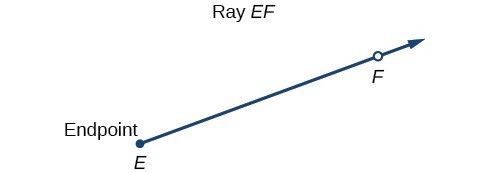
Properly defining an angle first requires that we define a ray. A ray consists of one point on a line and all points extending in one direction from that point. The first point is called the endpoint of the ray. We can refer to a specific ray by stating its endpoint and any other point on it. The ray shown can be named as ray EF, or in symbolic form [latex]\overrightarrow{EF}[/latex].
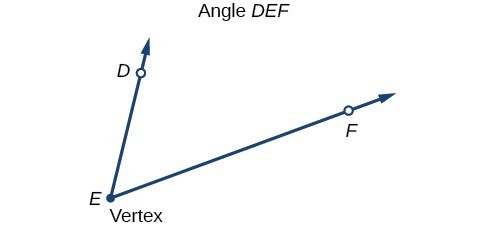
An angle is the union of two rays having a common endpoint. The endpoint is called the vertex of the angle, and the two rays are the sides of the angle. The angle in shown is formed from [latex]\overrightarrow{ED}[/latex] and [latex]\overrightarrow{EF}[/latex]. Angles can be named using a point on each ray and the vertex, such as angle [latex]{DEF}[/latex], or in symbol form [latex]\angle{DEF}[/latex].
angle
An angle is the union of two rays having a common endpoint. The endpoint is called the vertex of the angle, and the two rays are the sides of the angle.
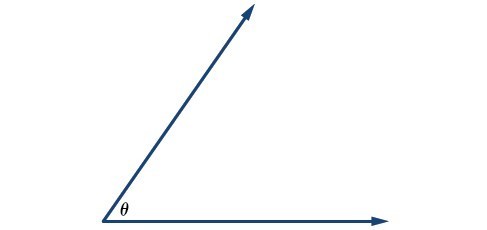
| [latex]\theta[/latex] | [latex]\phi \text{ or }\varphi[/latex] | [latex]\alpha[/latex] | [latex]\beta[/latex] | [latex]\gamma[/latex] |
| theta | phi | alpha | beta | gamma |
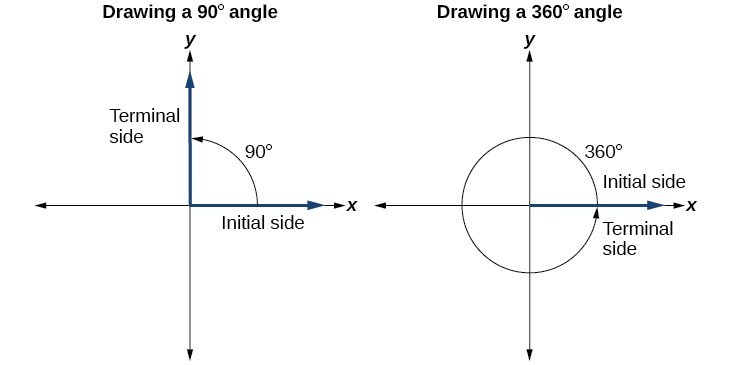
Angle creation is a dynamic process. We start with two rays lying on top of one another. We leave one fixed in place, and rotate the other. The fixed ray is the initial side, and the rotated ray is the terminal side. In order to identify the different sides, we indicate the rotation with a small arc and arrow close to the vertex.
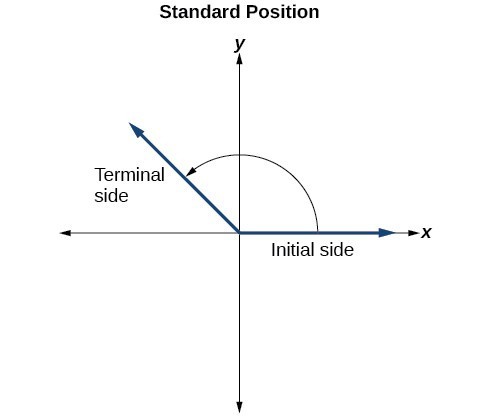
The measure of an angle is the amount of rotation from the initial side to the terminal side. Probably the most familiar unit of angle measurement is the degree. One degree is [latex]\frac{1}{360}[/latex] of a circular rotation, so a complete circular rotation contains 360 degrees. An angle measured in degrees should always include the unit “degrees” after the number, or include the degree symbol °. For example, 90 degrees = 90°.
angle measure
The angle measure is the amount of rotation from the initial side to the terminal side.
To formalize our work, we will begin by drawing angles on an x–y coordinate plane. Angles can occur in any position on the coordinate plane, but for the purpose of comparison, the convention is to illustrate them in the same position whenever possible. An angle is in standard position if its vertex is located at the origin, and its initial side extends along the positive x-axis.
If the angle is measured in a counterclockwise direction from the initial side to the terminal side, the angle is said to be a positive angle. If the angle is measured in a clockwise direction, the angle is said to be a negative angle.
Since we define an angle in standard position by its terminal side, we have a special type of angle whose terminal side lies on an axis, a quadrantal angle. This type of angle can have a measure of 0°, 90°, 180°, 270° or 360°.
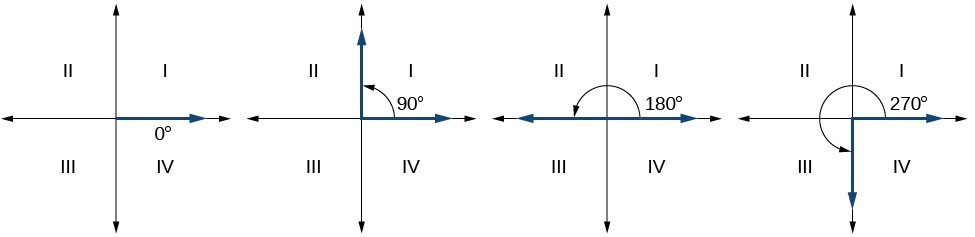
quadrantal angles
Quadrantal angles are angles whose terminal side lies on an axis, including 0°, 90°, 180°, 270°, or 360°.
quadrants
The coordinate plane is divided into four quadrants. Quadrant numbering begins at the positive x-axis and rotates counterclockwise.
- Determine which quadrant the angle belongs in:
- Quadrant 1: Angles between 0° and 90°
- Quadrant 2: Angles between 90° and 180°
- Quadrant 3: Angles between 180° and 270°
- Quadrant 4: Angles between 270° and 360°
- Draw an angle that lands proportionately within the desired quadrant.
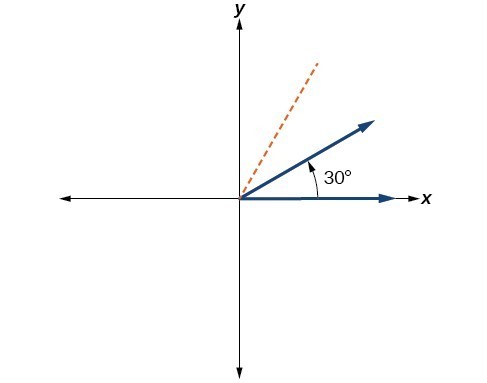

negative angles
A positive angle in standard position rotates counterclockwise from the positive x-axis. A negative angle in standard position rotates clockwise from the positive x-axis.