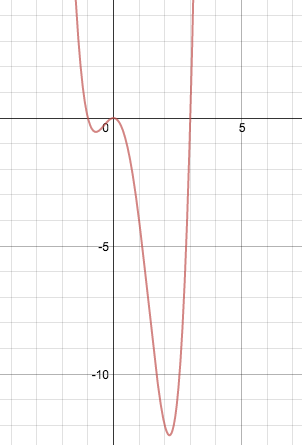
In our other examples, we were given polynomials that were already in factored form, here we have an additional step to finding the intervals on which solutions to the given inequality lie. Again, we will start by solving the equality [latex]{x}^{4} - 2{x}^{3} - 3{x}^{2} = 0[/latex]
Notice that there is a common factor of [latex]{x}^{2}[/latex] in each term of this polynomial. We can use factoring to simplify in the following way:
[latex]\begin{align}{x}^{4} - 2{x}^{3} - 3{x}^{2} &= 0&\\{x}^{2}\left({x}^{2} - 2{x} - 3\right) &= 0\\ {x}^{2}\left(x - 3\right)\left(x + 1 \right)&= 0\end{align}[/latex]
Now we can set each factor equal to zero to find the solution to the equality.
[latex]\begin{array}{ccc} {x}^{2} = 0 & \left(x - 3\right) = 0 &\left(x+1\right) = 0\\ {x} = 0 & x = 3 & x = -1\\ \end{array}[/latex].
Note that x = 0 has multiplicity of two, but since our inequality is strictly greater than, we don’t need to include it in our solutions.
We can choose a test value in each interval and evaluate the function
[latex]{x}^{4} - 2{x}^{3} - 3{x}^{2} = 0[/latex]
at each test value to determine if the function is positive or negative in that interval
| Interval |
Test x in interval |
> 0, < 0 |
| x < -1 |
-2 |
x > 0 |
| -1 < x < 0 |
-1/2 |
x < 0 |
| 0 < x < 3 |
1 |
x < 0 |
| x > 3 |
5 |
x > 0 |
We want to have the set of x values that will give us the intervals where the polynomial is greater than zero. Our answer will be [latex]\left(-\infty, -1\right]\cup\left[3,\infty\right)[/latex].
The graph of the function gives us additional confirmation of our solution.