Write the formula for a polynomial function given its graph.
Identifying Local Behavior of Polynomial Functions
In addition to the end behavior of polynomial functions, we are also interested in what happens in the “middle” of the function. In particular, we are interested in locations where graph behavior changes. A turning point is a point at which the function values change from increasing to decreasing or decreasing to increasing.
We are also interested in the intercepts. As with all functions, the [latex]y[/latex]-intercept is the point at which the graph intersects the vertical axis. The point corresponds to the coordinate pair in which the input value is zero. Because a polynomial is a function, only one output value corresponds to each input value so there can be only one [latex]y[/latex]-intercept [latex]\left(0,{a}_{0}\right)[/latex]. The [latex]x[/latex]–intercepts occur at the input values that correspond to an output value of zero. It is possible to have more than one [latex]x[/latex]–intercept.
Given the polynomial function [latex]f\left(x\right)=\left(x - 2\right)\left(x+1\right)\left(x - 4\right)[/latex], written in factored form for your convenience, determine the [latex]y[/latex] and [latex]x[/latex]-intercepts.
The y-intercept occurs when the input is zero, so substitute [latex]0[/latex] for [latex]x[/latex].
The [latex]x[/latex]-intercepts are [latex]\left(2,0\right),\left(-1,0\right)[/latex], and [latex]\left(4,0\right)[/latex].
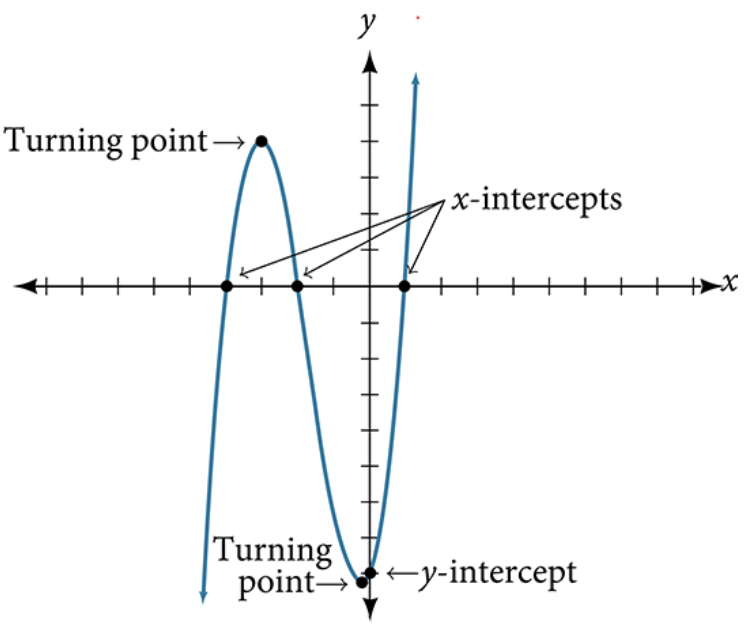
We can see these intercepts on the graph of the function shown below.
intercepts and turning points of polynomial functions
A turning point of a graph is a point where the graph changes from increasing to decreasing or decreasing to increasing.
The [latex]y[/latex]–intercept is the point where the function has an input value of zero.
The [latex]x[/latex]-intercepts are the points where the output value is zero.
A polynomial of degree [latex]n[/latex] will have, at most, [latex]n[/latex] [latex]x[/latex]-intercepts and [latex]n – 1[/latex] turning points.
Why do we use the phrase “at most [latex]n[/latex]” when describing the number of real roots (x-intercepts) of the graph of an [latex]n^{\text{th}}[/latex] degree polynomial? Can it have fewer?
Consider the graph of the polynomial function [latex]f(x)=x^2-x+1[/latex]. The function is a [latex]2^{\text{nd}}[/latex] degree polynomial, so it must have at most [latex]n[/latex] roots and [latex]n-1[/latex] turning points.
[latex]\\[/latex]
We know this function has non-real roots since the discriminant of the quadratic formula is negative. This means that this [latex]2^{\text{nd}}[/latex] polynomial has no real roots (apply the quadratic formula to prove this to yourself if needed). That is, it has no x-intercepts. But it does have two distinct complex roots.
[latex]\\[/latex]
Can you picture the graph of a quadratic function with one distinct real root? Two? But you can also see that there will never be more than two [latex]x[/latex]-intercepts. Since a parabola (the graph of a [latex]2^{\text{nd}}[/latex] degree polynomial) has only one turning point, it can’t cross the [latex]x[/latex]-axis more than twice.
Without graphing the function, determine the local behavior of the function by finding the maximum number of [latex]x[/latex]-intercepts and turning points for [latex]f\left(x\right)=-3{x}^{10}+4{x}^{7}-{x}^{4}+2{x}^{3}[/latex].
The polynomial has a degree of [latex]10[/latex], so there are at most [latex]10[/latex] [latex]x[/latex]-intercepts and at most [latex]10 – 1 = 9[/latex] turning points.
Now we can bring the two concepts of turning points and intercepts together to get a general picture of the behavior of polynomial functions. These types of analyses on polynomials developed before the advent of mass computing as a way to quickly understand the general behavior of a polynomial function. We now have a quick way, with computers, to graph and calculate important characteristics of polynomials that once took a lot of algebra.
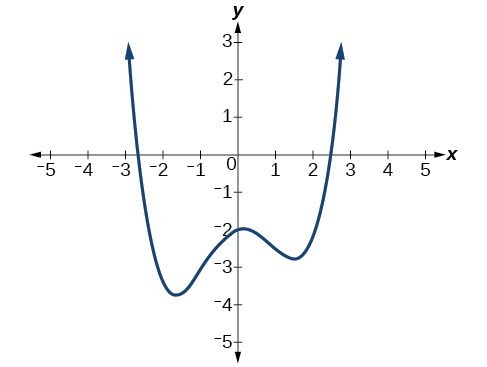
Given the graph of the polynomial function below, determine the least possible degree of the polynomial and whether it is even or odd. Use end behavior, the number of intercepts, and the number of turning points to help you.
The end behavior of the graph tells us this is the graph of an even-degree polynomial. The graph has [latex]2[/latex] [latex]x[/latex]-intercepts, suggesting a degree of [latex]2[/latex] or greater, and [latex]3[/latex] turning points, suggesting a degree of [latex]4[/latex] or greater. Based on this, it would be reasonable to conclude that the degree is even and at least [latex]4[/latex].
Now you try to determine the least possible degree of a polynomial given its graph.
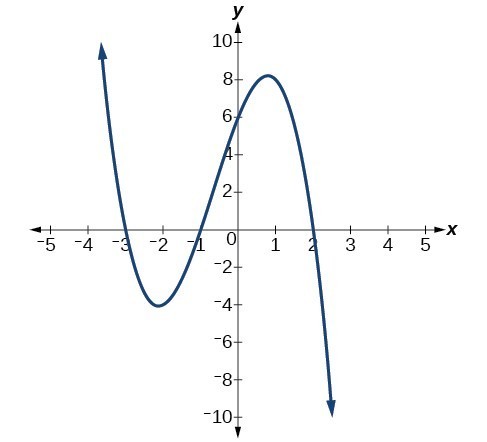
Given the graph of the polynomial function below, determine the least possible degree of the polynomial and whether it is even or odd. Use end behavior, the number of intercepts, and the number of turning points to help you.
The end behavior indicates an odd-degree polynomial function; there are [latex]3[/latex] [latex]x[/latex]-intercepts and [latex]2[/latex] turning points, so the degree is odd and at least [latex]3[/latex]. Because of the end behavior, we know that the leading coefficient must be negative.
Find the maximum number of turning points of each polynomial function.
 In addition to the end behavior of polynomial functions, we are also interested in what happens in the “middle” of the function. In particular, we are interested in locations where graph behavior changes. A turning point is a point at which the function values change from increasing to decreasing or decreasing to increasing.
 The end behavior of the graph tells us this is the graph of an even-degree polynomial. The graph has [latex]2[/latex] [latex]x[/latex]-intercepts, suggesting a degree of [latex]2[/latex] or greater, and [latex]3[/latex] turning points, suggesting a degree of [latex]4[/latex] or greater. Based on this, it would be reasonable to conclude that the degree is even and at least [latex]4[/latex].