Vertical and Horizontal Lines
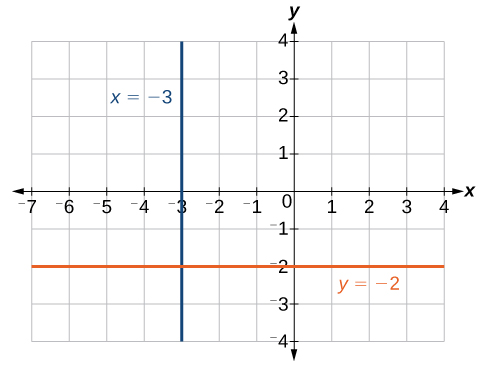
Most of the lines we have worked with so far have been slanted, or oblique. In other words, they were neither horizontal nor vertical lines. The equations of vertical and horizontal lines do not require any of the preceding formulas, although we can use the formulas to prove that the equations are correct. The equation of a vertical line is given as
where [latex]c[/latex] is a constant. The slope of a vertical line is undefined, and regardless of the [latex]y[/latex]–value of any point on the line, the [latex]x[/latex]–coordinate of the point will be [latex]c[/latex].
vertical line
The equation of a vertical line is given as
where [latex]c[/latex] is a constant. The slope of a vertical line is undefined, and regardless of the y-value of any point on the line, the x-coordinate of the point will be [latex]c[/latex].
The equation of a horizontal line is given as
where [latex]c[/latex] is a constant. The slope of a horizontal line is zero, and for any [latex]x[/latex]–value of a point on the line, the [latex]y[/latex]–coordinate will be [latex]c[/latex].
horizontal line
The equation of a horizontal line is given as
where [latex]c[/latex] is a constant. The slope of a horizontal line is zero, and for any x-value of a point on the line, the y-coordinate will be [latex]c[/latex].
- [latex]\left(-3,-5\right),\left(-3,1\right),\left(-3,3\right)[/latex], and [latex]\left(-3,5\right)[/latex].
- [latex]\left(-2,-2\right),\left(0,-2\right),\left(3,-2\right)[/latex], and [latex]\left(5,-2\right)[/latex].