- Identify key characteristics of parabolas from the graph.
- Understand how the graph of a parabola is related to its quadratic function
- Draw the graph of a quadratic function.
- Solve problems involving a quadratic function’s minimum or maximum value.
Quadratic functions are a fundamental concept in algebra that describe parabolic relationships. They are second-degree polynomial functions, meaning the highest power of the variable is [latex]2[/latex]. The graph of a quadratic function is modeled by a vertical (up or down opening) parabola. These functions have numerous real-world applications, from describing the path of a projectile to modeling revenue in economics.
Key Features of a Parabola’s Graph
The graph of a quadratic function is a U-shaped curve called a parabola. One important feature of the graph is that it has an extreme point, called the vertex. If the parabola opens up, the vertex represents the lowest point on the graph, or the minimum value of the quadratic function. If the parabola opens down, the vertex represents the highest point on the graph, or the maximum value. In either case, the vertex is a turning point on the graph. The graph is also symmetric with a vertical line drawn through the vertex, called the axis of symmetry.

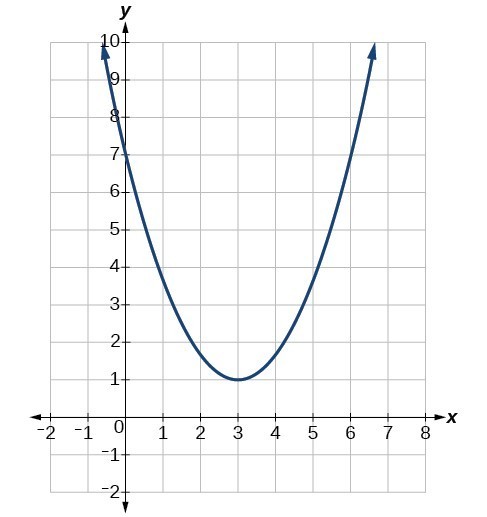
Finding the Domain and Range of a Quadratic Function
Any number can be the input value of a quadratic function. Therefore the domain of any quadratic function is all real numbers. Because parabolas have a maximum or a minimum at the vertex, the range is restricted. Since the vertex of a parabola will be either a maximum or a minimum, the range will consist of all [latex]y[/latex]-values greater than or equal to the [latex]y[/latex]-coordinate of the vertex or less than or equal to the [latex]y[/latex]-coordinate at the turning point, depending on whether the parabola opens up or down.
domain and range of a quadratic function
The domain of any quadratic function is all real numbers.
Determining the range of a quadratic formula is different depending on which form the quadratic function is in:
General Form
- The range of a quadratic function written in general form with a positive [latex]a[/latex] value is [latex]f\left(x\right)\ge f\left(-\frac{b}{2a}\right)[/latex], or [latex]\left[f\left(-\frac{b}{2a}\right),\infty \right)[/latex]
- The range of a quadratic function written in general form with a negative [latex]a[/latex] value is [latex]f\left(x\right)\le f\left(-\frac{b}{2a}\right)[/latex], or [latex]\left(-\infty ,f\left(-\frac{b}{2a}\right)\right][/latex].
Standard Form
- The range of a quadratic function written in standard form [latex]f\left(x\right)=a{\left(x-h\right)}^{2}+k[/latex] with a positive [latex]a[/latex] value is [latex]f\left(x\right)\ge k[/latex] or [latex][k,\infty)[/latex].
- The range of a quadratic function written in standard form with a negative [latex]a[/latex] value is [latex]f\left(x\right)\le k[/latex] or or [latex](-\infty,k][/latex].
- The domain of any quadratic function is all real numbers.
- Determine whether [latex]a[/latex] is positive or negative.
If [latex]a[/latex] is positive, the parabola has a minimum.
If [latex]a[/latex] is negative, the parabola has a maximum. - Determine the maximum or minimum value of the parabola, [latex]k[/latex].
If the parabola has a minimum, the range is given by [latex]f\left(x\right)\ge k[/latex], or [latex]\left[k,\infty \right)[/latex].
If the parabola has a maximum, the range is given by [latex]f\left(x\right)\le k[/latex], or [latex]\left(-\infty ,k\right][/latex].