- Express square roots of negative numbers as multiples of i.
- Plot complex numbers on the complex plane.
- Add, subtract, and multiply complex numbers.
- Rationalize complex denominators
The study of mathematics continuously builds upon itself. Negative integers, for example, fill a void left by the set of positive integers. The set of rational numbers, in turn, fills a void left by the set of integers. The set of real numbers fills a void left by the set of rational numbers. Not surprisingly, the set of real numbers has voids as well. For example, we still have no solution to equations such as
Our best guesses might be +2 or –2. But if we test +2 in this equation, it does not work. If we test –2, it does not work. If we want to have a solution for this equation, we will have to go farther than we have so far. After all, to this point we have described the square root of a negative number as undefined. Fortunately, there is another system of numbers that provides solutions to problems such as these. In this section, we will explore this number system and how to work within it.
Complex Numbers
We know how to find the square root of any positive real number. In a similar way we can find the square root of a negative number. The difference is that the root is not real. If the value in the radicand is negative, the root is said to be an imaginary number. The imaginary number [latex]i[/latex] is defined as the square root of negative 1.
[latex]\sqrt{-1}=i[/latex]
So, using properties of radicals,
[latex]{i}^{2}={\left(\sqrt{-1}\right)}^{2}=-1[/latex]
We can write the square root of any negative number as a multiple of [latex]i[/latex].
[latex]\begin{align}\sqrt{-25}&=\sqrt{25\cdot \left(-1\right)}\\&=\sqrt{25}\cdot\sqrt{-1}\\ &=5i\end{align}[/latex]
We use [latex]5i[/latex] and not [latex]-\text{5}i[/latex] because the principal root of [latex]25[/latex] is the positive root.
imaginary number
The imaginary number [latex]i[/latex] is defined to be [latex]i=\sqrt{-1}[/latex].
Any real multiple of [latex]i[/latex], like 5[latex]i[/latex], is also an imaginary number.
Example: [latex]\sqrt{9}=3[/latex] because [latex]3 \ast 3 = 9[/latex].
It is also true that [latex](-3)\ast (-3) = 9[/latex] although we agreed that using the radical symbol requests only the principle root, the positive one. But, there is no number that when multiplied by itself results in a negative number.
The property of integer multiplication states that both a negative number squared and a positive number squared result in a positive number. Indeed, you saw in the review section to this module that the square root of a negative number does not exist in the set of real numbers. Mathematicians realized the helpfulness of being to do calculations with such numbers though, so they assigned a value to [latex]\sqrt{-1}[/latex], calling it the imaginary unit [latex]i[/latex].
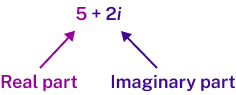
A complex number is the sum of a real number and an imaginary number. A complex number is expressed in standard form when written [latex]a+bi[/latex] where [latex]a[/latex] is the real part and [latex]bi[/latex] is the imaginary part.
complex number
A complex number is a number [latex]z = a + b i[/latex], where
- [latex]a[/latex] and [latex]b[/latex] are real numbers
- [latex]a[/latex] is the real part of the complex number
- [latex]b[/latex] is the imaginary part of the complex number