- Write the equation of a linear function given a point and a slope, two points, or a table of values.
- Graph linear functions given any form of its equation.
- Graph and write the equations of horizontal and vertical lines.
- Write the equation of a line parallel or perpendicular to a given line.
If we want to write the equation of a linear function there are three forms we can choose from:
different forms of a linear function
- Standard form: [latex]Ax+By=C[/latex]
- Slope-intercept form: [latex]y=mx+b[/latex] where
- [latex]m[/latex] is the slope, and
- [latex]b[/latex] is the [latex]y[/latex]-intercept
- Point-slope form: [latex]y-y_1=m(x-x_1)[/latex] where
- [latex]m[/latex] is the slope, and
- [latex](x_1,y_1)[/latex] is any point on the line.
Slope-Intercept Form
Perhaps the most familiar form of a linear equation is the slope-intercept form, written as [latex]y=mx+b[/latex], where [latex]m=\text{ slope }[/latex] and [latex]b=y-\text{intercept}[/latex].
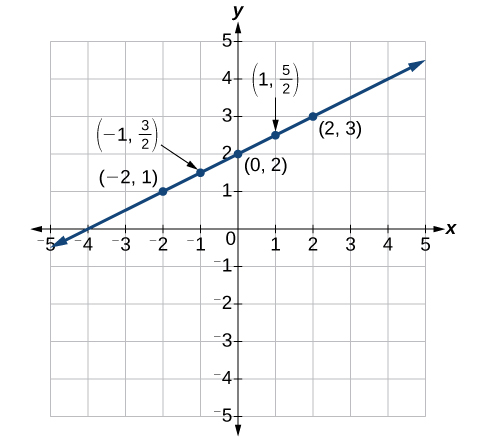
Step 1: Calculate the Slope ([latex]m[/latex])The slope of a line is calculated using the formula [latex]m=\frac{\text{rise}}{\text{run}} = \frac{{y}_{2}-{y}_{1}}{{x}_{2}-{x}_{1}}[/latex].
- Selecting two points from the graph: [latex](-2, 1)[/latex] and [latex](2, 3)[/latex].
- Using these points, we can calculate the slope:
[latex]m = \dfrac{y_2 - y_1}{x_2 - x_1} = \dfrac{3 - 1}{2 - (-2)} = \dfrac{2}{4} = \dfrac{1}{2}[/latex]
Step 2: Find the [latex]y[/latex]-intercept ([latex]b[/latex])
The [latex]y[/latex]-intercept is the value of [latex]y[/latex] when [latex]x=0[/latex]. From the graph, it is apparent that when [latex]x=0, y=2[/latex]. Therefore, [latex]b=2[/latex].
Step 3: Write the Equation
Now that we have the slope and [latex]y[/latex]-intercept, we can write the equation of the line:
[latex]y = \dfrac{1}{2}x+2[/latex]
slope-intercept form
The slope-intercept form of a line is written as:
[latex]y = mx+b[/latex]
where: