Graph functions using a combination of transformations.
Determine whether a function is even, odd, or neither from its graph.
Describe transformations based on a function formula.
Give the formula of a function based on its transformations.
(credit: “Misko”/Flickr)
We all know that a flat mirror enables us to see an accurate image of ourselves and whatever is behind us. When we tilt the mirror, the images we see may shift horizontally or vertically. But what happens when we bend a flexible mirror? Like a carnival funhouse mirror, it presents us with a distorted image of ourselves, stretched or compressed horizontally or vertically. In a similar way, we can distort or transform mathematical functions to better adapt them to describing objects or processes in the real world. In this section, we will take a look at several kinds of transformations.
Graphing Functions Using Reflections about the Axes
Another transformation that can be applied to a function is a reflection over the [latex]x[/latex]– or [latex]y[/latex]-axis. A vertical reflection reflects a graph vertically across the [latex]x[/latex]-axis, while a horizontal reflection reflects a graph horizontally across the [latex]y[/latex]-axis.
reflections
A vertical reflectionreflects a graph vertically across the [latex]x[/latex]-axis. This transformation changes the sign of the output values of [latex]f(x)[/latex].
If you reflect the graph of a function [latex]f(x)[/latex] over the [latex]x[/latex]-axis, the new function [latex]g(x)[/latex] is given by:
[latex]g(x) = -f(x)[/latex]
A horizontal reflectionreflects a graph horizontally across the [latex]y[/latex]-axis. This transformation changes the sign of the input values of [latex]f(x)[/latex].
If you reflect the graph of a function [latex]f(x)[/latex] over the [latex]y[/latex]-axis, the new function [latex]g(x)[/latex] is given by:
[latex]g(x) = f(-x)[/latex]
How To: Given a function, reflect the graph both vertically and horizontally.
Multiply all outputs by –1 for a vertical reflection. The new graph is a reflection of the original graph about the [latex]x[/latex]-axis.
Multiply all inputs by –1 for a horizontal reflection. The new graph is a reflection of the original graph about the [latex]y[/latex]-axis.
Reflect the graph of [latex]s\left(t\right)=\sqrt{t}[/latex]
vertically
horizontally
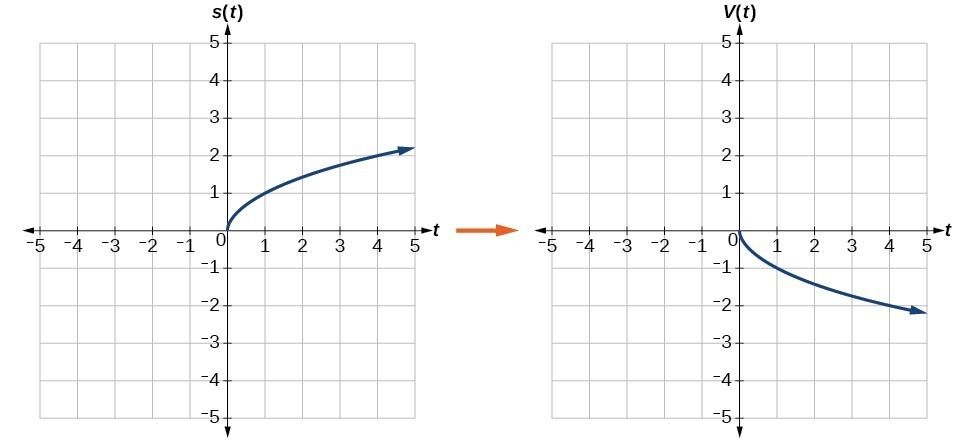
Reflecting the graph vertically means that each output value will be reflected over the horizontal [latex]t[/latex]–axis as shown below. Vertical reflection of the square root function
Table of values
[latex]t[/latex]
[latex]s(t) = \sqrt{t}[/latex]
Reflected Function [latex]V(t)[/latex]
[latex]0[/latex]
[latex]0[/latex]
[latex]0[/latex]
[latex]1[/latex]
[latex]1[/latex]
[latex]-1[/latex]
[latex]4[/latex]
[latex]2[/latex]
[latex]-2[/latex]
Because each output value is the opposite of the original output value, we can write
[latex]V\left(t\right)=-s\left(t\right)\text{ or }V\left(t\right)=-\sqrt{t}[/latex]
Notice that this is an outside change, or vertical shift, that affects the output [latex]s\left(t\right)[/latex] values, so the negative sign belongs outside of the function.
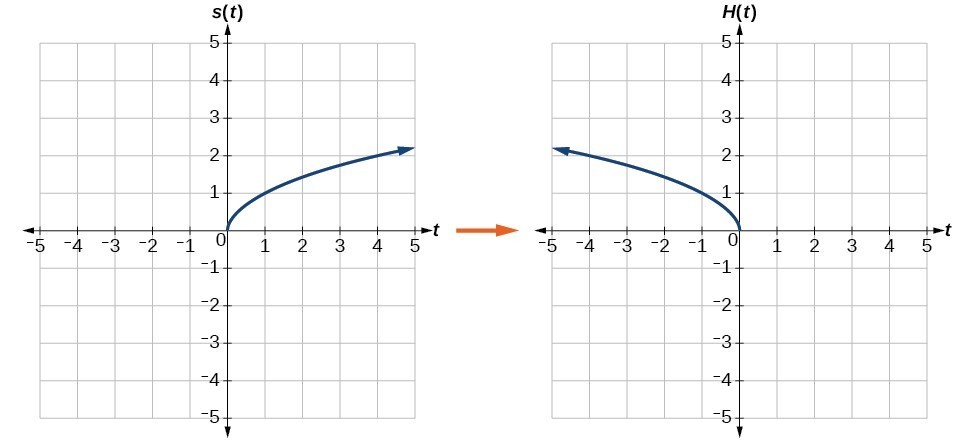
Reflecting horizontally means that each input value will be reflected over the vertical axis as shown below. Horizontal reflection of the square root function
Table for [latex]s(t) = \sqrt{t}[/latex]
[latex]t[/latex]
[latex]0[/latex]
[latex]1[/latex]
[latex]4[/latex]
[latex]s(t) = \sqrt{t}[/latex]
[latex]0[/latex]
[latex]1[/latex]
[latex]2[/latex]
Table for reflected function
[latex]t[/latex]
[latex]0[/latex]
[latex]-1[/latex]
[latex]-4[/latex]
[latex]H(t)[/latex]
[latex]0[/latex]
[latex]1[/latex]
[latex]2[/latex]
Because each input value is the opposite of the original input value, we can write
[latex]H\left(t\right)=s\left(-t\right)\text{ or }H\left(t\right)=\sqrt{-t}[/latex]
Notice that this is an inside change or horizontal change that affects the input values, so the negative sign is on the inside of the function.
Note that these transformations can affect the domain and range of the functions. While the original square root function has domain [latex]\left[0,\infty \right)[/latex] and range [latex]\left[0,\infty \right)[/latex], the vertical reflection gives the [latex]V\left(t\right)[/latex] function the range [latex]\left(-\infty ,0\right][/latex] and the horizontal reflection gives the [latex]H\left(t\right)[/latex] function the domain [latex]\left(-\infty ,0\right][/latex].
A function [latex]f\left(x\right)[/latex] is given. Create a table for the functions below.
[latex]g\left(x\right)=-f\left(x\right)[/latex]
[latex]h\left(x\right)=f\left(-x\right)[/latex]
[latex]x[/latex]
[latex]2[/latex]
[latex]4[/latex]
[latex]6[/latex]
[latex]8[/latex]
[latex]f\left(x\right)[/latex]
[latex]1[/latex]
[latex]3[/latex]
[latex]7[/latex]
[latex]11[/latex]
For [latex]g\left(x\right)[/latex], the negative sign outside the function indicates a vertical reflection, so the [latex]x[/latex]-values stay the same and each output value will be the opposite of the original output value.
[latex]x[/latex]
[latex]2[/latex]
[latex]4[/latex]
[latex]6[/latex]
[latex]8[/latex]
[latex]g\left(x\right)[/latex]
[latex]–1[/latex]
[latex]–3[/latex]
[latex]–7[/latex]
[latex]–11[/latex]
For [latex]h\left(x\right)[/latex], the negative sign inside the function indicates a horizontal reflection, so each input value will be the opposite of the original input value and the [latex]h\left(x\right)[/latex] values stay the same as the [latex]f\left(x\right)[/latex] values.