- Understand what a function is and use the vertical line test to check if a graph shows a function
- Use function notation [latex]f(x)[/latex] and evaluate functions
- Recognize the graphs of common functions
Determining Whether a Relation is a Function
A jetliner changes altitude as its distance from the starting point of a flight increases. The weight of a growing child increases with time. In each case, one quantity depends on another. There is a relationship between the two quantities that we can describe, analyze, and use to make predictions. In this section, we will analyze such relationships.
A relation is a set of ordered pairs. The set of the first components of each ordered pair is called the domain and the set of the second components of each ordered pair is called the range. Note that each value in the domain is also known as an input value, or independent variable, and is often labeled with the lowercase letter [latex]x[/latex]. Each value in the range is also known as an output value, or dependent variable, and is often labeled with lowercase letter [latex]y[/latex].
relation, domain, and range
A relation is defined as a set of ordered pairs, where the set of first components is known as the domain and each value in it is an input or independent variable, often labeled [latex]x[/latex]. The set of second components in the ordered pairs is called the range, and each value in the range is an output or dependent variable, often labeled [latex]y[/latex].
Determining Whether a Relation Represents a Function
Consider the following set of ordered pairs.
The domain is [latex]\left\{1,2,3,4,5\right\}[/latex]. The range is [latex]\left\{2,4,6,8,10\right\}[/latex].
Note that each value in the domain is also known as an input value. The input values are values of the independent variable which often labeled with the lowercase letter [latex]x[/latex]. Each value in the range is also known as an output value. The output values are values of the dependent variable which is often labeled lowercase letter [latex]y[/latex].
A function [latex]f[/latex] is a relation that assigns a single value in the range to each value in the domain. In other words no [latex]x[/latex]-values are repeated.
function
A function is a specific type of relation where each input value corresponds to one and only one output value. We say “the output is a function of the input.”
In a function:
- The input values make up the domain
- The output values make up the range.
- The input value is called the independent value.
- The output value is called the dependent value because it depends on the input value.
Now let’s consider the set of ordered pairs that relates the terms “even” and “odd” to the first five natural numbers. It would appear as
Notice that each element in the domain, [latex]\left\{\text{even,}\text{odd}\right\}[/latex] is not paired with exactly one element in the range, [latex]\left\{1,2,3,4,5\right\}[/latex]. For example, the term “odd” corresponds to three values from the domain, [latex]\left\{1,3,5\right\}[/latex] and the term “even” corresponds to two values from the range, [latex]\left\{2,4\right\}[/latex]. This violates the definition of a function, so this relation is not a function.
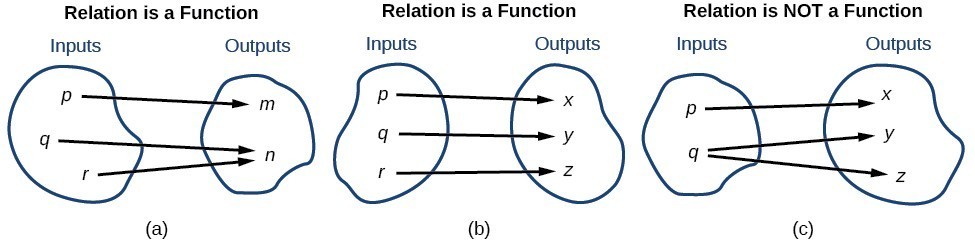
The figure below compares relations that are functions and not functions.
The coffee shop menu consists of items and their prices.
- Is price a function of the item?
- Is the item a function of the price?


| Percent Grade | 0–56 | 57–61 | 62–66 | 67–71 | 72–77 | 78–86 | 87–91 | 92–100 |
|---|---|---|---|---|---|---|---|---|
| Grade Point Average | 0.0 | 1.0 | 1.5 | 2.0 | 2.5 | 3.0 | 3.5 | 4.0 |