- Divide polynomials using long division
Polynomial Long Division
We can write a polynomial dividend as the product of the divisor and the quotient added to the remainder. The terms of the polynomial division correspond to the digits (and place values) of the whole number division. This method allows us to divide two polynomials.

We have found
[latex]\frac{2{x}^{3}-3{x}^{2}+4x+5}{x+2}=2{x}^{2}-7x+18-\frac{31}{x+2}[/latex]
or
[latex]2{x}^{3}-3{x}^{2}+4x+5=\left(x+2\right)\left(2{x}^{2}-7x+18\right)-31[/latex]
We can identify the dividend, divisor, quotient, and remainder.
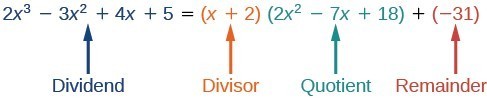
Writing the result in this manner illustrates the Division Algorithm.
- Set up the division problem.
- Determine the first term of the quotient by dividing the leading term of the dividend by the leading term of the divisor.
- Multiply the answer by the divisor and write it below the like terms of the dividend.
- Subtract the bottom binomial from the terms above it.
- Bring down the next term of the dividend.
- Repeat steps 2–5 until reaching the last term of the dividend.
- If the remainder is non-zero, express as a fraction using the divisor as the denominator.
