- Evaluate exponential functions.
- Find the equation of an exponential function.
- Use compound interest formulas.
Applications of Exponential Functions
Exponential functions are incredibly powerful tools in mathematics, and they have a wide range of applications in the real world. Whether you’re looking at population growth, radioactive decay, or even finance, exponential functions help us model situations where change happens at a constant multiplicative rate.
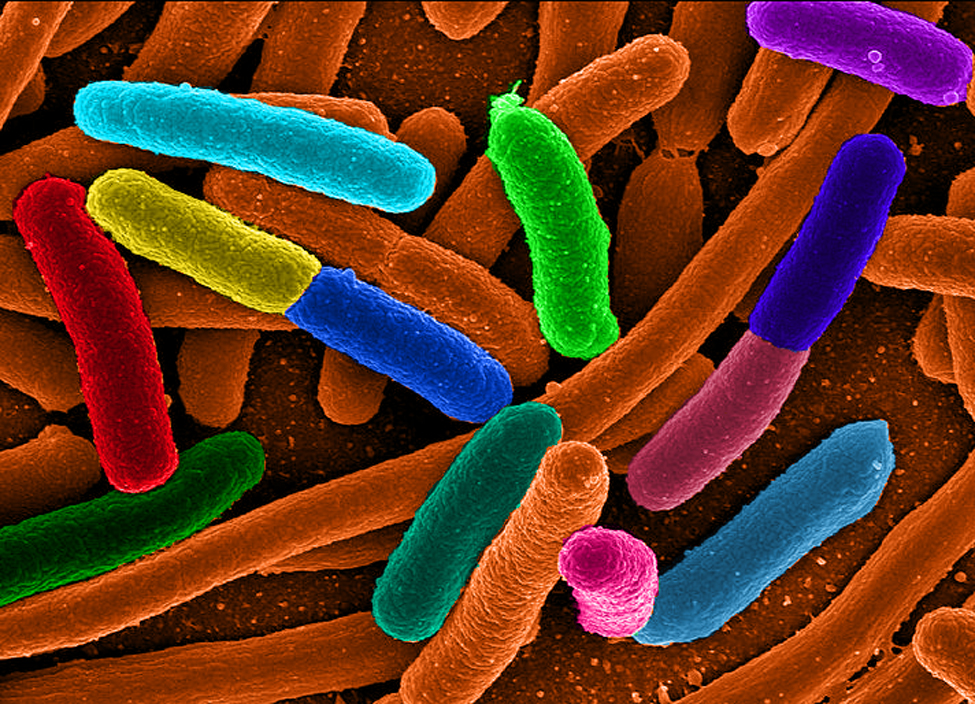
Bacteria commonly reproduce through a process called binary fission during which one bacterial cell splits into two. When conditions are right, bacteria can reproduce very quickly. Unlike humans and other complex organisms, the time required to form a new generation of bacteria is often a matter of minutes or hours as opposed to days or years.[1]
For simplicity’s sake, suppose we begin with a culture of one bacterial cell that can divide every hour. The table below shows the number of bacterial cells at the end of each subsequent hour. We see that the single bacterial cell leads to over one thousand bacterial cells in just ten hours! If we were to extrapolate the table to twenty-four hours, we would have over [latex]16[/latex] million!
| Hour | [latex]0[/latex] | [latex]1[/latex] | [latex]2[/latex] | [latex]3[/latex] | [latex]4[/latex] | [latex]5[/latex] | [latex]6[/latex] | [latex]7[/latex] | [latex]8[/latex] | [latex]9[/latex] | [latex]10[/latex] |
| Bacteria | [latex]1[/latex] | [latex]2[/latex] | [latex]4[/latex] | [latex]8[/latex] | [latex]16[/latex] | [latex]32[/latex] | [latex]64[/latex] | [latex]128[/latex] | [latex]256[/latex] | [latex]512[/latex] | [latex]1024[/latex] |
[latex]\text{ }f\left(x\right)=a{b}^{x}[/latex]
where
- [latex]a[/latex] is the initial or starting value of the function.
- [latex]b[/latex] is the growth factor or growth multiplier per unit [latex]x[/latex].
- Todar, PhD, Kenneth. Todar's Online Textbook of Bacteriology. http://textbookofbacteriology.net/growth_3.html. ↵