- Find the average rate of change
- Use a graph to see where a function is going up, going down, or staying flat
- Use a graph to identify the highest and lowest points
Climate Research Station
A climate station recorded atmospheric CO₂ levels over a 10-year period:
| Year | 2014 | 2016 | 2018 | 2020 | 2022 | 2024 |
|---|---|---|---|---|---|---|
| CO₂ (ppm) | 398.7 | 404.2 | 408.5 | 414.1 | 421.0 | 424.3 |
But what was the rate of change in 2014? In calculus, we’ll learn to extend the average rate of change and find the instantaneous rate of change at any specific moment using derivatives, giving us more precise information than these averages.
The NOAA Mauna Loa Observatory (MLO) is a key atmospheric research facility that monitors and collects long-term data on atmospheric composition and climate change. It’s known for its continuous measurements of rising carbon dioxide (CO2) concentrations, ozone, and other atmospheric constituents. The data collected at MLO helps scientists understand the impacts of human activities on the atmosphere and climate.
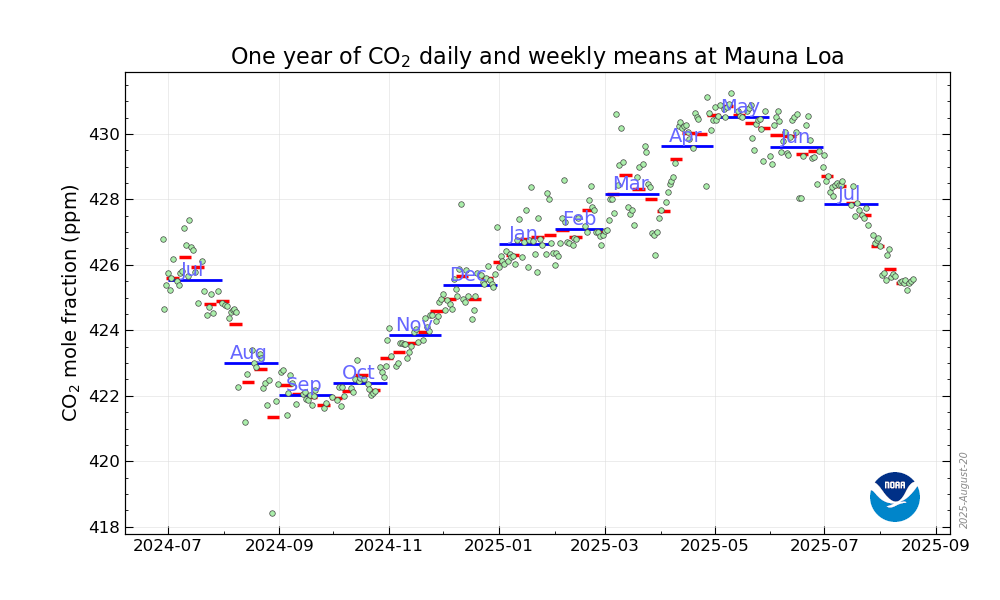
Your station models the annual CO₂ cycle with: [latex]C(d) = 426 + 3.85sin(\frac{2π}{365}(d-105))[/latex] where d = day of year.
This function captures how CO₂ levels fluctuate seasonally – rising in winter when plants are dormant and falling in summer when photosynthesis is most active.