Finding Points Where a Function’s Derivative Does Not Exist
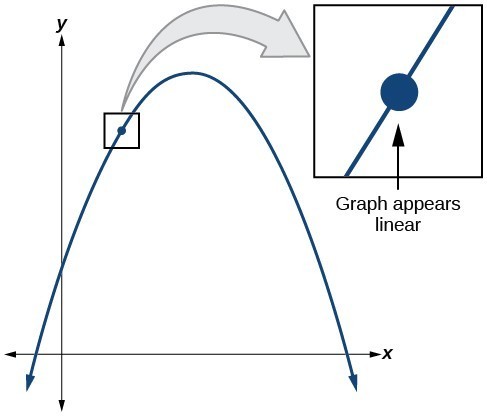
To understand where a function’s derivative does not exist, we need to recall what normally happens when a function [latex]f\left(x\right)[/latex] has a derivative at [latex]x=a[/latex] . Suppose we use a graphing utility to zoom in on [latex]x=a[/latex] . If the function [latex]f\left(x\right)[/latex] is differentiable, that is, if it is a function that can be differentiated, then the closer one zooms in, the more closely the graph approaches a straight line. This characteristic is called linearity.
Look at the graph. The closer we zoom in on the point, the more linear the curve appears.
We might presume the same thing would happen with any continuous function, but that is not so. The function [latex]f\left(x\right)=|x|[/latex], for example, is continuous at [latex]x=0[/latex], but not differentiable at [latex]x=0[/latex]. As we zoom in close to 0, the graph does not approach a straight line. No matter how close we zoom in, the graph maintains its sharp corner.
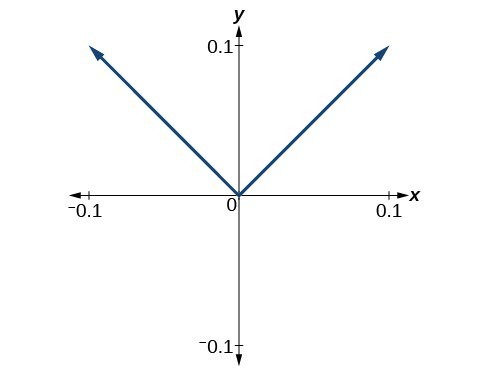
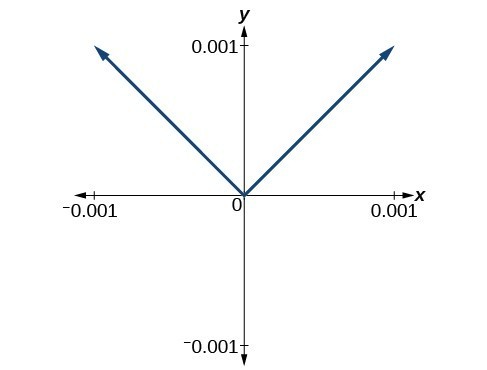
We zoom in closer by narrowing the range and continue to observe the same shape. This graph does not appear linear at [latex]x=0[/latex].
What are the characteristics of a graph that is not differentiable at a point? Here are some examples in which function [latex]f\left(x\right)[/latex] is not differentiable at [latex]x=a[/latex].
We see the graph of
[latex]f\left(x\right)=\begin{cases}x^{2}, \hfill& x\leq 2 \\ 8-x, \hfill& x>2\end{cases}[/latex].
Notice that, as [latex]x[/latex] approaches 2 from the left, the left-hand limit may be observed to be 4, while as [latex]x[/latex] approaches 2 from the right, the right-hand limit may be observed to be 6. We see that it has a discontinuity at [latex]x=2[/latex].
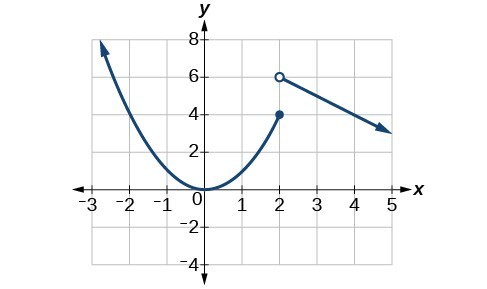
The graph of [latex]f\left(x\right)[/latex] has a discontinuity at [latex]x=2[/latex].
We see the graph of [latex]f\left(x\right)=|x|[/latex]. We see that the graph has a corner point at [latex]x=0[/latex].
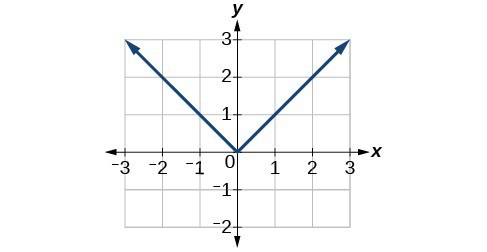
The graph of [latex]f\left(x\right)=|x|[/latex] has a corner point at [latex]x=0[/latex] .
We see that the graph of [latex]f\left(x\right)={x}^{\frac{2}{3}}[/latex] has a cusp at [latex]x=0[/latex]. A cusp has a unique feature. Moving away from the cusp, both the left-hand and right-hand limits approach either infinity or negative infinity. Notice the tangent lines as [latex]x[/latex] approaches 0 from both the left and the right appear to get increasingly steeper, but one has a negative slope, the other has a positive slope.
![Graph of f(x) = x^(2/3) with a viewing window of [-3, 3] by [-2, 3].](https://s3-us-west-2.amazonaws.com/courses-images/wp-content/uploads/sites/3675/2018/09/27185422/CNX_Precalc_Figure_12_04_0132.jpg)
We see that the graph of [latex]f\left(x\right)={x}^{\frac{1}{3}}[/latex] has a vertical tangent at [latex]x=0[/latex]. Recall that vertical tangents are vertical lines, so where a vertical tangent exists, the slope of the line is undefined. This is why the derivative, which measures the slope, does not exist there.
![Graph of f(x) = x^(1/3) with a viewing window of [-3, 3] by [-3, 3].](https://s3-us-west-2.amazonaws.com/courses-images/wp-content/uploads/sites/3675/2018/09/27185424/CNX_Precalc_Figure_12_04_0142.jpg)
differentiability
A function [latex]f\left(x\right)[/latex] is differentiable at [latex]x=a[/latex] if the derivative exists at [latex]x=a[/latex], which means that [latex]\begin{align}{f}^{\prime }\left(a\right)\end{align}[/latex] exists.
There are four cases for which a function [latex]f\left(x\right)[/latex] is not differentiable at a point [latex]x=a[/latex].
- When there is a discontinuity at [latex]x=a[/latex].
- When there is a corner point at [latex]x=a[/latex].
- When there is a cusp at [latex]x=a[/latex].
- Any other time when there is a vertical tangent at [latex]x=a[/latex].
- continuous
- discontinuous
- differentiable
- not differentiable
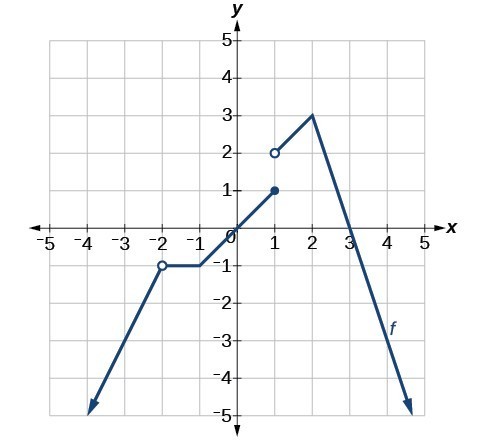
At the points where the graph is discontinuous or not differentiable, state why.