Identifying Discontinuities
Discontinuity can occur in different ways. We saw in the previous section that a function could have a left-hand limit and a right-hand limit even if they are not equal. If the left- and right-hand limits exist but are different, the graph “jumps” at [latex]x=a[/latex] . The function is said to have a jump discontinuity.
As an example, look at the graph of the function [latex]y=f\left(x\right)[/latex]. Notice as [latex]x[/latex] approaches [latex]a[/latex] how the output approaches different values from the left and from the right.
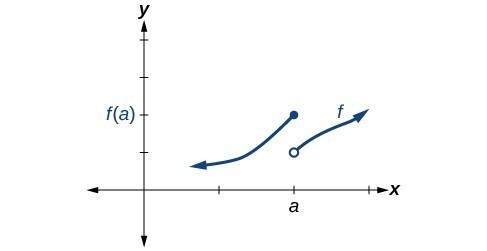
jump discontinuity
A function [latex]f\left(x\right)[/latex] has a jump discontinuity at [latex]x=a[/latex] if the left- and right-hand limits both exist but are not equal: [latex]\underset{x\to {a}^{-}}{\mathrm{lim}}f\left(x\right)\ne \underset{x\to {a}^{+}}{\mathrm{lim}}f\left(x\right)[/latex] .
Identifying Removable Discontinuity
Some functions have a discontinuity, but it is possible to redefine the function at that point to make it continuous. This type of function is said to have a removable discontinuity. Let’s look at the function [latex]y=f\left(x\right)[/latex] represented by the graph below. The function has a limit. However, there is a hole at [latex]x=a[/latex] . The hole can be filled by extending the domain to include the input [latex]x=a[/latex] and defining the corresponding output of the function at that value as the limit of the function at [latex]x=a[/latex] .
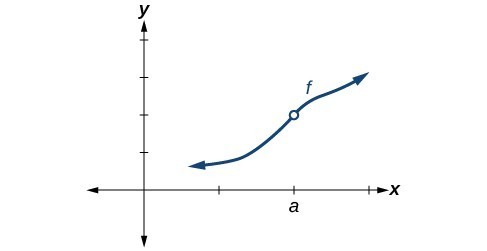
removable discontinuity
A function [latex]f\left(x\right)[/latex] has a removable discontinuity at [latex]x=a[/latex] if the limit, [latex]\underset{x\to a}{\mathrm{lim}}f\left(x\right)[/latex], exists, but either
- [latex]f\left(a\right)[/latex] does not exist or
- [latex]f\left(a\right)[/latex], the value of the function at [latex]x=a[/latex] does not equal the limit, [latex]f\left(a\right)\ne \underset{x\to a}{\mathrm{lim}}f\left(x\right)[/latex].
- [latex]f\left(x\right)=\frac{{x}^{2}-2x - 15}{x - 5}[/latex]
- [latex]g\left(x\right)=\begin{cases}x+1, \hfill& x<2 \\ -x, \hfill& x\geq2\end{cases}[/latex]