- Find the derivative of a function.
- Find instantaneous rates of change.
- Find an equation of the tangent line to the graph of a function at a point.
Finding the Average Rate of Change of a Function
The functions describing the examples above involve a change over time. Change divided by time is one example of a rate. The rates of change in the previous examples are each different. In other words, some changed faster than others. If we were to graph the functions, we could compare the rates by determining the slopes of the graphs.
A tangent line to a curve is a line that intersects the curve at only a single point but does not cross it there. (The tangent line may intersect the curve at another point away from the point of interest.) If we zoom in on a curve at that point, the curve appears linear, and the slope of the curve at that point is close to the slope of the tangent line at that point.
Consider the graph of the function [latex]f\left(x\right)={x}^{3}-4x[/latex]. We can see the slope at various points along the curve.
- slope at [latex]x=-2[/latex] is 8
- slope at [latex]x=-1[/latex] is –1
- slope at [latex]x=2[/latex] is 8
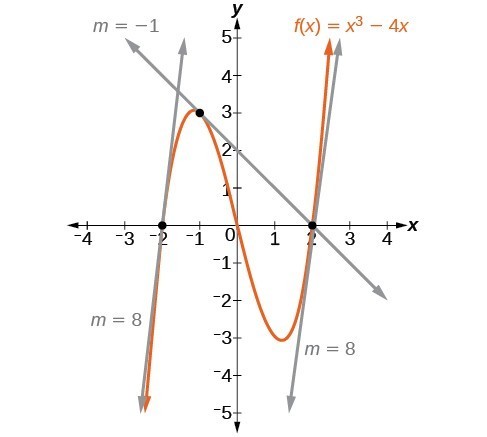
Graph showing tangents to curve at –2, –1, and 2.
Let’s imagine a point on the curve of function [latex]f[/latex] at [latex]x=a[/latex]. The coordinates of the point are [latex]\left(a,f\left(a\right)\right)[/latex]. Connect this point with a second point on the curve a little to the right of [latex]x=a[/latex], with an x-value increased by some small real number [latex]h[/latex]. The coordinates of this second point are [latex]\left(a+h,f\left(a+h\right)\right)[/latex] for some positive-value [latex]h[/latex].
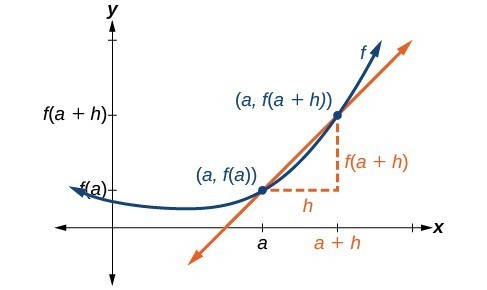
We can calculate the slope of the line connecting the two points [latex]\left(a,f\left(a\right)\right)[/latex] and [latex]\left(a+h,f\left(a+h\right)\right)[/latex], called a secant line, by applying the slope formula,
[latex]\text{slope = }\frac{\text{change in }y}{\text{change in }x}[/latex]
We use the notation [latex]{m}_{\sec }[/latex] to represent the slope of the secant line connecting two points.
The slope [latex]{m}_{\sec }[/latex] equals the average rate of change between two points [latex]\left(a,f\left(a\right)\right)[/latex] and [latex]\left(a+h,f\left(a+h\right)\right)[/latex].
average rate of change
The average rate of change (AROC) between two points [latex]\left(a,f\left(a\right)\right)[/latex] and [latex]\left(a+h,f\left(a+h\right)\right)[/latex] on the curve of [latex]f[/latex] is the slope of the line connecting the two points and is given by
[latex]\text{AROC}=\frac{f\left(a+h\right)-f\left(a\right)}{h}[/latex]
Understanding the Instantaneous Rate of Change
When calculating average rate of change we find the change between two points on the curve of a function. Suppose we make the distance between the two points closer together. As the second point approaches the first point, the connecting line between the two points, called the secant line, will get closer and closer to being a tangent to the function at [latex]x=a[/latex], and the slope of the secant line will get closer and closer to the slope of the tangent at [latex]x=a[/latex].
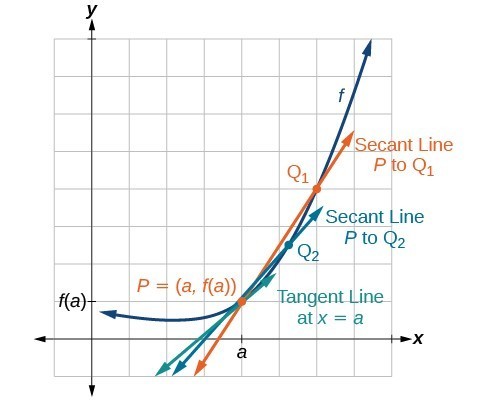
The connecting line between two points moves closer to being a tangent line at [latex]x=a[/latex].
Because we are looking for the slope of the tangent at [latex]x=a[/latex], we can think of the measure of the slope of the curve of a function [latex]f[/latex] at a given point as the rate of change at a particular instant. We call this slope the instantaneous rate of change, or the derivative of the function at [latex]x=a[/latex]. Both can be found by finding the limit of the slope of a line connecting the point at [latex]x=a[/latex] with a second point infinitesimally close along the curve. For a function [latex]f[/latex] both the instantaneous rate of change of the function and the derivative of the function at [latex]x=a[/latex] are written as [latex]f\text{'}\left(a\right)[/latex], and we can define them as a two-sided limit that has the same value whether approached from the left or the right.
The expression by which the limit is found is known as the difference quotient.
derivative
The derivative, or instantaneous rate of change, of a function [latex]f[/latex] at [latex]x=a[/latex], is given by
[latex]{f}^{\prime }\left(a\right)=\underset{h\to 0}{\mathrm{lim}}\dfrac{f\left(a+h\right)-f\left(a\right)}{h}[/latex]
The expression [latex]\frac{f\left(a+h\right)-f\left(a\right)}{h}[/latex] is called the difference quotient.
We use the difference quotient to evaluate the limit of the rate of change of the function as [latex]h[/latex] approaches 0.
The derivative of a function can be interpreted in different ways. It can be observed as the behavior of a graph of the function or calculated as a numerical rate of change of the function.
- The derivative of a function [latex]f\left(x\right)[/latex] at a point [latex]x=a[/latex] is the slope of the tangent line to the curve [latex]f\left(x\right)[/latex] at [latex]x=a[/latex]. The derivative of [latex]f\left(x\right)[/latex] at [latex]x=a[/latex] is written [latex]\begin{align}{f}^{\prime }\left(a\right)\end{align}[/latex].
- The derivative [latex]\begin{align}{f}^{\prime }\left(a\right)\end{align}[/latex] measures how the curve changes at the point [latex]\left(a,f\left(a\right)\right)[/latex].
- The derivative [latex]\begin{align}{f}^{\prime }\left(a\right)\end{align}[/latex] may be thought of as the instantaneous rate of change of the function [latex]f\left(x\right)[/latex] at [latex]x=a[/latex].
- If a function measures distance as a function of time, then the derivative measures the instantaneous velocity at time [latex]t=a[/latex].
- Calculate [latex]f\left(a+h\right)[/latex].
- Calculate [latex]f\left(a\right)[/latex].
- Substitute and simplify [latex]\frac{f\left(a+h\right)-f\left(a\right)}{h}[/latex].
- Evaluate the limit if it exists: [latex]{f}^{\prime }\left(a\right)=\underset{h\to 0}{\mathrm{lim}}\dfrac{f\left(a+h\right)-f\left(a\right)}{h}[/latex].