- Determine whether a function is continuous at a number.
- Determine the input values for which a function is discontinuous.
If temperature represents a continuous function, what kind of function would not be continuous? Consider an example of dollars expressed as a function of hours of parking. Let’s create the function [latex]D[/latex], where [latex]D\left(x\right)[/latex] is the output representing cost in dollars for parking [latex]x[/latex] number of hours.
Suppose a parking garage charges $4.00 per hour or fraction of an hour, with a $24 per day maximum charge. Park for two hours and five minutes and the charge is $12. Park an additional hour and the charge is $16. We can never be charged $13, $14, or $15. There are real numbers between 12 and 16 that the function never outputs. There are breaks in the function’s graph for this 24-hour period, points at which the price of parking jumps instantaneously by several dollars.
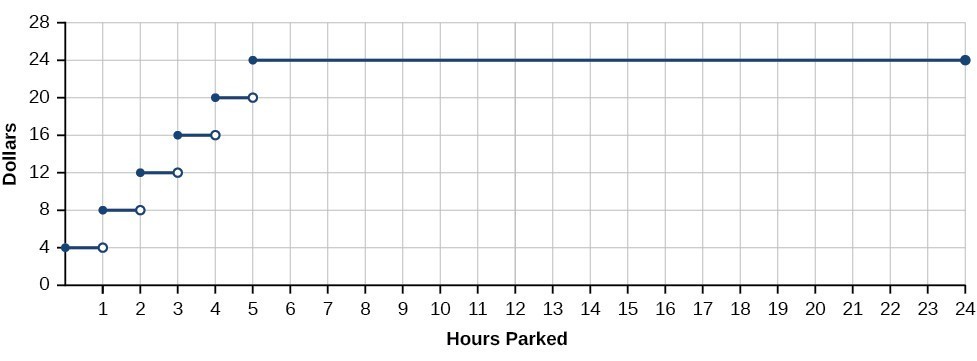
stepwise function
A function that remains level for an interval and then jumps instantaneously to a higher value is called a stepwise function. This function is an example.
discontinuous function
A function that has any hole or break in its graph is known as a discontinuous function.
So how can we decide if a function is continuous at a particular number? We can check three different conditions.
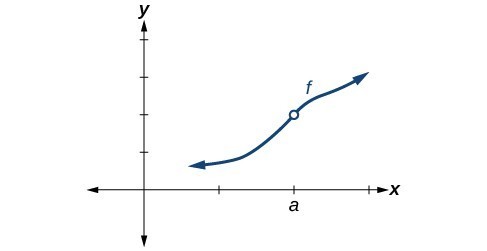
Condition 1 According to Condition 1, the function [latex]f\left(a\right)[/latex] defined at [latex]x=a[/latex] must exist. In other words, there is a y-coordinate at [latex]x=a[/latex].
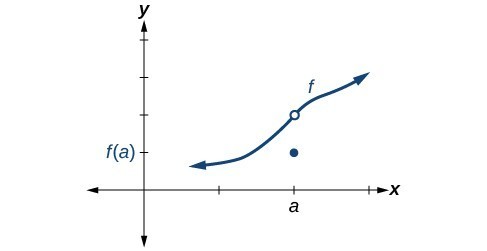
Condition 2 According to Condition 2, at [latex]x=a[/latex] the limit, written [latex]\underset{x\to a}{\mathrm{lim}}f\left(x\right)[/latex], must exist. This means that at [latex]x=a[/latex] the left-hand limit must equal the right-hand limit. Notice as the graph of [latex]f[/latex] approaches [latex]x=a[/latex] from the left and right, the same y-coordinate is approached. Therefore, Condition 2 is satisfied. However, there could still be a hole in the graph at [latex]x=a[/latex] .
Condition 3 According to Condition 3, the corresponding [latex]y[/latex] coordinate at [latex]x=a[/latex] fills in the hole in the graph of [latex]f[/latex]. This is written [latex]\underset{x\to a}{\mathrm{lim}}f\left(x\right)=f\left(a\right)[/latex].
Satisfying all three conditions means that the function is continuous. All three conditions are satisfied for the function represented below so the function is continuous as [latex]x=a[/latex].
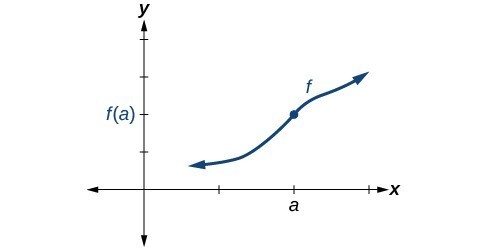
Below are several examples of graphs of functions that are not continuous at [latex]x=a[/latex] and the condition or conditions that fail.
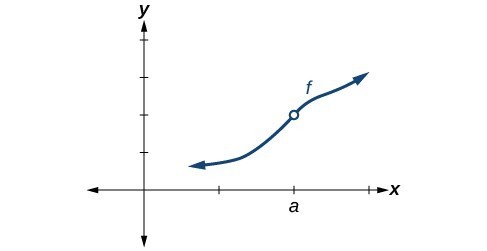
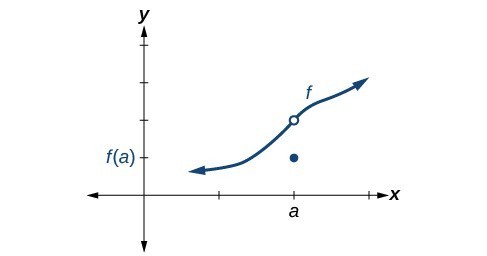
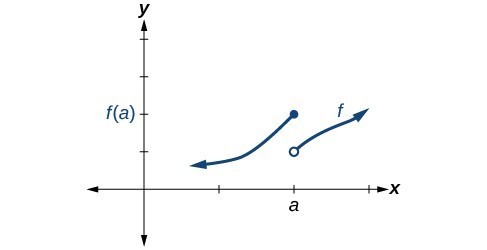
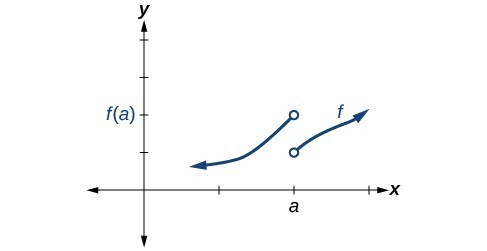
definition of continuity
A function [latex]f\left(x\right)[/latex] is continuous at [latex]x=a[/latex] provided all three of the following conditions hold true:
Condition 1: [latex]f(a)[/latex] exists.
Condition 2: [latex]\underset{x\to a}{\mathrm{lim}}f(x)[/latex] exists at [latex]x=a[/latex].
Condition 2: [latex]\underset{x\to a}{\mathrm{lim}}f(x)=f(a)[/latex].
If a function [latex]f\left(x\right)[/latex] is not continuous at [latex]x=a[/latex], the function is discontinuous at [latex]x=a[/latex] .