- Find a limit using a graph.
- Find a limit using a table.
Understanding Limit Notation
We have seen how a sequence can have a limit, a value that the sequence of terms moves toward as the nu mber of terms increases. For example, the terms of the sequence
gets closer and closer to 0. A sequence is one type of function, but functions that are not sequences can also have limits. We can describe the behavior of the function as the input values get close to a specific value. If the limit of a function [latex]f\left(x\right)=L[/latex], then as the input [latex]x[/latex] gets closer and closer to [latex]a[/latex], the output y-coordinate gets closer and closer to [latex]L[/latex]. We say that the output “approaches” [latex]L[/latex].
As the input value [latex]x[/latex] approaches [latex]a[/latex], the output value [latex]f\left(x\right)[/latex] approaches [latex]L[/latex].
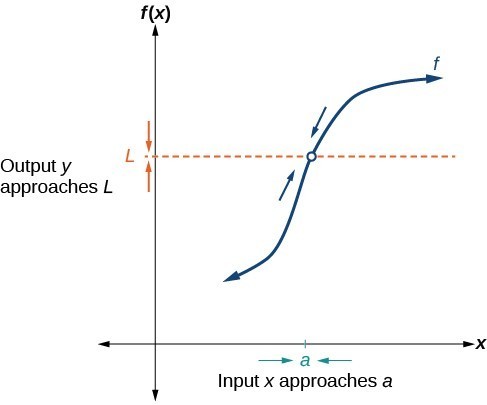
We write the equation of a limit as
This notation indicates that as [latex]x[/latex] approaches [latex]a[/latex] both from the left of [latex]x=a[/latex] and the right of [latex]x=a[/latex], the output value approaches [latex]L[/latex].
We can factor the function as shown.
Notice that [latex]x[/latex] cannot be 7, or we would be dividing by 0, so 7 is not in the domain of the original function. In order to avoid changing the function when we simplify, we set the same condition, [latex]x\ne 7[/latex], for the simplified function. We can represent the function graphically.
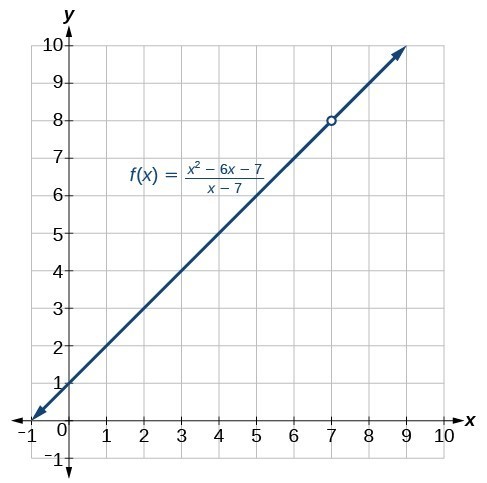
What happens at [latex]x=7[/latex] is completely different from what happens at points close to [latex]x=7[/latex] on either side. The notation
indicates that as the input [latex]x[/latex] approaches 7 from either the left or the right, the output approaches 8. The output can get as close to 8 as we like if the input is sufficiently near 7.
What happens at [latex]x=7?[/latex] When [latex]x=7[/latex], there is no corresponding output. We write this as
This notation indicates that 7 is not in the domain of the function. We had already indicated this when we wrote the function as
Notice that the limit of a function can exist even when [latex]f\left(x\right)[/latex] is not defined at [latex]x=a[/latex]. Much of our subsequent work will be determining limits of functions as [latex]x[/latex] nears [latex]a[/latex], even though the output at [latex]x=a[/latex] does not exist.
the limit of a function
A quantity [latex]L[/latex] is the limit of a function [latex]f\left(x\right)[/latex] as [latex]x[/latex] approaches [latex]a[/latex] if, as the input values of [latex]x[/latex] approach [latex]a[/latex] (but do not equal [latex]a[/latex]), the corresponding output values of [latex]f\left(x\right)[/latex] get closer to [latex]L[/latex]. Note that the value of the limit is not affected by the output value of [latex]f\left(x\right)[/latex] at [latex]a[/latex]. Both [latex]a[/latex] and [latex]L[/latex] must be real numbers. We write it as
[latex]\underset{x\to a}{\mathrm{lim}}f\left(x\right)=L[/latex]
[latex]\underset{x\to 2}{\mathrm{lim}}\left(3x+5\right)=11[/latex]