Simplifying Square Roots and Expressing Them in Lowest Terms
To simplify a square root means that we rewrite the square root as a rational number times the square root of a number that has no perfect square factors. The act of changing a square root into such a form is simplifying the square root. Before discussing how to simplify a square root, we need to introduce a rule about square roots.
the product rule for square roots
The square root of a product of numbers equals the product of the square roots of those number.
Given that [latex]a[/latex] and [latex]b[/latex] are nonnegative real numbers,
Using this formula, we can factor an integer inside a square root into a perfect square times another integer. Then the square root can be applied to the perfect square, leaving an integer times the square root of another integer. If the number remaining under the square root has no perfect square factors, then we’ve simplified the irrational number into lowest terms.
A perfect square is an integer that can be expressed as the square of another integer. For example, [latex]16[/latex], [latex]25[/latex], and [latex]36[/latex] are perfect squares because they are [latex]4^2[/latex], [latex]5^2[/latex], and [latex]6^2[/latex], respectively.How to: Simplify square roots into lowest terms when [latex]n[/latex] is an integer
Step 1: Determine the largest perfect square factor of [latex]n[/latex], which we denote [latex]a^2[/latex].
Step 2: Factor [latex]n[/latex] into [latex]a^2×b[/latex].
Step 4: Write [latex]\sqrt{n}[/latex] in its simplified form, [latex]a\sqrt{b}[/latex].
To simplify the given radical expressions, we’ll break down the numbers into their prime factors and simplify the radicals accordingly, while also considering the powers of the variables. Here are the steps:First, factor [latex]300[/latex] into its prime factors:
[latex]300 = 2^2 \cdot 3 \cdot 5^2[/latex]
Now, extract the square roots of the perfect squares:
[latex]\begin{align} \sqrt{300} &= \sqrt{2^2 \cdot 3 \cdot 5^2} && \text{Factor the number into prime factors.} \\ &= \sqrt{2^2} \cdot \sqrt{3} \cdot \sqrt{5^2} && \text{Separate each factor under its own square root.} \\ &= 2 \cdot \sqrt{3} \cdot 5 && \text{Simplify the square roots of perfect squares.} \\ &= 10\sqrt{3} && \text{Multiply the results to get the simplified form.} \end{align}[/latex]
Simplify [latex]\sqrt{162{a}^{5}{b}^{4}}[/latex].
\begin{align} \sqrt{162a^5b^4} &= \sqrt{2 \cdot 3^4 \cdot a^5 \cdot b^4} && \text{Factor the number into prime factors and express variables.} \\ &= \sqrt{2 \cdot (3^2)^2 \cdot a^4 \cdot a \cdot (b^2)^2} && \text{Break down the expression to show squares for clarity.} \\ &= \sqrt{2} \cdot \sqrt{(3^2)^2} \cdot \sqrt{a^4} \cdot \sqrt{a} \cdot \sqrt{(b^2)^2} && \text{Separate each factor under its own square root.} \\ &= \sqrt{2} \cdot 3^2 \cdot a^2 \cdot \sqrt{a} \cdot b^2 && \text{Simplify the square roots of perfect squares.} \\ &= 9a^2b^2 \cdot \sqrt{2a} && \text{Combine the constants and simplify further to finalize.} \end{align}
For the variable [latex]x[/latex], [latex]\sqrt{x^2} = |x|[/latex] , but why is that?When you square any values, the result is always non-negative, meaning it’s either positive or zero. Then, when you take the square root of this non-negative squared value, you get back the original number without its sign—just its size or magnitude. Thus, taking the square root of [latex]x^2[/latex] always yields the absolute value of [latex]x[/latex] ensuring that we consider [latex]x[/latex] in its non-negative form.
Given the product of multiple radical expressions, we can use the product rule to combine them into one radical expression and then simplify as we did above.
Simplify the following radical expression.
[latex]\sqrt{12}\cdot \sqrt{3}[/latex]
[latex]\sqrt{50x}\cdot \sqrt{2x}[/latex]
[latex]\begin{align}\sqrt{12}\cdot \sqrt{3} & = \sqrt{12\cdot 3} && \text{Express the product as a single radical expression}. \\ &= \sqrt{36} && \text{Simplify}. \\ &= 6 \end{align}[/latex]
[latex]\begin{align*} \sqrt{50x} \cdot \sqrt{2x} &= \sqrt{50x \cdot 2x} & \text{Multiply under the radicals} \\ &= \sqrt{100x^2} & \text{Simplify the product inside the radical} \\ &= 10|x| & \text{Take the square root of \(100\) and \(x^2\)} \end{align*}[/latex]
definition
transformed functions
The formula for a transformed function is [latex]g(x) = \pm a \cdot f\big(\pm b(x - h)\big) + k[/latex] where:
[latex]\pm a[/latex] describes the vertical reflection and stretch/compression
[latex]\pm b[/latex] describes the horizontal reflection and stretch/compression
[latex]h[/latex] describes the horizontal shift, and
[latex]k[/latex] describes the vertical shift
Find the parent function. If it's not given to you, check the toolkit functions.
Identify any shifts.
Identify any reflections, stretches or compresses.
Write the function using [latex]g(x) = a \cdot f\big(b(x - h)\big) + k[/latex]
Writing Functions Given the Transformed Graph
The graph shows two function: The toolkit function [latex]f(x) = x^3[/latex] (green) and [latex]g(x)[/latex] (red). Relate this new function [latex]g\left(x\right)[/latex] to [latex]f\left(x\right)[/latex], and then find a formula for [latex]g\left(x\right)[/latex].
The red curve [latex]g(x)[/latex] appears to be less steep compared to the green curve [latex]f(x)[/latex]. This suggests a vertical compression.If [latex]g(x)[/latex] is a vertical compression of [latex]f(x)[/latex], we have: [latex]g(x) = a \cdot f(x)[/latex], where [latex]0 < a < 1[/latex].To determine [latex]a[/latex], it is helpful to look for a point on the graph that is relatively clear.
In this graph, it appears that [latex]g\left(2\right)=2[/latex].
With the basic cubic function at the same input, [latex]f\left(2\right)={2}^{3}=8[/latex].
Based on that, it appears that the outputs of [latex]g[/latex] are [latex]\frac{1}{4}[/latex] the outputs of the function [latex]f[/latex] because [latex]2=\frac{1}{4} \cdot 8[/latex].
Relate the function [latex]g\left(x\right)[/latex] to [latex]f\left(x\right)[/latex].
The orange graph [latex]g(x)[/latex] appears to be a horizontally compressed version of the blue graph of [latex]f(x)[/latex].
[latex]\\[/latex]
If [latex]g(x)[/latex] is a horizontal compression of [latex]f(x)[/latex], we have: [latex]g(x) = f(b \cdot x)[/latex], where [latex]b > 1[/latex]. The graph is compressed by [latex]\dfrac{1}{b}[/latex].To determine [latex]b[/latex], it is helpful to look for a point on the graph that is relatively clear.
In the compressed graph [latex]g(x)[/latex], the end point is [latex](2, 4)[/latex].
The end point of [latex]f(x)[/latex] is [latex](6,4)[/latex].
We can see that the [latex]x[/latex]-values have been compressed by [latex]\frac{1}{3}[/latex], because [latex]2=\frac{1}{3} \cdot 6[/latex].
This means that [latex]\dfrac{1}{b} = \dfrac{1}{3}[/latex], which means [latex]b = 3[/latex].
Thus, [latex]g(x)=f(3x)[/latex].
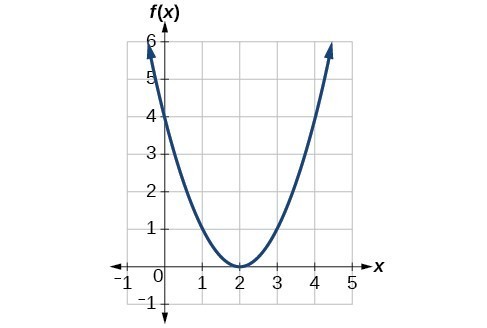
The graph below represents a transformation of the toolkit function [latex]f\left(x\right)={x}^{2}[/latex]. Relate this new function [latex]g\left(x\right)[/latex] to [latex]f\left(x\right)[/latex], and then find a formula for [latex]g\left(x\right)[/latex].
Notice that the graph is identical in shape to the [latex]f\left(x\right)={x}^{2}[/latex] function, but the [latex]x[/latex]-values are shifted to the right 2 units. The vertex used to be at (0,0), but now the vertex is at (2,0). The graph is the basic quadratic function shifted 2 units to the right, so
Notice how we must input the value [latex]x=2[/latex] to get the output value [latex]y=0[/latex]; the [latex]x[/latex]-values must be 2 units larger because of the shift to the right by 2 units. We can then use the definition of the [latex]f\left(x\right)[/latex] function to write a formula for [latex]g\left(x\right)[/latex] by evaluating [latex]f\left(x - 2\right)[/latex].
To determine whether the shift is [latex]+2[/latex] or [latex]-2[/latex] , consider a single reference point on the graph. For a quadratic, looking at the vertex point is convenient. In the original function, [latex]f\left(0\right)=0[/latex]. In our shifted function, [latex]g\left(2\right)=0[/latex]. To obtain the output value of 0 from the function [latex]f[/latex], we need to decide whether a plus or a minus sign will work to satisfy [latex]g\left(2\right)=f\left(x - 2\right)=f\left(0\right)=0[/latex]. For this to work, we will need to subtract 2 units from our input values.
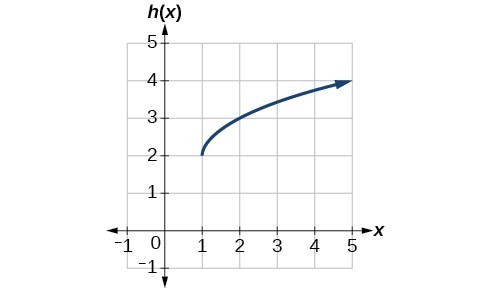
Write a formula for the graph shown in Figure 24, which is a transformation of the toolkit square root function.
Figure 24
The graph of the toolkit function starts at the origin, so this graph has been shifted 1 to the right and up 2. In function notation, we could write that as
Using the formula for the square root function, we can write
[latex]h\left(x\right)=\sqrt{x - 1}+2[/latex]
Analysis of the Solution
Note that this transformation has changed the domain and range of the function. This new graph has domain [latex]\left[1,\infty \right)[/latex] and range [latex]\left[2,\infty \right)[/latex].
Writing Functions Given the Transformed Graph
Write a formula for a transformation of the toolkit reciprocal function [latex]f\left(x\right)=\frac{1}{x}[/latex] that shifts the function’s graph one unit to the right and one unit up.
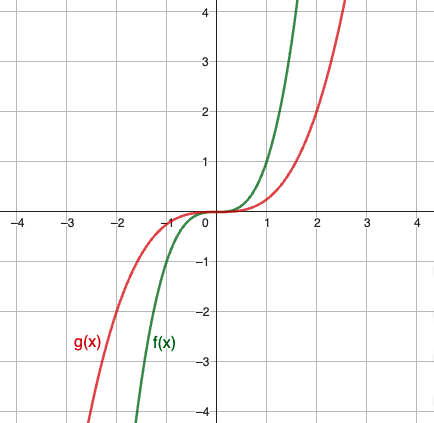 The graph shows two function: The toolkit function [latex]f(x) = x^3[/latex] (green) and [latex]g(x)[/latex] (red). Relate this new function [latex]g\left(x\right)[/latex] to [latex]f\left(x\right)[/latex], and then find a formula for [latex]g\left(x\right)[/latex].
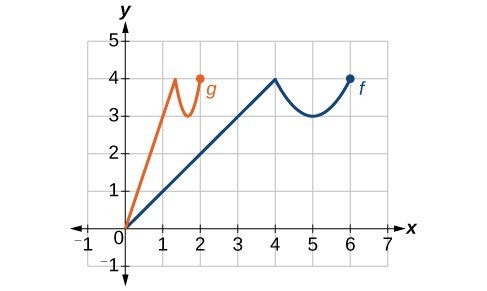 Relate the function [latex]g\left(x\right)[/latex] to [latex]f\left(x\right)[/latex].