Finding Limits: Numerical and Graphical Approaches
1. Explain the difference between a value at [latex]x=a[/latex] and the limit as [latex]x[/latex] approaches [latex]a[/latex].
For the following exercises, estimate the functional values and the limits from the graph of the function [latex]f[/latex].
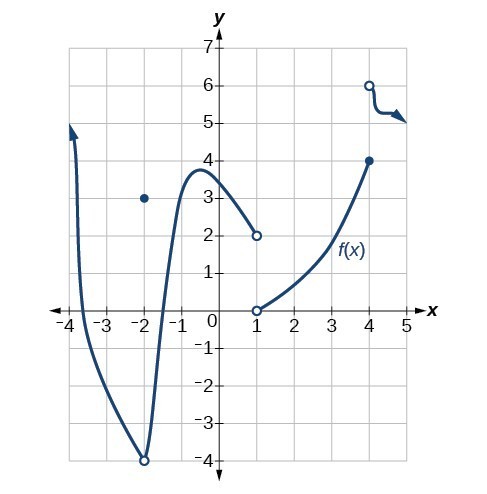
2. [latex]\underset{x\to -{2}^{-}}{\mathrm{lim}}f\left(x\right)[/latex]
3. [latex]\underset{x\to -2}{\mathrm{lim}}f\left(x\right)[/latex]
4. [latex]\underset{x\to -{1}^{-}}{\mathrm{lim}}f\left(x\right)[/latex]
5. [latex]\underset{x\to 1}{\mathrm{lim}}f\left(x\right)[/latex]
6. [latex]\underset{x\to {4}^{-}}{\mathrm{lim}}f\left(x\right)[/latex]
7. [latex]\underset{x\to 4}{\mathrm{lim}}f\left(x\right)[/latex]
For the following exercises, draw the graph of a function from the functional values and limits provided.
8. [latex]\underset{x\to {0}^{-}}{\mathrm{lim}}f\left(x\right)=2,\underset{x\to {0}^{+}}{\mathrm{lim}}f\left(x\right)=-3,\underset{x\to 2}{\mathrm{lim}}f\left(x\right)=2,f\left(0\right)=4,f\left(2\right)=-1,f\left(-3\right)\text{ does not exist}[/latex].
9. [latex]\underset{x\to {2}^{-}}{\mathrm{lim}}f\left(x\right)=2,\underset{x\to {2}^{+}}{\mathrm{lim}}f\left(x\right)=-3,\underset{x\to 0}{\mathrm{lim}}f\left(x\right)=5,f\left(0\right)=1,f\left(1\right)=0[/latex]
10. [latex]\underset{x\to 4}{\mathrm{lim}}f\left(x\right)=6,\underset{x\to {6}^{+}}{\mathrm{lim}}f\left(x\right)=-1,\underset{x\to 0}{\mathrm{lim}}f\left(x\right)=5,f\left(4\right)=6,f\left(2\right)=6[/latex]
11. [latex]\underset{x\to \pi }{\mathrm{lim}}f\left(x\right)={\pi }^{2},\underset{x\to -\pi }{\mathrm{lim}}f\left(x\right)=\frac{\pi }{2},\underset{x\to {1}^{-}}{\mathrm{lim}}f\left(x\right)=0,f\left(\pi \right)=\sqrt{2},f\left(0\right)\text{ does not exist}[/latex].
For the following exercises, use a graphing calculator to determine the limit to 5 decimal places as [latex]x[/latex] approaches 0.
12. [latex]g\left(x\right)={\left(1+x\right)}^{\frac{2}{x}}[/latex]
13. [latex]i\left(x\right)={\left(1+x\right)}^{\frac{4}{x}}[/latex]
14. Based on the pattern you observed in the exercises above, make a conjecture as to the limit of [latex]f\left(x\right)={\left(1+x\right)}^{\frac{6}{x}}[/latex], [latex]g\left(x\right)={\left(1+x\right)}^{\frac{7}{x}}[/latex], [latex]\text{and }h\left(x\right)={\left(1+x\right)}^{\frac{n}{x}}[/latex].
For the following exercises, use a graphing utility to find graphical evidence to determine the left- and right-hand limits of the function given as [latex]x[/latex] approaches [latex]a[/latex]. If the function has a limit as [latex]x[/latex] approaches [latex]a[/latex], state it. If not, discuss why there is no limit.
15. [latex]f\left(x\right)=\begin{cases}\dfrac{1}{x+1},\hfill& \text{if }x=−2 \\ \left(x+1\right)^{2},\hfill& \text{if }x\ne−2\end{cases};\text{ }a=−2[/latex]
For the following exercises, use numerical evidence to determine whether the limit exists at [latex]x=a[/latex]. If not, describe the behavior of the graph of the function near [latex]x=a[/latex]. Round answers to two decimal places.
16. [latex]f\left(x\right)=\frac{{x}^{2}-x - 6}{{x}^{2}-9};a=3[/latex]
17. [latex]f\left(x\right)=\frac{{x}^{2}-1}{{x}^{2}-3x+2};a=1[/latex]
18. [latex]f\left(x\right)=\frac{10 - 10{x}^{2}}{{x}^{2}-3x+2};a=1[/latex]
19. [latex]f\left(x\right)=\frac{x}{4{x}^{2}+4x+1};a=-\frac{1}{2}[/latex]
For the following exercises, use a calculator to estimate the limit by preparing a table of values. If there is no limit, describe the behavior of the function as [latex]x[/latex] approaches the given value.
20. [latex]\underset{x\to 0}{\mathrm{lim}}\dfrac{7\tan x}{3x}[/latex]
21. [latex]\underset{x\to 0}{\mathrm{lim}}\dfrac{2\sin x}{4\tan x}[/latex]
For the following exercises, use a graphing utility to find numerical or graphical evidence to determine the left and right-hand limits of the function given as [latex]x[/latex] approaches [latex]a[/latex]. If the function has a limit as [latex]x[/latex] approaches [latex]a[/latex], state it. If not, discuss why there is no limit.
22. [latex]\underset{x\to 0}{\mathrm{lim}}{e}^{{e}^{-\frac{1}{{x}^{2}}}}[/latex]
23. [latex]\underset{x\to -1}{\mathrm{lim}}\dfrac{|x+1|}{x+1}[/latex]
24. [latex]\underset{x\to -1}{\mathrm{lim}}\dfrac{1}{{\left(x+1\right)}^{2}}[/latex]
25. [latex]\underset{x\to 0}{\mathrm{lim}}\dfrac{5}{1-{e}^{\frac{2}{x}}}[/latex]
26. According to the Theory of Relativity, the mass [latex]m[/latex] of a particle depends on its velocity [latex]v[/latex] . That is
[latex]m=\frac{{m}_{o}}{\sqrt{1-\left({v}^{2}/{c}^{2}\right)}}[/latex]
where [latex]{m}_{o}[/latex] is the mass when the particle is at rest and [latex]c[/latex] is the speed of light. Find the limit of the mass, [latex]m[/latex], as [latex]v[/latex] approaches [latex]{c}^{-}[/latex].
Finding Limits: Properties of Limits
1. Give an example of a type of function [latex]f[/latex] whose limit, as [latex]x[/latex] approaches [latex]a[/latex], is [latex]f\left(a\right)[/latex].
2. What does it mean to say the limit of [latex]f\left(x\right)[/latex], as [latex]x[/latex] approaches [latex]c[/latex], is undefined?
For the following exercises, evaluate the limits algebraically.
3. [latex]\underset{x\to 2}{\mathrm{lim}}\left(\dfrac{-5x}{{x}^{2}-1}\right)[/latex]
4. [latex]\underset{x\to 3}{\mathrm{lim}}\left(\dfrac{{x}^{2}-9}{x - 3}\right)[/latex]
5. [latex]\underset{x\to \frac{3}{2}}{\mathrm{lim}}\left(\dfrac{6{x}^{2}-17x+12}{2x - 3}\right)[/latex]
6. [latex]\underset{x\to 3}{\mathrm{lim}}\left(\dfrac{{x}^{2}-9}{x - 5x+6}\right)[/latex]
7. [latex]\underset{x\to 3}{\mathrm{lim}}\left(\dfrac{{x}^{2}+2x - 3}{x - 3}\right)[/latex]
8. [latex]\underset{h\to 0}{\mathrm{lim}}\left(\dfrac{{\left(2-h\right)}^{3}-8}{h}\right)[/latex]
9. [latex]\underset{h\to 0}{\mathrm{lim}}\left(\dfrac{\sqrt{5-h}-\sqrt{5}}{h}\right)[/latex]
10. [latex]\underset{x\to 9}{\mathrm{lim}}\left(\dfrac{{x}^{2}-81}{3-\sqrt{x}}\right)[/latex]
11. [latex]\underset{x\to 0}{\mathrm{lim}}\left(\dfrac{x}{\sqrt{1+2x}-1}\right)[/latex]
12. [latex]\underset{x\to 4}{\mathrm{lim}}\left(\dfrac{{x}^{3}-64}{{x}^{2}-16}\right)[/latex]
13. [latex]\underset{x\to {2}^{+}}{\mathrm{lim}}\left(\dfrac{|x - 2|}{x - 2}\right)[/latex]
14. [latex]\underset{x\to {4}^{-}}{\mathrm{lim}}\left(\dfrac{|x - 4|}{4-x}\right)[/latex]
15. [latex]\underset{x\to 4}{\mathrm{lim}}\left(\dfrac{|x - 4|}{4-x}\right)[/latex]
For the following exercise, use the given information to evaluate the limits: [latex]\underset{x\to c}{\mathrm{lim}}f\left(x\right)=3[/latex], [latex]\underset{x\to c}{\mathrm{lim}}g\left(x\right)=5[/latex]
16. [latex]\underset{x\to c}{\mathrm{lim}}\left[2f\left(x\right)+\sqrt{g\left(x\right)}\right][/latex]
17. [latex]\underset{x\to c}{\mathrm{lim}}\frac{f\left(x\right)}{g\left(x\right)}[/latex]
For the following exercises, evaluate the following limits.
18. [latex]\underset{x\to 2}{\mathrm{lim}}\sin \left(\pi x\right)[/latex]
19. [latex]{f}\left(x\right)=\begin{cases}2x^{2}+2x+1, \hfill& x\leq0 \\ x-3, \hfill& x>0\end{cases};\underset{x\to 0^{+}}{\mathrm{lim}}f \left(x\right)[/latex]
20. [latex]{f}\left(x\right)=\begin{cases}2x^{2}+2x+1, \hfill& x\leq0 \\ x-3, \hfill& x>0\end{cases};\underset{x\to 0}{\mathrm{lim}}f \left(x\right)[/latex]
21. [latex]\underset{x\to {3}^{+}}{\mathrm{lim}}\dfrac{{x}^{2}}{{x}^{2}-9}[/latex]
For the following exercises, find the average rate of change [latex]\frac{f\left(x+h\right)-f\left(x\right)}{h}[/latex].
22. [latex]f\left(x\right)=2{x}^{2}-1[/latex]
23. [latex]f\left(x\right)={x}^{2}+4x - 100[/latex]
24. [latex]f\left(x\right)=\cos \left(x\right)[/latex]
25. [latex]f\left(x\right)=\frac{1}{x}[/latex]
26. [latex]f\left(x\right)=\sqrt{x}[/latex]
27. Find an equation that could be represented by the graph.
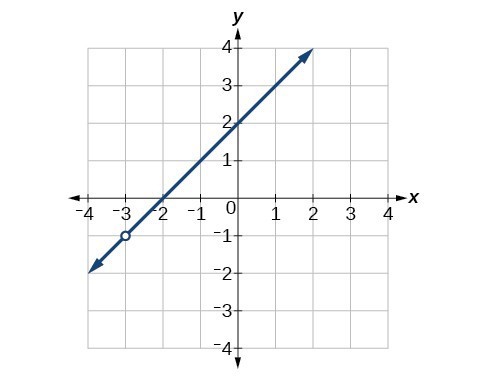
For the following exercises, refer to the graph.
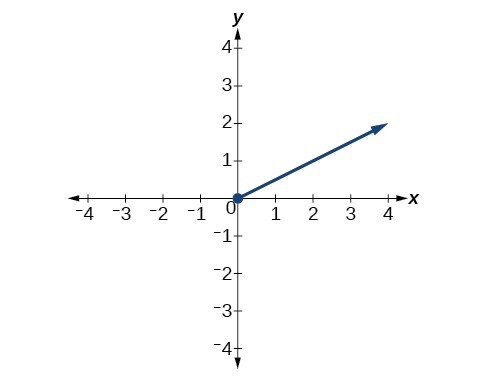
28. What is the left-hand limit of the function as [latex]x[/latex] approaches 0?
29. The height of a projectile is given by [latex]s\left(t\right)=-64{t}^{2}+192t[/latex] Find the average rate of change of the height from [latex]t=1[/latex] second to [latex]t=1.5[/latex] seconds.
Continuity
1. State in your own words what it means for a function [latex]f[/latex] to be continuous at [latex]x=c[/latex].
For the following exercises, determine why the function [latex]f[/latex] is discontinuous at a given point [latex]a[/latex] on the graph. State which condition fails.
2. [latex]f\left(x\right)=\mathrm{ln}\text{ }|\text{ }x+3\text{ }|,a=-3[/latex]
3. [latex]f\left(x\right)=\frac{{x}^{2}-16}{x+4},a=-4[/latex]
4. [latex]f\left(x\right)=\begin{cases}x,\hfill& x\neq 3 \\ 2x, \hfill& x=3\end{cases}a=3[/latex]
5. [latex]f\left(x\right)=\begin{cases}\frac{1}{2-x}, \hfill& x\neq 2 \\ 3, \hfill& x=2\end{cases}a=2[/latex]
6. [latex]f\left(x\right)=\begin{cases}3+x, \hfill& x<1 \\ x, \hfill& x=1 \\ x^{2}, \hfill& x>1\end{cases}a=1[/latex]
7. [latex]f\left(x\right)=\begin{cases}3+2x, \hfill& x<1 \\ x, \hfill& x=1 \\ -x^{2}, \hfill& x>1\end{cases}a=1[/latex]
8. [latex]f\left(x\right)=\begin{cases}\frac{x^{2}-9}{x+3}, \hfill& x<-3 \\ x-9, \hfill& x=-3 \\ \frac{1}{x}, \hfill& x>-3\end{cases}a=-3[/latex]
9. [latex]f\left(x\right)=\frac{{x}^{2}-4}{x - 2},\text{ }a=2[/latex]
10. [latex]f\left(x\right)=\frac{{x}^{3}-9x}{{x}^{2}+11x+24},\text{ }a=-3[/latex]
11. [latex]f\left(x\right)=\frac{x}{|x|},\text{ }a=0[/latex]
For the following exercises, determine whether or not the given function [latex]f[/latex] is continuous everywhere. If it is continuous everywhere it is defined, state for what range it is continuous. If it is discontinuous, state where it is discontinuous.
12. [latex]f\left(x\right)={x}^{3}-2x - 15[/latex]
13. [latex]f\left(x\right)=2\cdot {3}^{x+4}[/latex]
14. [latex]f\left(x\right)=\frac{|x - 2|}{{x}^{2}-2x}[/latex]
15. [latex]f\left(x\right)=2x+\frac{5}{x}[/latex]
16. [latex]f\left(x\right)=\mathrm{ln}\text{ }{x}^{2}[/latex]
17. [latex]f\left(x\right)=\sqrt{x - 4}[/latex]
18. [latex]f\left(x\right)={x}^{2}+\sin \left(x\right)[/latex]
For the following exercises, refer to the graph. Each square represents one square unit. For each value of [latex]a[/latex], determine which of the three conditions of continuity are satisfied at [latex]x=a[/latex] and which are not.
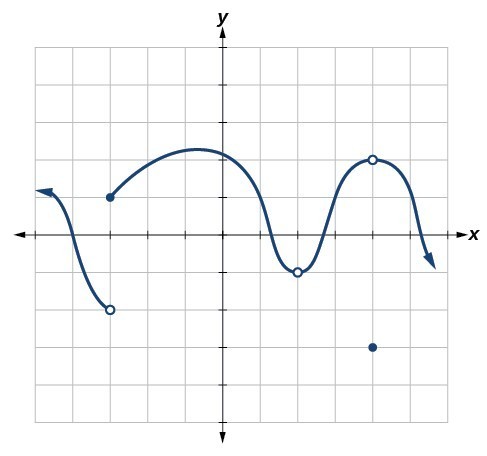
19. [latex]x=-3[/latex]
20. [latex]x=4[/latex]
For the following exercises, consider the function shown in the graph.
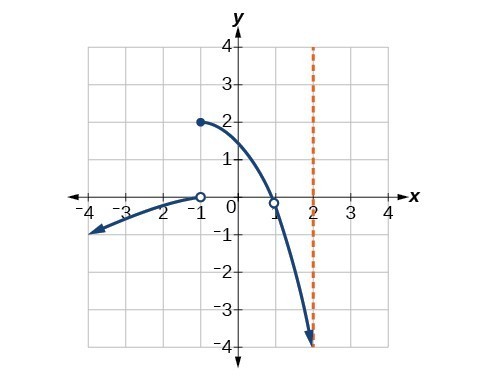
21. What condition of continuity is violated at each of the points where the graph is discontinuous?
22. Construct a function that passes through the origin with a constant slope of 1, with r
23. The graph of [latex]f\left(x\right)=\frac{\sin \left(2x\right)}{x}[/latex] is shown. Is the function [latex]f\left(x\right)[/latex] continuous at [latex]x=0?[/latex] Why or why not?
![Graph of the function f(x) = sin(2x)/x with a viewing window of [-4.5, 4.5] by [-1, 2.5]](https://s3-us-west-2.amazonaws.com/courses-images/wp-content/uploads/sites/3675/2018/09/27185352/CNX_Precalc_Figure_12_03_206.jpg)
Derivatives
1. How is the slope of a linear function similar to the derivative?
2. A car traveled 110 miles during the time period from 2:00 P.M. to 4:00 P.M. What was the car’s average velocity? At exactly 2:30 P.M., the speed of the car registered exactly 62 miles per hour. What is another name for the speed of the car at 2:30 P.M.? Why does this speed differ from the average velocity?
3. Suppose water is flowing into a tank at an average rate of 45 gallons per minute. Translate this statement into the language of mathematics.
For the following exercises, use the definition of derivative [latex]\underset{h\to 0}{\mathrm{lim}}\dfrac{f\left(x+h\right)-f\left(x\right)}{h}[/latex] to calculate the derivative of each function.
4. [latex]f\left(x\right)=-2x+1[/latex]
5. [latex]f\left(x\right)=2{x}^{2}+x - 3[/latex]
6. [latex]f\left(x\right)=\frac{-1}{x - 2}[/latex]
7. [latex]f\left(x\right)=\frac{5 - 2x}{3+2x}[/latex]
8. [latex]f\left(x\right)=3{x}^{3}-{x}^{2}+2x+5[/latex]
9. [latex]f\left(x\right)=5\pi[/latex]
For the following exercises, find the average rate of change between the two points.
10. [latex]\left(4,-3\right)[/latex] and [latex]\left(-2,-1\right)[/latex]
11. [latex]\left(7,-2\right)[/latex] and [latex]\left(7,10\right)[/latex]
For the following polynomial functions, find the derivatives.
12. [latex]f\left(x\right)=-3{x}^{2}-7x=6[/latex]
13. [latex]f\left(x\right)=3{x}^{3}+2{x}^{2}+x - 26[/latex]
For the following functions, find the equation of the tangent line to the curve at the given point [latex]x[/latex] on the curve.
14. [latex]\begin{array}{ll}f\left(x\right)={x}^{3}+1\hfill & x=2\hfill \end{array}[/latex]
For the following exercise, find [latex]k[/latex] such that the given line is tangent to the graph of the function.
15. [latex]\begin{array}{ll}f\left(x\right)={x}^{2}-kx,\hfill & y=4x - 9\hfill \end{array}[/latex]
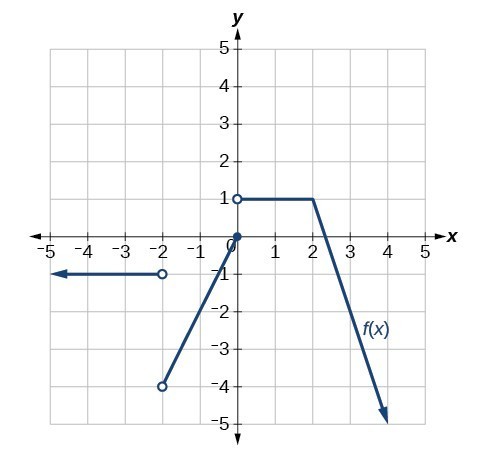
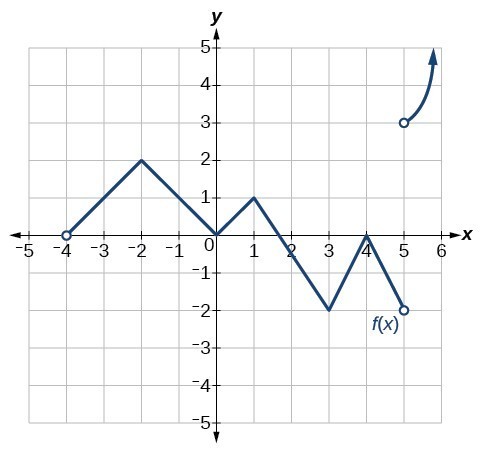
For the following exercises, consider the graph of the function [latex]f[/latex] and determine where the function is continuous/discontinuous and differentiable/not differentiable.
16.
17.
For the following exercises, use the graph to estimate either the function at a given value of [latex]x[/latex] or the derivative at a given value of [latex]x[/latex], as indicated.
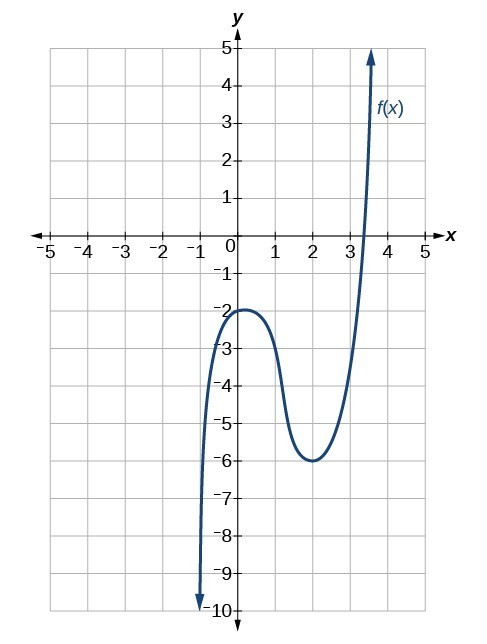
18. [latex]f\left(0\right)[/latex]
19. [latex]f\left(2\right)[/latex]
20. [latex]\begin{align}{f}^{\prime }\left(-1\right)\end{align}[/latex]
21. [latex]\begin{align}{f}^{\prime }\left(1\right)\end{align}[/latex]
22. [latex]\begin{align}{f}^{\prime }\left(3\right)\end{align}[/latex]
For the following exercises, explain the notation in words. The volume [latex]f\left(t\right)[/latex] of a tank of gasoline, in gallons, [latex]t[/latex] minutes after noon.
23. [latex]\begin{align}f^{\prime}\left(30\right)=-20\end{align}[/latex]
24. [latex]\begin{align}f^{\prime}\left(200\right)=30\end{align}[/latex]
For the following exercises, explain the functions in words. The height, [latex]s[/latex], of a projectile after [latex]t[/latex] seconds is given by [latex]s\left(t\right)=-16{t}^{2}+80t[/latex].
25. [latex]s\left(2\right)=96[/latex]
26. [latex]s\left(3\right)=96[/latex]
27. [latex]s\left(0\right)=0,s\left(5\right)=0[/latex].
For the following exercises, the volume [latex]V[/latex] of a sphere with respect to its radius [latex]r[/latex] is given by [latex]V=\frac{4}{3}\pi {r}^{3}[/latex].
28. Find the instantaneous rate of change of [latex]V[/latex] when [latex]r=3\text{ cm}\text{.}[/latex]
For the following exercises, the revenue generated by selling [latex]x[/latex] items is given by [latex]R\left(x\right)=2{x}^{2}+10x[/latex].
29. Find [latex]\begin{align}R^{\prime}\left(10\right)\end{align}[/latex] and interpret.
For the following exercises, the cost of producing [latex]x[/latex] cellphones is described by the function [latex]C\left(x\right)={x}^{2}-4x+1000[/latex].
30. Find the average rate of change in the total cost as [latex]x[/latex] changes from [latex]x=10\text{ to }x=15[/latex].
31. Find the approximate marginal cost, when 20 cellphones have been produced, of producing the 21st cellphone.
For the following exercises, use the definition for the derivative at a point [latex]x=a[/latex], [latex]\underset{x\to a}{\mathrm{lim}}\dfrac{f\left(x\right)-f\left(a\right)}{x-a}[/latex], to find the derivative of the functions.
32. [latex]f\left(x\right)=5{x}^{2}-x+4[/latex]
33. [latex]f\left(x\right)=\frac{-4}{3-{x}^{2}}[/latex]