Right Triangle Trigonometry
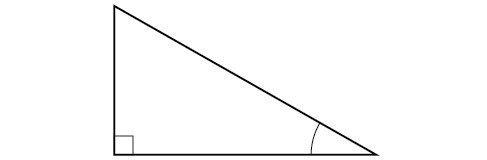
1. For the given right triangle, label the adjacent side, opposite side, and hypotenuse for the indicated angle.
2. What is the relationship between the two acute angles in a right triangle?
For the following exercises, use cofunctions of complementary angles.
3. [latex]\cos \left(\frac{\pi }{3}\right)=\sin \text{(___)}[/latex]
4. [latex]\tan \left(\frac{\pi }{4}\right)=\cot \left(\text{__}\right)[/latex]
For the following exercises, find the lengths of the missing sides if side [latex]a[/latex] is opposite angle [latex]A[/latex], side [latex]b[/latex] is opposite angle [latex]B[/latex], and side [latex]c[/latex] is the hypotenuse.
5. [latex]\sin B=\frac{1}{2}, a=20[/latex]
6. [latex]\tan A=100,b=100[/latex]
7. [latex]a=5,\measuredangle A={60}^{\circ }[/latex]
For the following exercises, use the triangle to evaluate each trigonometric function of angle [latex]A[/latex].
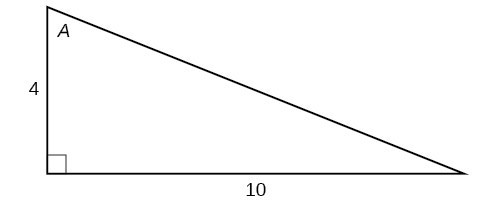
8. [latex]\sin A[/latex]
9. [latex]\tan A[/latex]
10. [latex]\sec A[/latex]
For the following exercises, use the triangle to evaluate each trigonometric function of angle [latex]A[/latex].
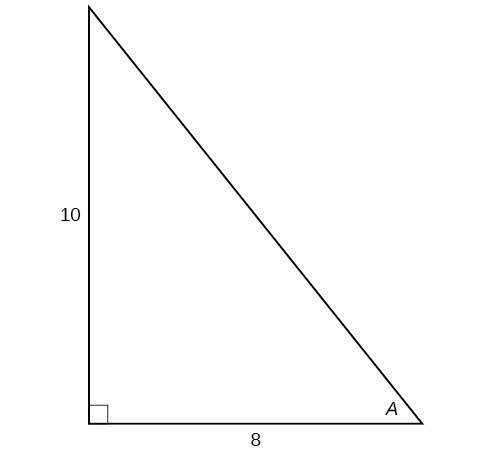
11. [latex]\sin A[/latex]
12. [latex]\tan A[/latex]
13. [latex]\sec A[/latex]
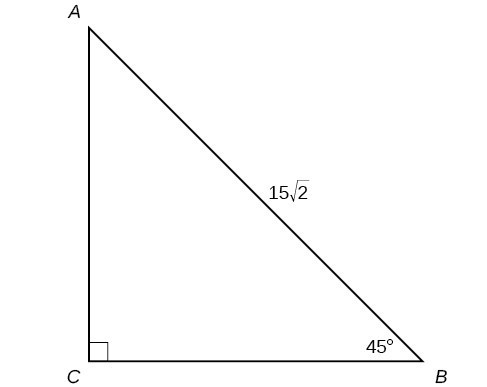
For the following exercises, solve for the unknown sides of the given triangle.
14.
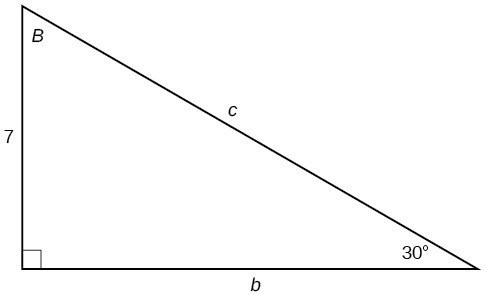
15.
For the following exercises, use a calculator to find the length of each side to four decimal places.
16.
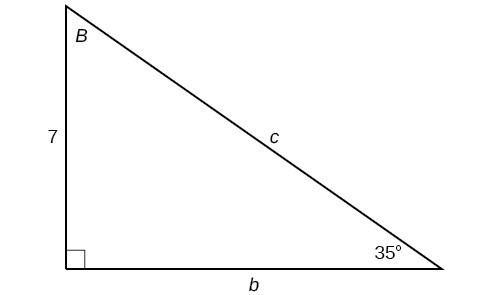
17.

18. [latex]b=15,\measuredangle B={15}^{\circ }[/latex]
19. [latex]c=50,\measuredangle B={21}^{\circ }[/latex]
20. [latex]b=3.5,\measuredangle A={78}^{\circ }[/latex]
21. Find [latex]x[/latex].
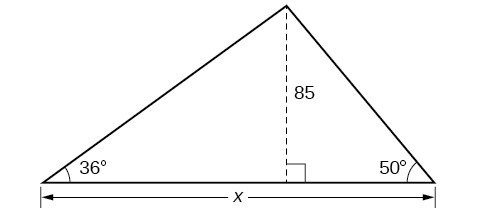
22. Find [latex]x[/latex].
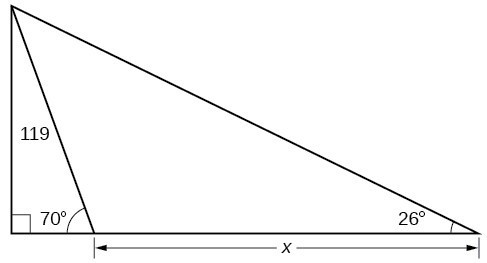
23. A radio tower is located 325 feet from a building. From a window in the building, a person determines that the angle of elevation to the top of the tower is [latex]43^\circ[/latex], and that the angle of depression to the bottom of the tower is [latex]31^\circ[/latex]. How tall is the tower?
24. A 400-foot tall monument is located in the distance. From a window in a building, a person determines that the angle of elevation to the top of the monument is [latex]18^\circ[/latex], and that the angle of depression to the bottom of the tower is [latex]3^\circ[/latex]. How far is the person from the monument?
25. There is lightning rod on the top of a building. From a location 500 feet from the base of the building, the angle of elevation to the top of the building is measured to be [latex]36^\circ[/latex]. From the same location, the angle of elevation to the top of the lightning rod is measured to be [latex]38^\circ[/latex]. Find the height of the lightning rod.
26. A 23-ft ladder leans against a building so that the angle between the ground and the ladder is [latex]80^\circ[/latex]. How high does the ladder reach up the side of the building?
27. The angle of elevation to the top of a building in Seattle is found to be 2 degrees from the ground at a distance of 2 miles from the base of the building. Using this information, find the height of the building.
Inverse Trigonometric Functions
1. Why do the functions [latex]f(x)=\sin^{−1}x[/latex] and [latex]g(x)=\cos^{−1}x[/latex] have different ranges?
2. Most calculators do not have a key to evaluate [latex]\sec^{−1}(2)[/latex]. Explain how this can be done using the cosine function or the inverse cosine function.
For the following exercises, evaluate the expressions.
3. [latex]\sin^{−1}\left(−\frac{1}{2}\right)[/latex]
4. [latex]\cos^{−1}\left(−\frac{\sqrt{2}}{2}\right)[/latex]
5. [latex]\tan^{−1}(\sqrt{3})[/latex]
For the following exercises, use a calculator to evaluate each expression. Express answers to the nearest hundredth.
6. [latex]\cos^{−1}(−0.4)[/latex]
7. [latex]\arccos\left(\frac{3}{5}\right)[/latex]
8. [latex]\tan^{−1}(6)[/latex]
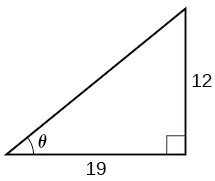
For the following exercises, find the angle θ in the given right triangle. Round answers to the nearest hundredth.
9.
For the following exercises, find the exact value, if possible, without a calculator. If it is not possible, explain why.
10. [latex]\tan^{−1}(\sin(\pi))[/latex]
11. [latex]\tan^{−1}\left(\sin\left(\frac{4\pi}{3}\right)\right)[/latex]
12. [latex]\tan^{−1}\left(\sin\left(\frac{−5\pi}{2}\right)\right)[/latex]
13. [latex]\sin\left(\cos^{−1}\left(\frac{3}{5}\right)\right)[/latex]
14. [latex]\cos\left(\tan^{−1}\left(\frac{12}{5}\right)\right)[/latex]
For the following exercises, find the function if [latex]\sin t=\frac{x}{x+1}[/latex].
15. [latex]\cos t[/latex]
16. [latex]\cot t[/latex]
17. [latex]\tan^{−1}\left({x}{\sqrt{2x+1}}\right)[/latex]
18. Graph [latex]y=\arccos x[/latex] and state the domain and range of the function.
19. Suppose a 13-foot ladder is leaning against a building, reaching to the bottom of a second-floor window 12 feet above the ground. What angle, in radians, does the ladder make with the building?
20. An isosceles triangle has two congruent sides of length 9 inches. The remaining side has a length of 8 inches. Find the angle that a side of 9 inches makes with the 8-inch side.
21. A truss for the roof of a house is constructed from two identical right triangles. Each has a base of 12 feet and height of 4 feet. Find the measure of the acute angle adjacent to the 4-foot side.
22. A 20-foot ladder leans up against the side of a building so that the foot of the ladder is 10 feet from the base of the building. If specifications call for the ladder’s angle of elevation to be between 35 and 45 degrees, does the placement of this ladder satisfy safety specifications?
Non-right Triangles: Law of Sines
- 1. When can you use the Law of Sines to find a missing angle?2. What type of triangle results in an ambiguous case?
For the following exercises, assume [latex]\alpha[/latex] is opposite side [latex]a,\beta[/latex] is opposite side [latex]b[/latex], and [latex]\gamma[/latex] is opposite side [latex]c[/latex]. Solve each triangle, if possible. Round each answer to the nearest tenth.
3. [latex]\alpha =35^\circ ,\gamma =73^\circ ,c=20[/latex]
4. [latex]a=4,\alpha =60^\circ ,\beta =100^\circ[/latex]
For the following exercises, use the Law of Sines to solve for the missing side for each oblique triangle. Round each answer to the nearest hundredth. Assume that angle [latex]A[/latex] is opposite side [latex]a[/latex], angle [latex]B[/latex] is opposite side [latex]b[/latex], and angle [latex]C[/latex] is opposite side [latex]c[/latex].
5. Find side [latex]b[/latex] when [latex]A=37^\circ ,B=49^\circ ,c=5[/latex].
6. Find side [latex]c[/latex] when [latex]B=37^\circ ,C=21,b=23[/latex].
For the following exercises, assume [latex]\alpha[/latex] is opposite side [latex]a,\beta[/latex] is opposite side [latex]b[/latex], and [latex]\gamma[/latex] is opposite side [latex]c[/latex]. Determine whether there is no triangle, one triangle, or two triangles. Then solve each triangle, if possible. Round each answer to the nearest tenth.
7. [latex]\gamma =113^\circ ,b=10,c=32[/latex]
8. [latex]a=12,c=17,\alpha =35^\circ[/latex]
9. [latex]a=7,c=9,\alpha =43^\circ[/latex]
10. [latex]b=13,c=5,\gamma =10^\circ[/latex]
11. [latex]\beta =119^\circ ,b=8.2,a=11.3[/latex]
For the following exercise, use the Law of Sines to solve, if possible, the missing side or angle for each triangle or triangles in the ambiguous case. Round each answer to the nearest tenth.
12. Find angle [latex]A[/latex] when [latex]a=13,b=6,B=20^\circ[/latex].
For the following exercises, find the area of the triangle with the given measurements. Round each answer to the nearest tenth.
13. [latex]a=5,c=6,\beta =35^\circ[/latex]
14. [latex]a=32,b=24,\gamma =75^\circ[/latex]
For the following exercises, find the length of side [latex]x[/latex]. Round to the nearest tenth.
15.
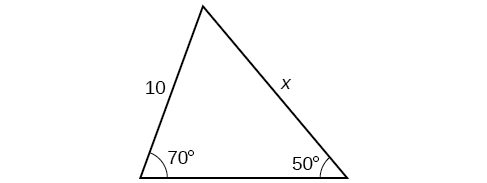
16.
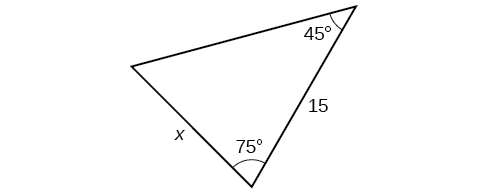
17.
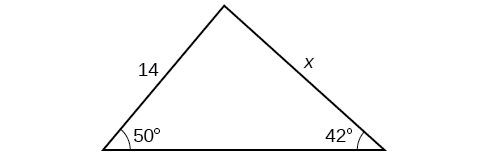
For the following exercises, find the measure of angle [latex]x[/latex], if possible. Round to the nearest tenth.
18.
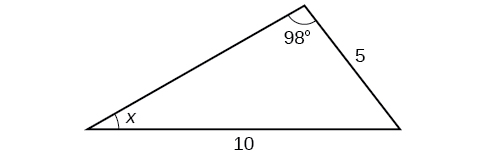
19.
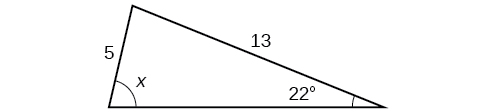
20. Notice that [latex]x[/latex] is an obtuse angle.
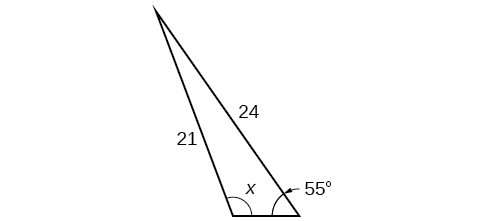
For the following exercises, find the area of each triangle. Round each answer to the nearest tenth.
21.
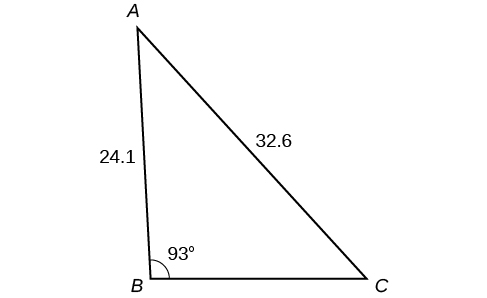
22.
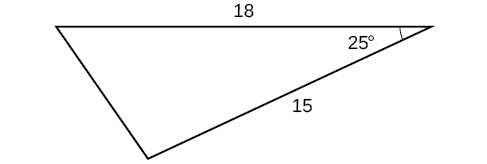
23.
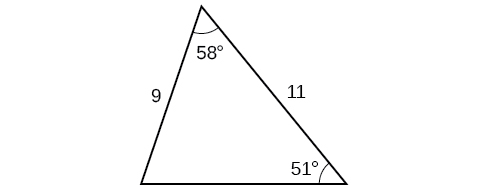
24.
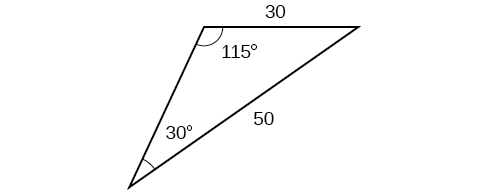
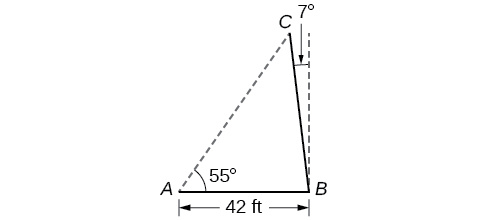
25. A pole leans away from the sun at an angle of [latex]7^\circ[/latex] to the vertical, as shown in below. When the elevation of the sun is [latex]55^\circ[/latex], the pole casts a shadow 42 feet long on the level ground. How long is the pole? Round the answer to the nearest tenth.
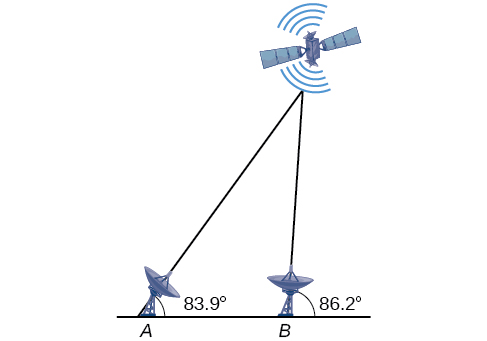
26. The diagram below shows a satellite orbiting Earth. The satellite passes directly over two tracking stations [latex]A[/latex] and [latex]B[/latex], which are 69 miles apart. When the satellite is on one side of the two stations, the angles of elevation at [latex]A[/latex] and [latex]B[/latex] are measured to be [latex]86.2^\circ[/latex] and [latex]83.9^\circ[/latex], respectively. How far is the satellite from station [latex]A[/latex] and how high is the satellite above the ground? Round answers to the nearest whole mile.
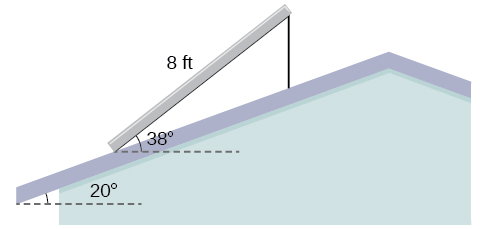
27. The roof of a house is at a [latex]20^\circ[/latex] angle. An 8-foot solar panel is to be mounted on the roof and should be angled [latex]38^\circ[/latex] relative to the horizontal for optimal results. How long does the vertical support holding up the back of the panel need to be? Round to the nearest tenth.
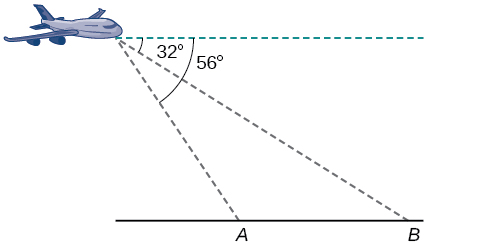
28. A pilot is flying over a straight highway. He determines the angles of depression to two mileposts, 4.3 km apart, to be 32° and 56°, as shown below. Find the distance of the plane from point [latex]A[/latex] to the nearest tenth of a kilometer.
29. In order to estimate the height of a building, two students stand at a certain distance from the building at street level. From this point, they find the angle of elevation from the street to the top of the building to be 35°. They then move 250 feet closer to the building and find the angle of elevation to be 53°. Assuming that the street is level, estimate the height of the building to the nearest foot.
30. A street light is mounted on a pole. A 6-foot-tall man is standing on the street a short distance from the pole, casting a shadow. The angle of elevation from the tip of the man’s shadow to the top of his head of 28°. A 6-foot-tall woman is standing on the same street on the opposite side of the pole from the man. The angle of elevation from the tip of her shadow to the top of her head is 28°. If the man and woman are 20 feet apart, how far is the street light from the tip of the shadow of each person? Round the distance to the nearest tenth of a foot.
31. Two streets meet at an 80° angle. At the corner, a park is being built in the shape of a triangle. Find the area of the park if, along one road, the park measures 180 feet, and along the other road, the park measures 215 feet.
32. The Bermuda triangle is a region of the Atlantic Ocean that connects Bermuda, Florida, and Puerto Rico. Find the area of the Bermuda triangle if the distance from Florida to Bermuda is 1030 miles, the distance from Puerto Rico to Bermuda is 980 miles, and the angle created by the two distances is 62°.
Non-right Triangles: Law of Cosines
- 1. If you are looking for a missing side of a triangle, what do you need to know when using the Law of Cosines?2. If you are looking for a missing angle of a triangle, what do you need to know when using the Law of Cosines?3. Explain what [latex]s[/latex] represents in Heron’s formula.
For the following exercises, assume [latex]\alpha[/latex] is opposite side [latex]a,\beta[/latex] is opposite side [latex]b[/latex], and [latex]\gamma[/latex] is opposite side [latex]c[/latex]. If possible, solve each triangle for the unknown side. Round to the nearest tenth.
4. [latex]\alpha =120^\circ ,b=6,c=7[/latex]
5. [latex]\alpha =43.1^\circ ,a=184.2,b=242.8[/latex]
6. [latex]\beta =50^\circ ,a=105,b=45{}_{}{}^{}[/latex]
For the following exercises, use the Law of Cosines to solve for the missing angle of the oblique triangle. Round to the nearest tenth.
7. [latex]a=14,\text{ }b=13,\text{ }c=20[/latex]; find angle [latex]C[/latex].
8. [latex]a=13,b=22,c=28[/latex]; find angle [latex]A[/latex].
For the following exercises, solve the triangle. Round to the nearest tenth.
9. [latex]A=35^\circ ,b=8,c=11[/latex]
10. [latex]C=121^\circ ,a=21,b=37[/latex]
11. [latex]a=3.1,b=3.5,c=5[/latex]
For the following exercises, use Heron’s formula to find the area of the triangle. Round to the nearest hundredth.
12. Find the area of a triangle with sides of length 18 in, 21 in, and 32 in. Round to the nearest tenth.
13. [latex]a=\frac{1}{2}\text{m},b=\frac{1}{3}\text{m},c=\frac{1}{4}\text{m}[/latex]
14. [latex]a=1.6\text{ yd},\text{ }b=2.6\text{ yd},\text{ }c=4.1\text{ yd}[/latex]
For the