Graphs of the Sine and Cosine Function
1. Why are the sine and cosine functions called periodic functions?
2. For the equation [latex]A\cos(Bx+C)+D[/latex], what constants affect the range of the function and how do they affect the range?
For each function, state the amplitude, period, and midline. State the maximum and minimum y-values and their corresponding x-values on one period for [latex]x>0[/latex]. State the phase shift and vertical translation, if applicable. Round answers to two decimal places if necessary.
3. [latex]f(x)=\frac{2}{3}\cos x[/latex]
4. [latex]f(x)=4\sin x[/latex]
5. [latex]f(x)=\cos(2x)[/latex]
6. [latex]f(x)=4\cos(\pi x)[/latex]
7. [latex]y=3\sin(8(x+4))+5[/latex]
8. [latex]y=5\sin(5x+20)−2[/latex]
For the following exercises, graph one full period of each function, starting at [latex]x=0[/latex]. For each function, state the amplitude, period, and midline. State the maximum and minimum y-values and their corresponding x-values on one period for [latex]x>0[/latex]. State the phase shift and vertical translation, if applicable. Round answers to two decimal places if necessary.
9. [latex]f(t)=−\cos\left(t+\frac{\pi}{3}\right)+1[/latex]
10. [latex]f(t)=−\sin\left(12t+\frac{5\pi}{3}\right)[/latex]
Determine the amplitude, midline, period, and an equation involving the sine function for the graph shown.
11.
![A sinusoidal graph with amplitude of 2, range of [-5, -1], period of 4, and midline at y=-3.](https://s3-us-west-2.amazonaws.com/courses-images/wp-content/uploads/sites/3675/2018/09/27004008/CNX_Precalc_Figure_06_01_218.jpg)
12.
![A graph with a cosine parent function with an amplitude of 2, period of 5, midline at y=3, and a range of [1,5].](https://s3-us-west-2.amazonaws.com/courses-images/wp-content/uploads/sites/3675/2018/09/27004012/CNX_Precalc_Figure_06_01_220.jpg)
13.
![A graph with cosine parent function, range of function is [-4,4], amplitude of 4, period of 2.](https://s3-us-west-2.amazonaws.com/courses-images/wp-content/uploads/sites/3675/2018/09/27004017/CNX_Precalc_Figure_06_01_222.jpg)
14.
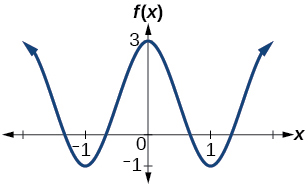
For the following exercises, let [latex]f(x)=\sin x[/latex].
15. On [0,2π), solve [latex]f(x)=\frac{1}{2}[/latex].
16. On [0,2π), [latex]f(x)=\frac{\sqrt{2}}{2}[/latex]. Find all values of x.
17. On [0,2π), the minimum value(s) of the function occur(s) at what x-value(s)?
For the following exercises, let [latex]f(x)=\cos x[/latex].
18. On [0,2π), solve the equation [latex]f(x)=\cos x=0[/latex].
19. On [0,2π), find the x-intercepts of [latex]f(x)=\cos x[/latex].
20. On [0,2π), solve the equation [latex]f(x)=\frac{\sqrt{3}}{2}[/latex].
21. A Ferris wheel is 25 meters in diameter and boarded from a platform that is 1 meter above the ground. The six o’clock position on the Ferris wheel is level with the loading platform. The wheel completes 1 full revolution in 10 minutes. The function h(t) gives a person’s height in meters above the ground t minutes after the wheel begins to turn.
a. Find the amplitude, midline, and period of h(t).
b. Find a formula for the height function h(t).
c. How high off the ground is a person after 5 minutes?
Graphs of the Other Trigonometric Functions
1. Explain how the graph of the sine function can be used to graph [latex]y=\csc x[/latex].
2. Explain why the period of [latex]\tan x[/latex] is equal to π.
For the following exercises, match each trigonometric function with one of the following graphs.
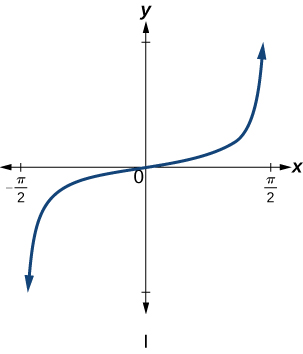
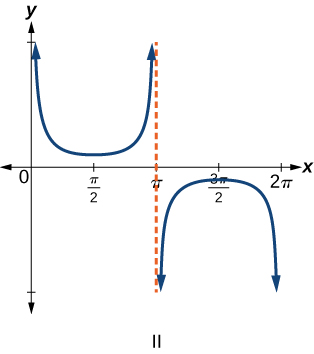
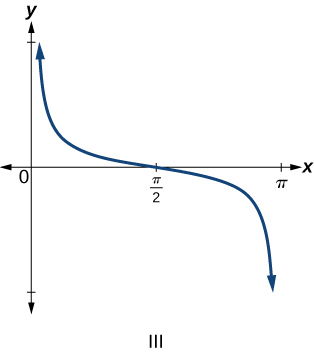
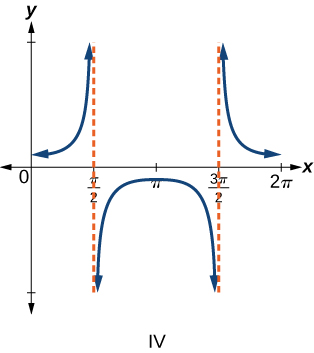
3. [latex]f(x)=\tan x[/latex]
4. [latex]f(x)=\sec x[/latex]
5. [latex]f(x)=\csc x[/latex]
6. [latex]f(x)=\cot x[/latex]
For the following exercises, find the period and horizontal shift of each of the functions.
7. [latex]h(x)=2\sec\left(\frac{\pi}{4}(x+1)\right)[/latex]
8. If tan x = −1.5, find tan(−x).
9. If csc x = −5, find csc(−x).
For the following exercises, rewrite each expression such that the argument x is positive.
10. [latex]\cot(−x)\cos(−x)+\sin(−x)[/latex]
For the following exercises, sketch two periods of the graph for each of the following functions. Identify the stretching factor, period, and asymptotes.
11. [latex]f(x)=2\tan(4x−32)[/latex]
12. [latex]m(x)=6\csc\left(\frac{\pi}{3}x+\pi\right)[/latex]
13. [latex]p(x)=\tan\left(x−\frac{\pi}{2}\right)[/latex]
14. [latex]f(x)=\tan\left(x+\frac{\pi}{4}\right)[/latex]
15. [latex]f(x)=2\csc(x)[/latex]
16. [latex]f(x)=4\sec(3x)[/latex]
17. [latex]f(x)=7\sec(5x)[/latex]
18. [latex]f(x)=2\csc \left(x+\frac{\pi}{4}\right)−1[/latex]
19. [latex]f(x)=\frac{7}{5}\csc \left(x−\frac{\pi}{4}\right)[/latex]
For the following exercises, find and graph two periods of the periodic function with the given stretching factor, |A|, period, and phase shift.
20. A tangent curve, [latex]A=1[/latex], period of [latex]\frac{\pi}{3}[/latex]; and phase shift [latex](h\text{,}k)=\left(\frac{\pi}{4}\text{,}2\right)[/latex]
For the following exercises, find an equation for the graph of each function.
21.
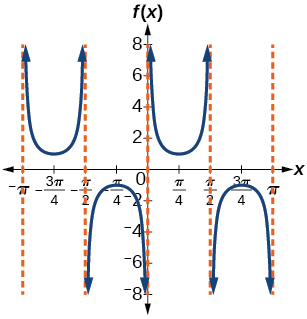
22.
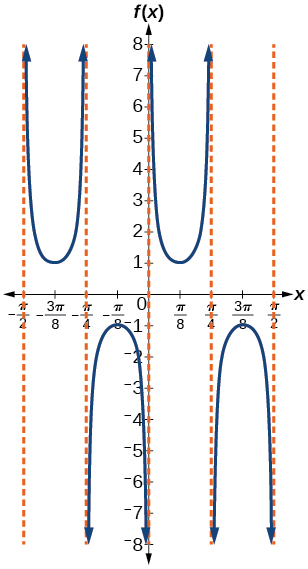
23.
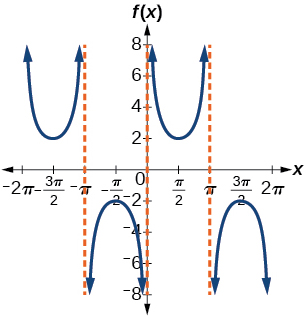
24.
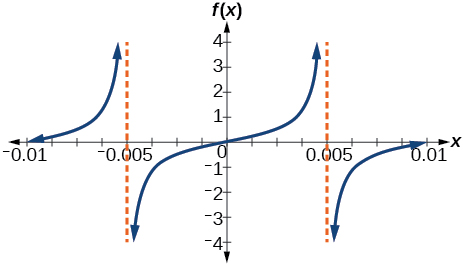
25.
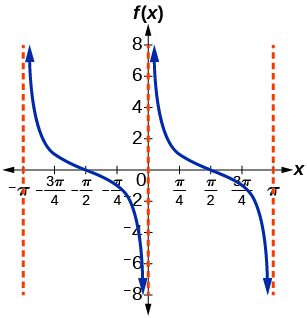
26. Standing on the shore of a lake, a fisherman sights a boat far in the distance to his left. Let x, measured in radians, be the angle formed by the line of sight to the ship and a line due north from his position. Assume due north is 0 and x is measured negative to the left and positive to the right. The boat travels from due west to due east and, ignoring the curvature of the Earth, the distance [latex]d(x)[/latex], in kilometers, from the fisherman to the boat is given by the function [latex]d(x)=1.5\sec(x)[/latex].
b. Graph d(x) on this domain.
c. Find and discuss the meaning of any vertical asymptotes on the graph of [latex]d(x)[/latex].
d. Calculate and interpret [latex]d(−\frac{\pi}{3})[/latex]. Round to the second decimal place.
e. Calculate and interpret [latex]d(\frac{\pi}{6})[/latex]. Round to the second decimal place.
f. What is the minimum distance between the fisherman and the boat? When does this occur?
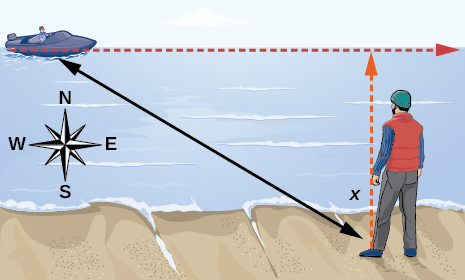
27. A video camera is focused on a rocket on a launching pad 2 miles from the camera. The angle of elevation from the ground to the rocket after x seconds is [latex]\frac{\pi}{120}x[/latex].
b. Graph [latex]h(x)[/latex] on the interval (0,60).
c. Evaluate and interpret the values [latex]h(0)[/latex] and [latex]h(30)[/latex].
d. What happens to the values of [latex]h(x)[/latex] as x approaches 60 seconds? Interpret the meaning of this in terms of the problem.