- View vectors geometrically.
- Find magnitude and direction.
- Find the component form of a vector.
- Find the unit vector in the direction of v.
A Geometric View of Vectors
A vector is a specific quantity drawn as a line segment with an arrowhead at one end. It has an initial point, where it begins, and a terminal point, where it ends. A vector is defined by its magnitude, or the length of the line, and its direction, indicated by an arrowhead at the terminal point. Thus, a vector is a directed line segment.
- Lower case, boldfaced type, with or without an arrow on top such as [latex]\boldsymbol{v,u,w,\stackrel{\to }{v},\stackrel{\to }{u},\stackrel{\to }{w}}[/latex].
- Given initial point [latex]P[/latex] and terminal point [latex]Q[/latex], a vector can be represented as [latex]\stackrel{\to }{PQ}[/latex]. The arrowhead on top is what indicates that it is not just a line, but a directed line segment.
- Given an initial point of [latex]\left(0,0\right)[/latex] and terminal point [latex]\left(a,b\right)[/latex], a vector may be represented as [latex]\langle a,b\rangle[/latex].
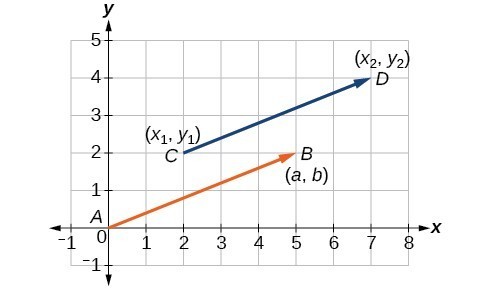
This last symbol [latex]\langle a,b\rangle[/latex] has special significance. It is called the standard position. The position vector has an initial point [latex]\left(0,0\right)[/latex] and a terminal point [latex]\langle a,b\rangle[/latex]. To change any vector into the position vector, we think about the change in the x-coordinates and the change in the y-coordinates. Thus, if the initial point of a vector [latex]\stackrel{\to }{CD}[/latex] is [latex]C\left({x}_{1},{y}_{1}\right)[/latex] and the terminal point is [latex]D\left({x}_{2},{y}_{2}\right)[/latex], then the position vector is found by calculating
The original vector [latex]\stackrel{\to }{CD}[/latex] and the position vector [latex]\stackrel{\to }{AB}[/latex].
vector
A vector is a directed line segment with an initial point and a terminal point. Vectors are identified by magnitude, or the length of the line, and direction, represented by the arrowhead pointing toward the terminal point. The position vector has an initial point at [latex]\left(0,0\right)[/latex] and is identified by its terminal point [latex]\langle a,b\rangle[/latex].

