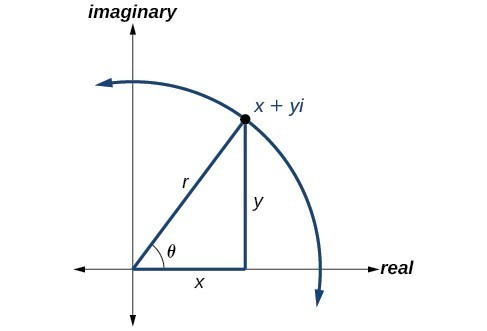
The polar form of a complex number expresses a number in terms of an angle [latex]\theta[/latex] and its distance from the origin [latex]r[/latex]. Given a complex number in rectangular form expressed as [latex]z=x+yi[/latex], we use the same conversion formulas as we do to write the number in trigonometric form:
We use the term modulus to represent the absolute value of a complex number, or the distance from the origin to the point [latex]\left(x,y\right)[/latex]. The modulus, then, is the same as [latex]r[/latex], the radius in polar form. We use [latex]\theta[/latex] to indicate the angle of direction (just as with polar coordinates). Substituting, we have
where [latex]r[/latex] is the modulus and [latex]\theta[/latex] is the argument. We often use the abbreviation [latex]r\text{cis}\theta[/latex] to represent [latex]r\left(\cos \theta +i\sin \theta \right)[/latex].
Express the complex number [latex]4i[/latex] using polar coordinates.
On the complex plane, the number [latex]z=4i[/latex] is the same as [latex]z=0+4i[/latex]. Writing it in polar form, we have to calculate [latex]r[/latex] first.
Next, we look at [latex]x[/latex]. If [latex]x=r\cos \theta[/latex], and [latex]x=0[/latex], then [latex]\theta =\frac{\pi }{2}[/latex]. In polar coordinates, the complex number [latex]z=0+4i[/latex] can be written as [latex]z=4\left(\cos \left(\frac{\pi }{2}\right)+i\sin \left(\frac{\pi }{2}\right)\right)[/latex] or [latex]4\text{cis}\left(\frac{\pi }{2}\right)[/latex].