Find the area of an oblique triangle using the sine function.
Solve applied problems using the Law of Sines.
Solving Applied Problems Using the Law of Sines
The more we study trigonometric applications, the more we discover that the applications are countless. Some are flat, diagram-type situations, but many applications in calculus, engineering, and physics involve three dimensions and motion.
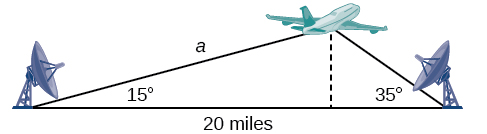
Find the altitude of the aircraft in the problem introduced at the beginning of this section, shown in Figure 16. Round the altitude to the nearest tenth of a mile.
Figure 16
To find the elevation of the aircraft, we first find the distance from one station to the aircraft, such as the side [latex]a[/latex], and then use right triangle relationships to find the height of the aircraft, [latex]h[/latex].
Because the angles in the triangle add up to 180 degrees, the unknown angle must be 180°−15°−35°=130°. This angle is opposite the side of length 20, allowing us to set up a Law of Sines relationship.
The aircraft is at an altitude of approximately 3.9 miles.
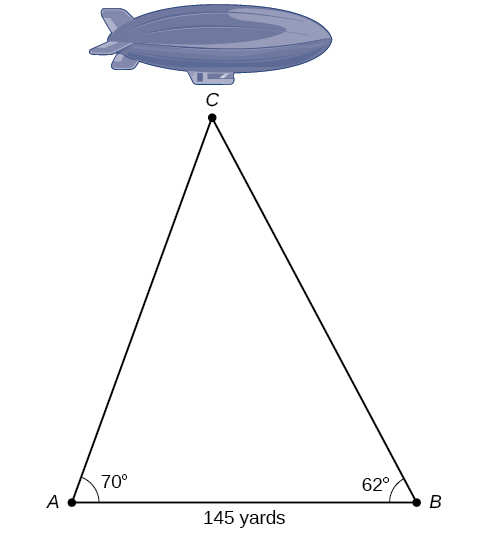
The diagram represents the height of a blimp flying over a football stadium. Find the height of the blimp if the angle of elevation at the southern end zone, point A, is 70°, the angle of elevation from the northern end zone, point [latex]B[/latex], is 62°, and the distance between the viewing points of the two end zones is 145 yards.