Composition of Functions
1. How does one find the domain of the quotient of two functions, [latex]\frac{f}{g}?[/latex]
2. If the order is reversed when composing two functions, can the result ever be the same as the answer in the original order of the composition? If yes, give an example. If no, explain why not.
3. Given [latex]f\left(x\right)=2{x}^{2}+4x\text{ }[/latex] and [latex]\text{ }g\left(x\right)=\frac{1}{2x}[/latex], find [latex]f+g,f-g,fg,\text{ }[/latex] and [latex]\text{ }\frac{f}{g}[/latex]. Determine the domain for each function in interval notation.
4. Given [latex]f\left(x\right)=2{x}^{2}+1[/latex] and [latex]g\left(x\right)=3x - 5[/latex], find the following:
[latex]f\left(g\left(2\right)\right)[/latex]
[latex]f\left(g\left(x\right)\right)[/latex]
[latex]g\left(f\left(x\right)\right)[/latex]
[latex]\left(g\circ g\right)\left(x\right)[/latex]
[latex]\left(f\circ f\right)\left(-2\right)[/latex]
For the following exercises, use each pair of functions to find [latex]f\left(g\left(x\right)\right)[/latex] and [latex]g\left(f\left(x\right)\right)[/latex]. Simplify your answers.
5. [latex]f\left(x\right)=\sqrt{x}+2,g\left(x\right)={x}^{2}+3[/latex]
6. For [latex]f\left(x\right)=\frac{1}{x}[/latex] and [latex]g\left(x\right)=\sqrt{x - 1}[/latex], write the domain of [latex]\left(f\circ g\right)\left(x\right)[/latex] in interval notation.
For the following exercises, find functions [latex]f\left(x\right)[/latex] and [latex]g\left(x\right)[/latex] so the given function can be expressed as [latex]h\left(x\right)=f\left(g\left(x\right)\right)[/latex].
7. [latex]h\left(x\right)={\left(x - 5\right)}^{3}[/latex]
8. [latex]h\left(x\right)=\sqrt{2x+6}[/latex]
For the following exercises, use the graphs of [latex]f[/latex] and [latex]g[/latex] to evaluate the expressions.
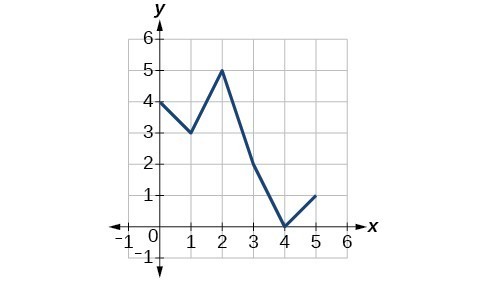
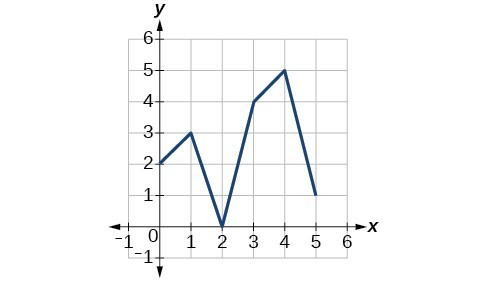
9. [latex]f\left(g\left(1\right)\right)[/latex]
10. [latex]g\left(f\left(0\right)\right)[/latex]
For the following exercises, use the function values for [latex]f\text{ and }g[/latex] to evaluate each expression.
| [latex]x[/latex] | [latex]f\left(x\right)[/latex] | [latex]g\left(x\right)[/latex] |
| 0 | 7 | 9 |
| 1 | 6 | 5 |
| 2 | 5 | 6 |
| 3 | 8 | 2 |
| 4 | 4 | 1 |
| 5 | 0 | 8 |
| 6 | 2 | 7 |
| 7 | 1 | 3 |
| 8 | 9 | 4 |
| 9 | 3 | 0 |
11. [latex]f\left(g\left(5\right)\right)[/latex]
12. [latex]g\left(f\left(3\right)\right)[/latex]
13. [latex]f\left(f\left(1\right)\right)[/latex]
For the following exercises, use each pair of functions to find [latex]f\left(g\left(0\right)\right)[/latex] and [latex]g\left(f\left(0\right)\right)[/latex].
14. [latex]f\left(x\right)=5x+7,g\left(x\right)=4 - 2{x}^{2}[/latex]
15. The function [latex]A\left(d\right)[/latex] gives the pain level on a scale of 0 to 10 experienced by a patient with [latex]d[/latex] milligrams of a pain-reducing drug in her system. The milligrams of the drug in the patient’s system after [latex]t[/latex] minutes is modeled by [latex]m\left(t\right)[/latex]. Which of the following would you do in order to determine when the patient will be at a pain level of 4?
a. Evaluate [latex]A\left(m\left(4\right)\right)[/latex].
b. Evaluate [latex]m\left(A\left(4\right)\right)[/latex].
c. Solve [latex]A\left(m\left(t\right)\right)=4[/latex].
d. Solve [latex]m\left(A\left(d\right)\right)=4[/latex].
Transformation of Functions
1. When examining the formula of a function that is the result of multiple transformations, how can you tell a horizontal shift from a vertical shift?
2. When examining the formula of a function that is the result of multiple transformations, how can you tell a horizontal compression from a vertical compression?
3. Write a formula for the function obtained when the graph of [latex]f\left(x\right)=|x|[/latex]
is shifted down 3 units and to the right 1 unit.
For the following exercises, describe how the graph of the function is a transformation of the graph of the original function [latex]f[/latex].
4. [latex]y=f\left(x+43\right)[/latex]
5. [latex]y=f\left(x\right)+8[/latex]
6. [latex]y=f\left(x+4\right)-1[/latex]
For the following exercises, determine the interval(s) on which the function is increasing and decreasing.
7. [latex]g\left(x\right)=5{\left(x+3\right)}^{2}-2[/latex]
8. [latex]k\left(x\right)=-3\sqrt{x}-1[/latex]
For the following exercises, sketch a graph of the function as a transformation of the graph of one of the toolkit functions.
9. [latex]f\left(t\right)={\left(t+1\right)}^{2}-3[/latex]
10. [latex]k\left(x\right)={\left(x - 2\right)}^{3}-1[/latex]
11. Tabular representations for the functions [latex]f,g[/latex], and [latex]h[/latex] are given below. Write [latex]g\left(x\right)[/latex] and [latex]h\left(x\right)[/latex] as transformations of [latex]f\left(x\right)[/latex].
| [latex]x[/latex] | −2 | −1 | 0 | 1 | 2 |
| [latex]f\left(x\right)[/latex] | −2 | −1 | −3 | 1 | 2 |
| [latex]x[/latex] | −1 | 0 | 1 | 2 | 3 |
| [latex]g\left(x\right)[/latex] | −2 | −1 | −3 | 1 | 2 |
| [latex]x[/latex] | −2 | −1 | 0 | 1 | 2 |
| [latex]h\left(x\right)[/latex] | −1 | 0 | −2 | 2 | 3 |
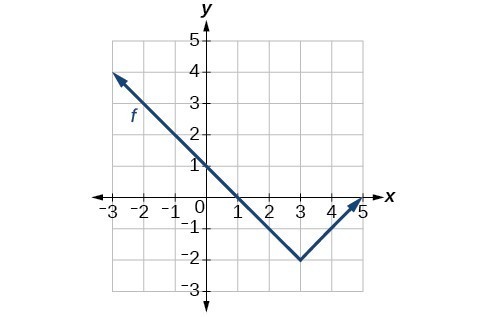
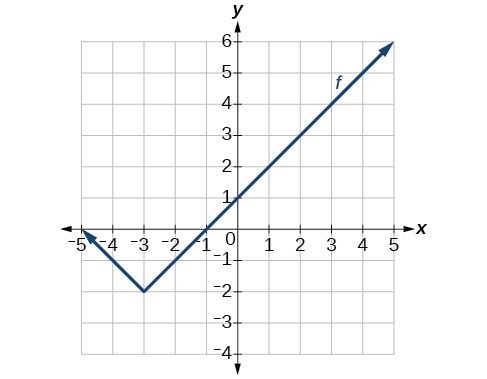
For the following exercises, write an equation for each graphed function by using transformations of the graphs of one of the toolkit functions.
12.
13.
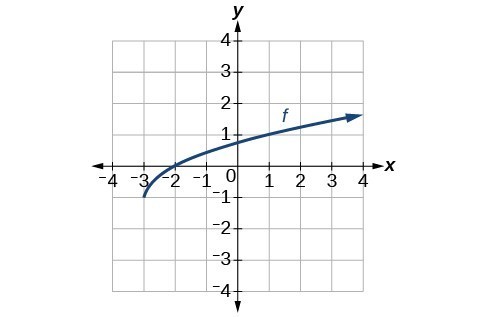
14.
For the following exercises, determine whether the function is odd, even, or neither.
15. [latex]f\left(x\right)=3{x}^{4}[/latex]
16. [latex]h\left(x\right)=\frac{1}{x}+3x[/latex]
For the following exercises, describe how the graph of each function is a transformation of the graph of the original function [latex]f[/latex].
17. [latex]g\left(x\right)=-f\left(x\right)[/latex]
18. [latex]g\left(x\right)=f\left(5x\right)[/latex]
19. [latex]g\left(x\right)=f\left(\frac{1}{3}x\right)[/latex]
20. [latex]g\left(x\right)=3f\left(-x\right)[/latex]
For the following exercises, write a formula for the function [latex]g[/latex] that results when the graph of a given toolkit function is transformed as described.
21. The graph of [latex]f\left(x\right)=\frac{1}{{x}^{2}}[/latex] is vertically compressed by a factor of [latex]\frac{1}{3}[/latex], then shifted to the left 2 units and down 3 units.
22. The graph of [latex]f\left(x\right)={x}^{2}[/latex] is vertically compressed by a factor of [latex]\frac{1}{2}[/latex], then shifted to the right 5 units and up 1 unit.
For the following exercises, describe how the formula is a transformation of a toolkit function. Then sketch a graph of the transformation.
23. [latex]g\left(x\right)=4{\left(x+1\right)}^{2}-5[/latex]
24. [latex]a\left(x\right)=\sqrt{-x+4}[/latex]
Inverse Functions
1. Describe why the horizontal line test is an effective way to determine whether a function is one-to-one?
2. Can a function be its own inverse? Explain.
3. How do you find the inverse of a function algebraically?
For the following exercises, find [latex]{f}^{-1}\left(x\right)[/latex] for each function.
4. [latex]f\left(x\right)=x+3[/latex]
5. [latex]f\left(x\right)=\frac{x}{x+2}[/latex]
For the following exercises, find a domain on which each function [latex]f[/latex] is one-to-one and non-decreasing. Write the domain in interval notation. Then find the inverse of [latex]f[/latex] restricted to that domain.
6. [latex]f\left(x\right)={\left(x+7\right)}^{2}[/latex]
7. [latex]f\left(x\right)={x}^{2}-5[/latex]
For the following exercises, use function composition to verify that [latex]f\left(x\right)[/latex] and [latex]g\left(x\right)[/latex] are inverse functions.
8. [latex]f\left(x\right)=\sqrt[3]{x - 1}[/latex] and [latex]g\left(x\right)={x}^{3}+1[/latex]
For the following exercises, use the graph of [latex]f[/latex] shown below.
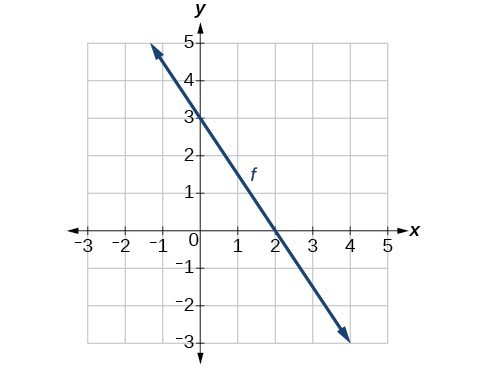
9. Find [latex]f\left(0\right)[/latex].
10. Find [latex]{f}^{-1}\left(0\right)[/latex].
For the following exercises, use the graph of the one-to-one function shown below.
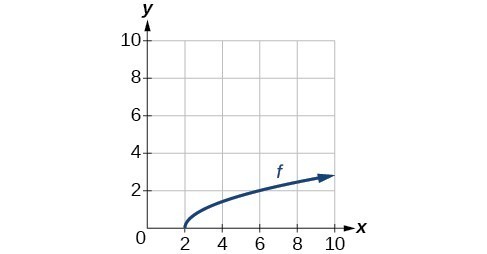
11. Sketch the graph of [latex]{f}^{-1}[/latex].
For the following exercises, evaluate or solve, assuming that the function [latex]f[/latex] is one-to-one.
12. If [latex]f\left(6\right)=7[/latex], find [latex]{f}^{-1}\left(7\right)[/latex].
13. If [latex]{f}^{-1}\left(-4\right)=-8[/latex], find [latex]f\left(-8\right)[/latex].
For the following exercises, use the values listed in the table below to evaluate or solve.
| [latex]x[/latex] | [latex]f\left(x\right)[/latex] |
| 0 | 8 |
| 1 | 0 |
| 2 | 7 |
| 3 | 4 |
| 4 | 2 |
| 5 | 6 |
| 6 | 5 |
| 7 | 3 |
| 8 | 9 |
| 9 | 1 |
14. Find [latex]f\left(1\right)[/latex].
15. Find [latex]{f}^{-1}\left(0\right)[/latex].
16. Use the tabular representation of [latex]f[/latex] to create a table for [latex]{f}^{-1}\left(x\right)[/latex].