Using Equal Cofunction of Complements
[latex]\begin{align} &\sin \frac{\pi }{3}=\cos \frac{\pi }{6}=\frac{\sqrt{3}s}{2s}=\frac{\sqrt{3}}{2} \\ &\sin \frac{\pi }{6}=\cos \frac{\pi }{3}=\frac{s}{2s}=\frac{1}{2} \end{align}[/latex] 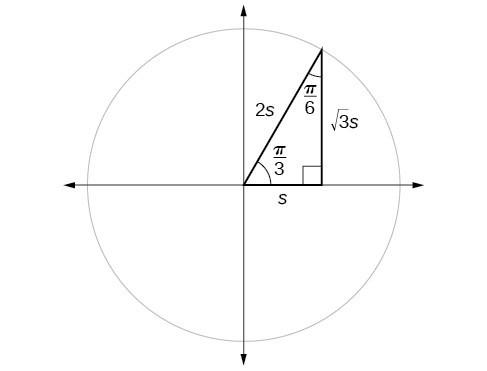
The sine of [latex]\frac{\pi }{3}[/latex] equals the cosine of [latex]\frac{\pi }{6}[/latex] and vice versa.
This result should not be surprising because the side opposite the angle of [latex]\frac{\pi }{3}[/latex] is also the side adjacent to [latex]\frac{\pi }{6}[/latex], so [latex]\sin \left(\frac{\pi }{3}\right)[/latex] and [latex]\cos \left(\frac{\pi }{6}\right)[/latex] are exactly the same ratio of the same two sides, [latex]\sqrt{3}s[/latex] and [latex]2s[/latex]. Similarly, [latex]\cos \left(\frac{\pi }{3}\right)[/latex] and [latex]\sin \left(\frac{\pi }{6}\right)[/latex] are also the same ratio using the same two sides, [latex]s[/latex] and [latex]2s[/latex].
The interrelationship between the sines and cosines of [latex]\frac{\pi }{6}[/latex] and [latex]\frac{\pi }{3}[/latex] also holds for the two acute angles in any right triangle, since in every case, the ratio of the same two sides would constitute the sine of one angle and the cosine of the other. Since the three angles of a triangle add to [latex]\pi[/latex], and the right angle is [latex]\frac{\pi }{2}[/latex], the remaining two angles must also add up to [latex]\frac{\pi }{2}[/latex]. That means that a right triangle can be formed with any two angles that add to [latex]\frac{\pi }{2}[/latex] —in other words, any two complementary angles. So we may state a cofunction identity: If any two angles are complementary, the sine of one is the cosine of the other, and vice versa.
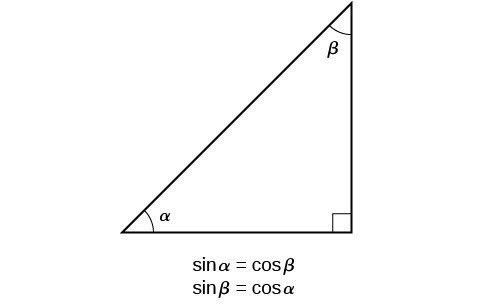
Cofunction identity of sine and cosine of complementary angles
Using this identity, we can state without calculating, for instance, that the sine of [latex]\frac{\pi }{12}[/latex] equals the cosine of [latex]\frac{5\pi }{12}[/latex], and that the sine of [latex]\frac{5\pi }{12}[/latex] equals the cosine of [latex]\frac{\pi }{12}[/latex]. We can also state that if, for a certain angle [latex]t[/latex], [latex]\cos \text{ }t=\frac{5}{13}[/latex], then [latex]\sin \left(\frac{\pi }{2}-t\right)=\frac{5}{13}[/latex] as well.
cofunction identities
| [latex]\cos t=\sin \left(\frac{\pi }{2}-t\right)[/latex] | [latex]\sin t=\cos \left(\frac{\pi }{2}-t\right)[/latex] |
| [latex]\tan t=\cot \left(\frac{\pi }{2}-t\right)[/latex] | [latex]\cot t=\tan \left(\frac{\pi }{2}-t\right)[/latex] |
| [latex]\sec t=\csc \left(\frac{\pi }{2}-t\right)[/latex] | [latex]\csc t=\sec \left(\frac{\pi }{2}-t\right)[/latex] |
- To find the sine of the complementary angle, find the cosine of the original angle.
- To find the cosine of the complementary angle, find the sine of the original angle.