Relating Angles and Their Functions
When working with right triangles, the same rules apply regardless of the orientation of the triangle. In fact, we can evaluate the six trigonometric functions of either of the two acute angles in the triangle.
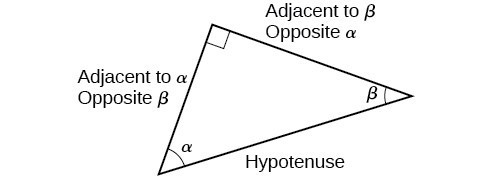
We will be asked to find all six trigonometric functions for a given angle in a triangle. Our strategy is to find the sine, cosine, and tangent of the angles first. Then, we can find the other trigonometric functions easily because we know that the reciprocal of sine is cosecant, the reciprocal of cosine is secant, and the reciprocal of tangent is cotangent.
- If needed, draw the right triangle and label the angle provided.
- Identify the angle, the adjacent side, the side opposite the angle, and the hypotenuse of the right triangle.
- Find the required function:
- sine as the ratio of the opposite side to the hypotenuse
- cosine as the ratio of the adjacent side to the hypotenuse
- tangent as the ratio of the opposite side to the adjacent side
- secant as the ratio of the hypotenuse to the adjacent side
- cosecant as the ratio of the hypotenuse to the opposite side
- cotangent as the ratio of the adjacent side to the opposite side
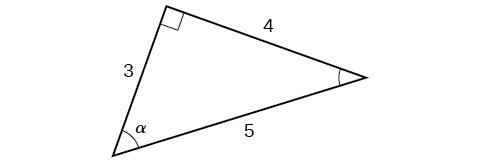
Finding Trigonometric Functions of Special Angles Using Side Lengths
We have already discussed the trigonometric functions as they relate to the special angles on the unit circle. Now, we can use those relationships to evaluate triangles that contain those special angles. We do this because when we evaluate the special angles in trigonometric functions, they have relatively friendly values, values that contain either no or just one square root in the ratio. Therefore, these are the angles often used in math and science problems. We will use multiples of [latex]30^\circ[/latex], [latex]60^\circ[/latex], and [latex]45^\circ[/latex], however, remember that when dealing with right triangles, we are limited to angles between [latex]0^\circ \text{ and } 90^\circ[/latex].
Suppose we have a [latex]30^\circ ,60^\circ ,90^\circ[/latex] triangle, which can also be described as a [latex]\frac{\pi }{6}, \frac{\pi }{3},\frac{\pi }{2}[/latex] triangle. The sides have lengths in the relation [latex]s,\sqrt{3}s,2s[/latex]. The sides of a [latex]45^\circ ,45^\circ ,90^\circ[/latex] triangle, which can also be described as a [latex]\frac{\pi }{4},\frac{\pi }{4},\frac{\pi }{2}[/latex] triangle, have lengths in the relation [latex]s,s,\sqrt{2}s[/latex].
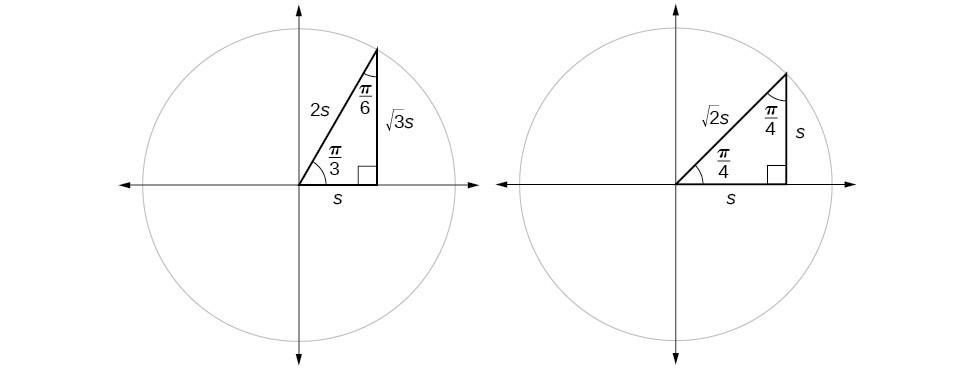
We can then use the ratios of the side lengths to evaluate trigonometric functions of special angles.
ratios of special right triangles
For every special right triangle:
- For 45º or [latex]\frac{\pi}{4}[/latex] angles
- [latex]\cos(x)=\sin(x)=\frac{\sqrt{2}}{2}[/latex]
- [latex]\tan(x)=\cot(x)=1[/latex]
- [latex]\sec(x)=\csc(x)=\sqrt{2}[/latex]
- For 30º or [latex]\frac{\pi}{6}[/latex] angles
- [latex]\cos(x)=\frac{\sqrt{3}}{2}[/latex]
- [latex]\sin(x)=\frac{1}{2}[/latex]
- [latex]\tan(x)=\frac{\sqrt{3}}{3}[/latex]
- [latex]\cot(x)=\sqrt{3}[/latex]
- [latex]\sec(x)=\frac{2\sqrt{3}}{3}[/latex]
- [latex]\csc(x)=2[/latex]
- For 60º or [latex]\frac{\pi}{3}[/latex] angles
- [latex]\cos(x)=\frac{1}{2}[/latex]
- [latex]\sin(x)=\frac{\sqrt{3}}{2}[/latex]
- [latex]\tan(x)=\sqrt{3}[/latex]
- [latex]\cot(x)=\frac{\sqrt{3}}{3}[/latex]
- [latex]\sec(x)=2[/latex]
- [latex]\csc(x)=\frac{2\sqrt{3}}{3}[/latex]