The average person’s blood pressure is modeled by the function [latex]f\left(t\right)=20\sin \left(160\pi t\right)+100[/latex], where [latex]f\left(t\right)[/latex] represents the blood pressure at time [latex]t[/latex], measured in minutes. Interpret the function in terms of period and frequency. Sketch the graph and find the blood pressure reading.
The blood pressure reading on the graph is [latex]\frac{120}{80}\text{ }\left(\frac{\text{maximum}}{\text{minimum}}\right)[/latex].
Analysis of the Solution
Blood pressure of [latex]\frac{120}{80}[/latex] is considered to be normal. The top number is the maximum or systolic reading, which measures the pressure in the arteries when the heart contracts. The bottom number is the minimum or diastolic reading, which measures the pressure in the arteries as the heart relaxes between beats, refilling with blood. Thus, normal blood pressure can be modeled by a periodic function with a maximum of 120 and a minimum of 80.
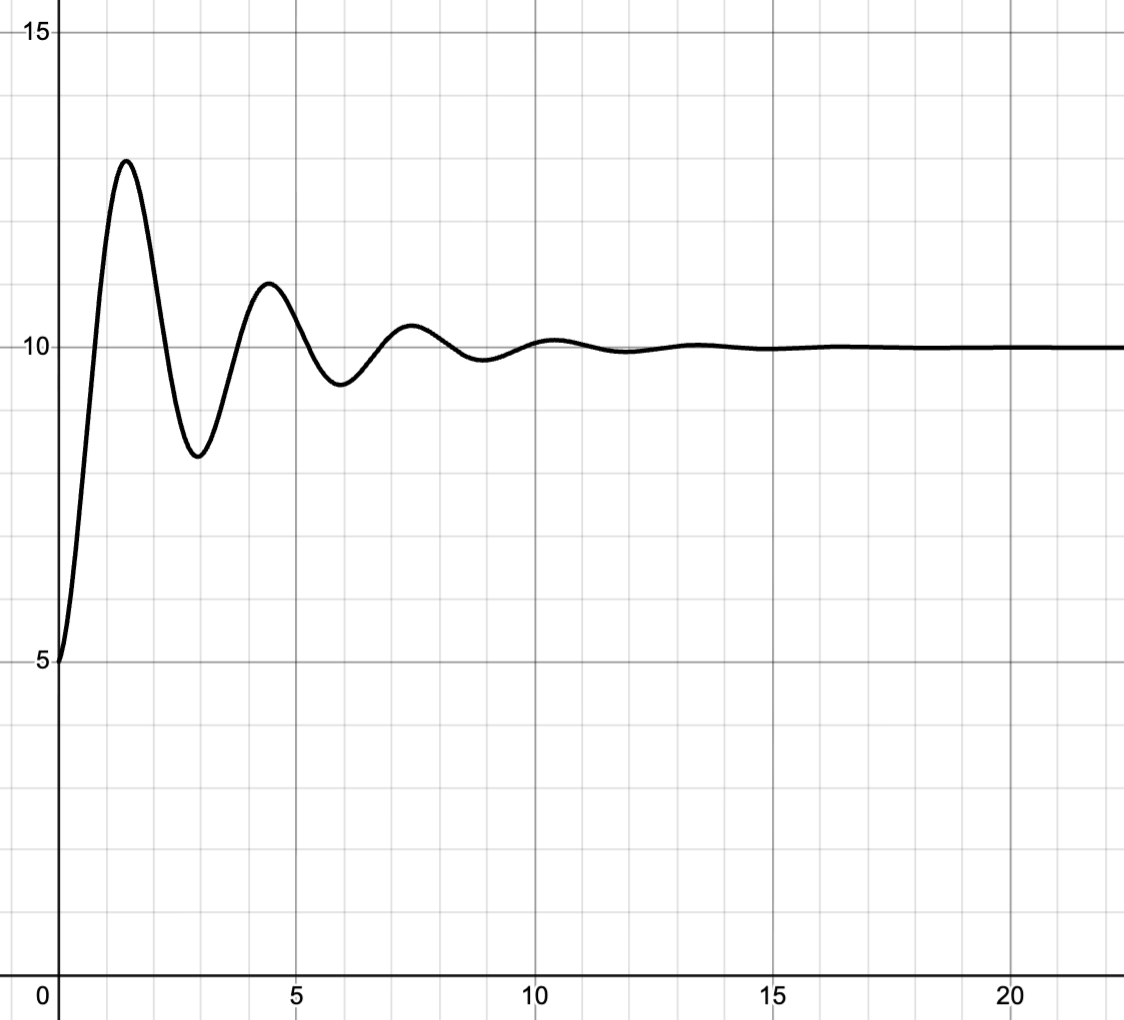
A spring measuring 10 inches in natural length is compressed by 5 inches and released. It oscillates once every 3 seconds, and its amplitude decreases by 30% every second. Find an equation that models the position of the spring [latex]t[/latex] seconds after being released.
The amplitude begins at 5 in. and deceases 30% each second. Because the spring is initially compressed, we will write A as a negative value. We can write the amplitude portion of the function as
The natural length of 10 inches is the midline. We will use the cosine function, since the spring starts out at its maximum displacement. This portion of the equation is represented as
A guitar string is plucked and vibrates in damped harmonic motion. The string is pulled and displaced 2 cm from its resting position. After 3 seconds, the displacement of the string measures 1 cm. Find the damping constant.
The displacement factor represents the amplitude and is determined by the coefficient [latex]a{e}^{-ct}[/latex] in the model for damped harmonic motion. The damping constant is included in the term [latex]{e}^{-ct}[/latex]. It is known that after 3 seconds, the local maximum measures one-half of its original value. Therefore, we have the equation
The damping constant is [latex]\frac{\mathrm{ln}2}{3}[/latex].
Bounding Curves in Harmonic Motion
Harmonic motion graphs may be enclosed by bounding curves. When a function has a varying amplitude, such that the amplitude rises and falls multiple times within a period, we can determine the bounding curves from part of the function.
Graph the function [latex]f\left(x\right)=\cos \left(2\pi x\right)\cos \left(16\pi x\right)[/latex].
The graph produced by this function will be shown in two parts. The first graph will be the exact function [latex]f\left(x\right)[/latex], and the second graph is the exact function [latex]f\left(x\right)[/latex] plus a bounding function. The graphs look quite different.
Analysis of the Solution
The curves [latex]y=\cos \left(2\pi x\right)[/latex] and [latex]y=-\cos \left(2\pi x\right)[/latex] are bounding curves: they bound the function from above and below, tracing out the high and low points. The harmonic motion graph sits inside the bounding curves. This is an example of a function whose amplitude not only decreases with time, but actually increases and decreases multiple times within a period.