Solve equations involving a single trigonometric function.
Solve trigonometric equations that involve factoring.
Solve trigonometric equations using fundamental identities.
Solve trigonometric equations with multiple angles.
Solving Right Triangle Problems
We can now use all of the methods we have learned to solve problems that involve applying the properties of right triangles and the Pythagorean Theorem. We begin with the familiar Pythagorean Theorem, [latex]{a}^{2}+{b}^{2}={c}^{2}[/latex], and model an equation to fit a situation.
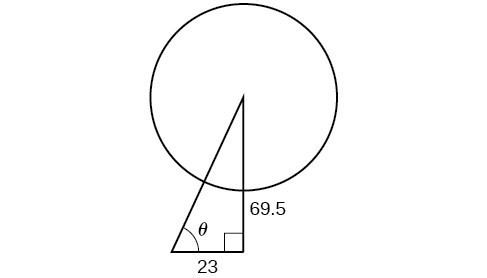
Use the Pythagorean Theorem, and the properties of right triangles to model an equation that fits the problem.One of the cables that anchors the center of the London Eye Ferris wheel to the ground must be replaced. The center of the Ferris wheel is 69.5 meters above the ground, and the second anchor on the ground is 23 meters from the base of the Ferris wheel. Approximately how long is the cable, and what is the angle of elevation (from ground up to the center of the Ferris wheel)?
Using the information given, we can draw a right triangle. We can find the length of the cable with the Pythagorean Theorem.
The angle of elevation is [latex]\theta[/latex], formed by the second anchor on the ground and the cable reaching to the center of the wheel. We can use the tangent function to find its measure. Round to two decimal places.
The angle of elevation is approximately [latex]{71.7}^{\circ }[/latex], and the length of the cable is 73.2 meters.
Always check which quadrants satisfy the sign of your trigonometric function value to find all solutions in the given interval.OSHA safety regulations require that the base of a ladder be placed 1 foot from the wall for every 4 feet of ladder length. Find the angle that a ladder of any length forms with the ground and the height at which the ladder touches the wall.
For any length of ladder, the base needs to be a distance from the wall equal to one fourth of the ladder’s length. Equivalently, if the base of the ladder is “a” feet from the wall, the length of the ladder will be 4a feet.The side adjacent to [latex]\theta[/latex] is a and the hypotenuse is [latex]4a[/latex]. Thus,
The elevation of the ladder forms an angle of [latex]{75.5}^{\circ }[/latex] with the ground. The height at which the ladder touches the wall can be found using the Pythagorean Theorem:
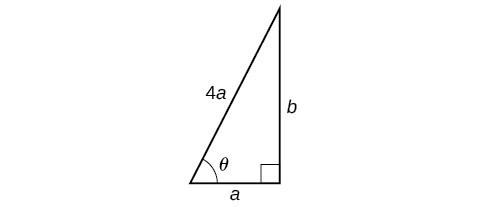 The side adjacent to [latex]\theta[/latex] is a and the hypotenuse is [latex]4a[/latex]. Thus,