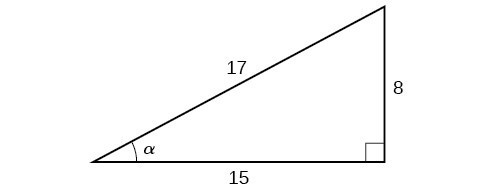
- Use right triangles to evaluate trigonometric functions.
- Use cofunctions of complementary angles.
- Use the definitions of trigonometric functions of any angle.
- Use right triangle trigonometry to solve applied problems.
Using Right Triangles to Evaluate Trigonometric Functions
In earlier sections, we used a unit circle to define the trigonometric functions. In this section, we will extend those definitions so that we can apply them to right triangles. The value of the sine or cosine function of [latex]t[/latex] is its value at [latex]t[/latex] radians. First, we need to create our right triangle. If we drop a vertical line segment from the point [latex](x,y)[/latex] to the x-axis, we have a right triangle whose vertical side has length [latex]y[/latex] and whose horizontal side has length [latex]x[/latex]. We can use this right triangle to redefine sine, cosine, and the other trigonometric functions as ratios of the sides of a right triangle.
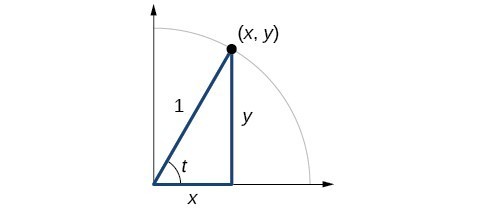
These ratios still apply to the sides of a right triangle when no unit circle is involved and when the triangle is not in standard position and is not being graphed using [latex]\left(x,y\right)[/latex] coordinates. To be able to use these ratios freely, we will give the sides more general names: Instead of [latex]x[/latex], we will call the side between the given angle and the right angle the adjacent side to angle [latex]t[/latex]. (Adjacent means “next to.”) Instead of [latex]y[/latex], we will call the side most distant from the given angle the opposite side from angle [latex]t[/latex]. And instead of [latex]1[/latex], we will call the side of a right triangle opposite the right angle the hypotenuse.
labeling right triangle sides
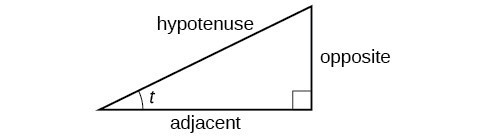
The sides of a right triangle in relation to angle [latex]t[/latex].
Understanding Right Triangle Relationships
Given a right triangle with an acute angle of [latex]t[/latex],
A common mnemonic for remembering these relationships is SOH-CAH-TOA, formed from the first letters of “Sine is opposite over hypotenuse, Cosine is adjacent over hypotenuse, Tangent is opposite over adjacent.”
- Find the sine as the ratio of the opposite side to the hypotenuse.
- Find the cosine as the ratio of the adjacent side to the hypotenuse.
- Find the tangent is the ratio of the opposite side to the adjacent side.